
Commercial buildings rely on fan systems that must operate reliably across fluctuating loads, extended runtimes, and increasingly complex building operations. Yet many facilities still depend on fan architectures and control strategies developed decades ago. These systems often require continuous oversight, specialized troubleshooting, and operational workarounds that do not scale well in large facilities. As buildings modernize their mechanical infrastructure, the limitations of legacy fan systems and their control frameworks are becoming increasingly apparent.
For much of the past century, commercial air handlers were built around large centrifugal blowers driven by a single motor. These systems performed well in an era when control requirements were minimal and fans typically operated at fixed speeds. Over time, energy regulations and operational cost pressures required fans to modulate output to match load conditions. Variable frequency drives (VFDs) became the standard solution, enabling speed control and improving part-load efficiency.
As these systems aged, reliability concerns became more pronounced. A single fan created a single point of failure, and a motor failure could interrupt airflow entirely. Redundant systems were introduced to mitigate this risk, but redundancy often required duplicating large fans and their supporting equipment, increasing system cost and footprint.
In the 1990s, fan arrays emerged as a more practical form of redundancy. Rather tha installing multiple full-size fans, arrays use multiple smaller fans operating in parallel. This approach distributes airflow across several fans, allowing the system to maintain airflow if a single fan fails.
Fan arrays also introduced practical advantages in retrofit projects. Smaller fans are easier to transport through doorways, elevators, and mechanical spaces. The reduced motor size also made electronically commutated (EC) motors viable in large air handlers, improving efficiency across a wider range of operating points. While these benefits improved reliability and serviceability, they also introduced new complexities.
Fan Array Control Challenges in Commercial Air Handlers
In traditional fan array systems, each fan is treated as an independent device. Although the components are mechanically identical, each unit has its own power and control wiring and requires unique addressing within the control system. As a result, the array cannot function as a self-contained device and instead requires an external control panel to coordinate the operation of multiple fans. This panel becomes a custom device responsible for power distribution, motor protection, signal management, and operational coordination.
The scope of these control panels expands quickly. Individual fuse blocks, motor protection devices, and control interfaces are required for each fan. The panel becomes larger and more complex as the number of fans increases, consuming space and engineering effort that might otherwise be allocated to higher-level system monitoring or control functionality.
There are different maintenance challenges between AC and EC fan arrays. In AC fan arrays, replacing an AC motor often requires partially disassembling the fan array and aligning and balancing the impeller. This can make the replacement process mechanically cumbersome.
EC motors simplify the mechanical process because the entire motorized impeller assembly is replaced rather than repaired. However, EC fan arrays introduce additional layers of feedback, diagnostics, and electrical complexity. Motors may provide detailed operational data and alarm states, though these capabilities often have limited practical value in the field because EC motors are not serviceable components. Replacement motors may also require addressing, configuration, or other manual integration with the control system.
Some newer array systems attempt to simplify maintenance by introducing connection points within the airstream itself. While this reduces wiring complexity, it does not address the underlying architectural dependency between the fan array and its control panel.
This relationship ultimately reduces flexibility in both fan selection and controls architecture. Maintaining compatibility with an existing controls framework can limit the available fan options, potentially forcing the selection of a system that does not fully meet performance targets for airflow or efficiency. Conversely, selecting the fan system that best meets performance requirements may require modifying or replacing the existing controls architecture, increasing system complexity and creating a more difficult long-term support and service environment.
How Integrated Fan Controls Simplify Building Automation System Integration
An alternative approach is to relocate the coordination of multiple motors from the external control panel to an integrated controller.
In this architecture, an embedded controller within the fan system manages motor coordination, power distribution, and monitoring. From the perspective of the building automation system, the fan system behaves as a single fan rather than a collection of independent fans.
A single power and control connection terminates at the fan system. The external control panel is no longer responsible for coordinating multiple motors and can instead focus on its intended function: interfacing with building automation systems, integrating sensors, and managing broader system logic.
In its simplest implementation, such a fan system can operate with standard power connection and a single analog speed control signal. This allows compatibility with virtually any control panel or building automation platform. More advanced integrations can support common building automation protocols such as Modbus, BACnet, or LonWorks, enabling deeper system monitoring without requiring proprietary control schemes.
This architectural shift reduces the complexity of the controls framework while preserving the redundancy and flexibility that made fan arrays attractive.
SINGLE POINT-OF-CONTACT: The Q-PAC Multimotor Plenum Fan architecture integrates a controller directly into the fan that serves as the single point of connection for power and control signals. (Courtesy of Q-PAC)
The Multimotor Plenum Fan Architecture
This concept is realized in an emerging fan category known as the multimotor plenum fan (MPF). While it visually resembles a fan array, the MPF fundamentally differs in architecture: multiple motorized impellers are integrated into a single coordinated fan system rather than operating as independent devices bound to a control panel.
The fan incorporates a shared structural frame and an embedded controller that serves as the single landing point for power and control. The controller distributes commands to each motor and coordinates their operation internally within the fan system, allowing the motors to function collectively as one fan. From the building automation system’s perspective, the MPF behaves like a conventional single fan with a single interface for power and control.
This architecture combines the strengths of the two dominant fan approaches. It preserves the straightforward integration and single-device behavior of traditional blowers while adopting the multiple-fan configuration and redundancy of fan arrays. By consolidating multiple motors into a coordinated fan assembly, the MPF removes the single point of failure associated with large blowers while avoiding the multi-device control complexity that typically accompanies fan arrays.
An Example of Integrated Multimotor Design
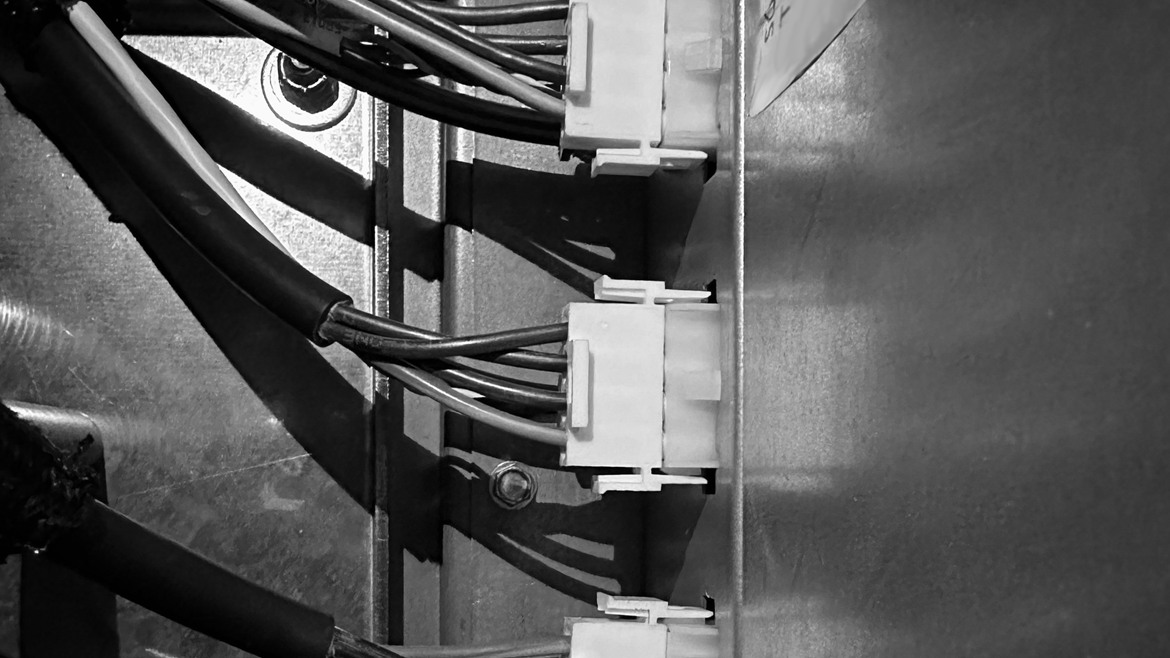
One example of this approach is the Q-PAC Multimotor Plenum Fan; the fan’s architecture integrates a controller directly into the fan’s frame. The controller serves as the single point of connection for power and control signals and distributes them to each motor through prefabricated harnesses. It also monitors motor status and supports communication with external systems.
From the building automation system perspective, the fan behaves as a single device, requiring only three-phase power and a speed control signal for basic operation. By consolidating motor coordination within the fan itself, the system eliminates the need for external control logic to manage multiple motors. Additional monitoring and control capabilities are supported through Modbus and BACnet communication, allowing the fan to integrate directly with the building automation system without requiring proprietary control hardware.
How Multimotor Plenum Fans Support Airflow Reliability and Maintenance
The multimotor architecture inherently improves system resilience. Because airflow is generated by multiple motors operating in parallel, the failure of a single motor does not stop airflow. The remaining motors can increase speed to maintain airflow until maintenance can be scheduled.
The design also minimizes the risk of a centralized failure. While the motors are coordinated by the fan’s controller, the system incorporates a bypass mode that routes the incoming speed control signal directly to each motor if the controller is unresponsive. This allows the fan to continue operating even in the unlikely event of a controller failure, eliminating a traditional single point of failure in the control architecture.
The internal controller architecture also enables firmware updates, allowing new functionality to be added without replacing hardware.
Why Integrated Multimotor Fan Architecture Is a Better Approach
Modern buildings demand reliable airflow, energy efficiency, and maintainable mechanical systems. While fan arrays improved reliability compared to single-motor blowers, they introduced complexity in the controls architecture that can complicate integration and maintenance.
By designing the motor coordination to exist within the fan itself, the multimotor plenum fan architecture simplifies system integration while maintaining redundancy and modularity.
In this model, the fan and the control panel return to clearly defined roles: the fan manages airflow generation, while the control system manages building operation. This separation reduces system complexity and provides facility teams with greater flexibility in how their mechanical systems are controlled and maintained.
Whether you require installation, repair, or maintenance, our technicians will assist you with top-quality service at any time of the day or night. Take comfort in knowing your indoor air quality is the best it can be with MOE heating & cooling services Ontario's solution for heating, air conditioning, and ventilation that’s cooler than the rest.
Contact us to schedule a visit. Our qualified team of technicians, are always ready to help you and guide you for heating and cooling issues. Weather you want to replace an old furnace or install a brand new air conditioner, we are here to help you. Our main office is at Kitchener but we can service most of Ontario's cities
Source link

