Standby vs. Portable Generator in Westerville: Which One Does Your Home Actually Need?
The choice between a standby vs. portable generator in Westerville comes down to three things: how much power you need, how hands-on you want to be during an outage, and what you’re willing to spend upfront.
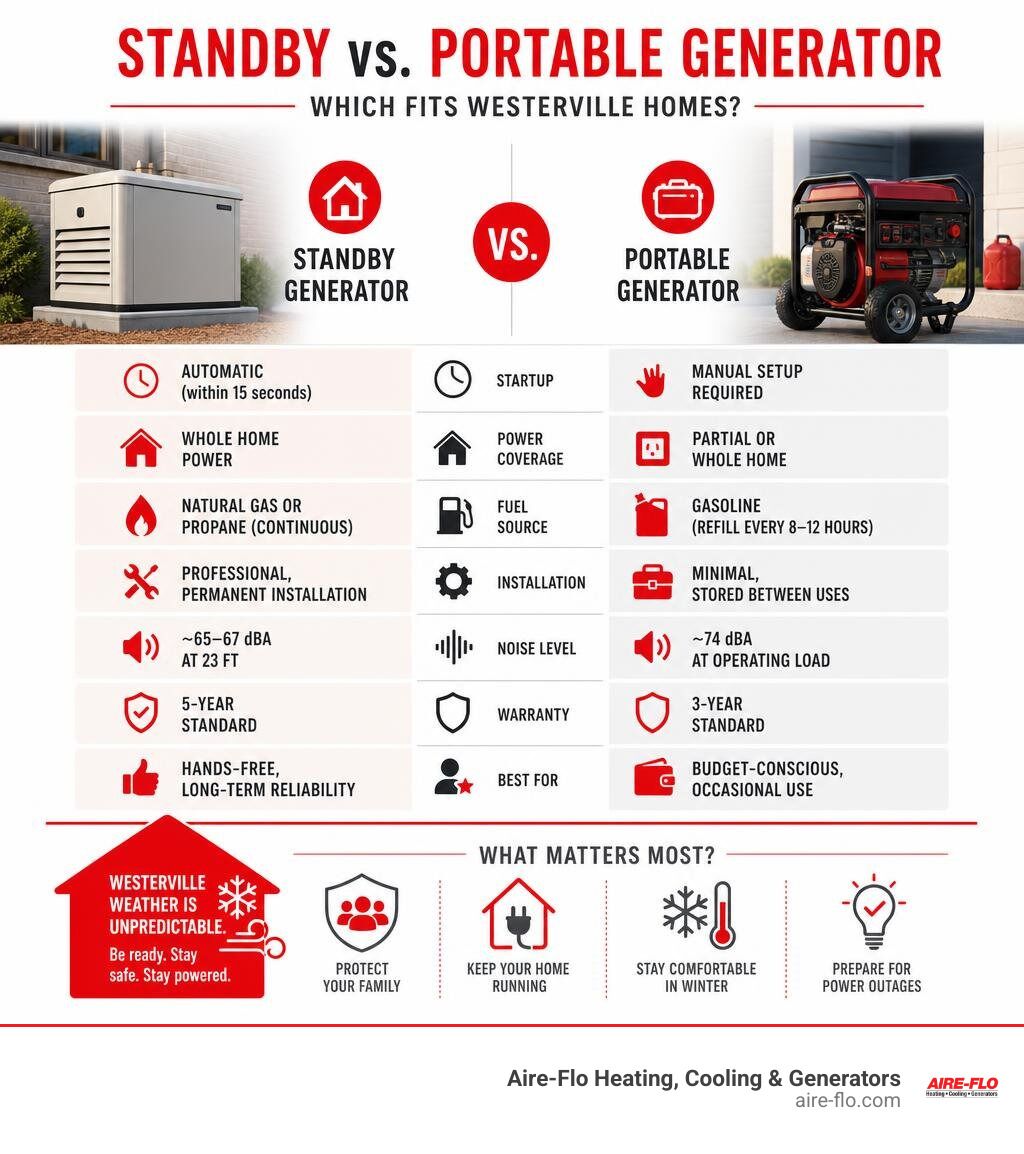
Here’s a quick side-by-side to help you decide fast:
| Factor | Standby Generator | Portable Generator |
|---|---|---|
| Startup | Automatic, usually within seconds | Manual setup required |
| Power coverage | Whole home | Partial or whole home |
| Fuel source | Natural gas or propane | Gasoline refills required |
| Installation | Professional, permanent | Minimal, stored between uses |
| Noise level | Quieter operation | Louder operation |
| Warranty | Longer standard coverage | Shorter standard coverage |
| Best for | Hands-free, long-term reliability | Budget-conscious, occasional use |
Bottom line: If you want power to come back on automatically while you sleep through a storm, a standby generator wins. If you only need to run a few essential appliances occasionally and don’t mind manual setup, a portable generator can work.
Westerville homeowners face real risks from Ohio’s winter ice storms, high winds, and multi-day outages. The wrong generator choice can leave your family in the cold or create serious safety hazards. That’s why it’s worth understanding exactly how these two options compare before you buy.
Our team at Aire-Flo Heating, Cooling & Generators has spent decades helping central Ohio homeowners navigate the standby vs. portable generator decision for their Westerville properties. In the sections below, we will walk you through everything you need to make a confident, informed choice.
Understanding Standby vs Portable Generator Westerville Options
To make the right choice for your household, you must first understand how these two systems operate. They represent entirely different approaches to emergency power.

A portable generator is a mobile unit that you store in your garage or shed. When the power goes out, you must physically wheel it outside, fill it with gasoline, start the engine, and connect it to your home. You can run extension cords directly to individual appliances or connect the unit to a pre-installed manual transfer switch. Portable units generally provide enough power for essential circuits, such as your refrigerator, select lights, and basic electronics.
A permanent standby generator sits on a concrete pad or gravel base in your yard. It connects directly to your home electrical panel and your local utility line. It runs on natural gas or liquid propane. A standby system monitors your utility power continuously. When the grid goes down, the system detects the loss, starts up, and transfers your electrical load automatically. This entire sequence happens in seconds, whether you are home or away.
The difference in power capacity is also significant. Portable units typically offer lower power capacities, which might limit you to running a few appliances at once. Standby generators offer much higher power capacities. They can easily support high-demand systems like central air conditioners, electric water heaters, and sump pumps at the same time.
Why Choose a Standby vs Portable Generator Westerville System for Long-Term Reliability?
When we look at long-term reliability, permanent standby systems offer several clear advantages. The first is equipment lifespan. A professionally maintained standby generator can last for many years. Portable generators typically have a shorter operational lifespan because they experience more wear and tear during transport and storage.
Standby units also protect themselves through automatic self-testing. Once a week, the generator runs a brief exercise cycle to lubricate engine parts, check battery health, and verify system electronics. If the system detects a problem, it alerts you before a real storm hits. Portable generators require you to manually start them every few months to keep the engine healthy, a task that many homeowners forget.
Warranty coverage represents another major difference. Premium standby systems often come with longer limited warranty coverage, and you can purchase extended coverage in many cases. Portable models usually carry shorter limited warranty coverage.
Standby designs also build in weather protection. These units feature durable, wind-resistant enclosures that withstand severe weather, including high winds and heavy snow. Portable generators cannot operate safely in rain or snow without specialized, open-air physical covers because moisture can damage the electrical outlets.
A properly selected backup system protects comfort, food storage, medical equipment, sump pumps, and everyday routines during an outage. Our home electric backup generator guide explains how these systems support a household during grid failures, while our main generators page outlines the generator services available through Aire-Flo Heating, Cooling & Generators.
How Do Local Rules Impact Your Standby vs Portable Generator Westerville Decision?
Installing a permanent standby generator in Westerville involves navigating local regulations. You cannot simply place a unit next to your house and turn it on. The City of Westerville requires proper building and electrical permits before installation begins. These rules ensure that the wiring is safe and that the unit sits a safe distance from windows, doors, and property lines.
If you live in a neighborhood with a homeowners association, you must also check your community guidelines. Many HOAs in the Westerville area have strict rules regarding the placement, visibility, and noise levels of outdoor equipment. A permanent unit may require architectural review board approval. Our team at Aire-Flo Heating, Cooling & Generators regularly helps local homeowners secure these approvals.
Utility connections are another key factor. A standby generator requires a high-volume connection to your natural gas line or an external propane tank. In Westerville, local utility providers must verify that your gas meter can handle the increased demand. If your current meter is too small, the utility company will need to upgrade it. Portable generators do not require utility upgrades because they run on portable gasoline cans, though this means you must store and refresh fuel throughout the year.
For homeowners comparing generator options around Westerville, our Westerville generator services page explains how our team supports local generator installation, maintenance, and repair needs.
Key Differences in Installation, Cost, and Operation
The upfront investment and installation process for these two options are very different. A portable generator requires almost no site preparation. You simply buy the unit, purchase fuel cans, and store it. However, if you want to power your home circuits safely without running extension cords through open windows, you need a professional to install a manual transfer switch.
A permanent standby generator requires professional installation from start to finish. The process begins with site preparation, which involves pouring a concrete slab or preparing a stable gravel bed. An electrician must install an automatic transfer switch next to your main electrical panel. A licensed plumber must then run a dedicated gas line from your meter to the generator.

While the physical installation of a standby unit may move quickly, securing permits and coordinating with utility companies can take longer. The exact timeline depends on the equipment, the property, and local approval steps. Our generator installation services page explains how professional installation helps Westerville homeowners size the unit, plan placement, and connect the system safely.
When comparing the total cost of ownership, portable systems are much less expensive upfront. However, you must factor in the cost of manual transfer switches, regular fuel purchases, and shorter equipment lifespans. Standby systems require a higher initial investment for the equipment, permits, and professional labor, but they add permanent value to your home.
Our guide on home generator costs breaks down the factors that affect total project cost, including generator size, fuel source, transfer switch needs, and installation complexity.
| Feature | Standby Generator | Portable Generator |
|---|---|---|
| Site Prep | Concrete pad or gravel bed required | None, stored in a garage or shed |
| Fuel Line | Hardwired natural gas or propane | Manual gasoline refills |
| Transfer Switch | Automatic | Manual, optional but recommended |
| Upfront Cost | Higher, includes professional labor | Lower, DIY placement |
| Maintenance | Annual professional service | Manual oil changes and fuel stabilization |
Performance, Reliability, and Westerville Weather Challenges
Westerville weather can be unpredictable. Heavy ice storms in the winter can snap tree branches and bring down power lines for days. Summer thunderstorms can bring high winds that disrupt the local grid. When these storms hit, the performance of your backup power system matters.
A standby generator excels in severe weather. Because it connects directly to your natural gas line, you do not have to worry about running out of fuel during a prolonged outage. You do not have to venture outside in freezing rain or high winds to refuel a hot engine. These systems also use secure outdoor enclosures that help them remain operational during severe storms.
Portable generators present several challenges during major local weather events. If an ice storm knocks out power, you must wheel the heavy unit out of storage and set it up in the cold. You must store fresh gasoline, which can be difficult to source if local gas stations lose power too. Standard portable generators also require refueling during long outages, forcing you to go outside in dangerous conditions to keep the power running.
Power quality is another critical issue. Standard portable generators can produce inconsistent electrical output, often called dirty power. This voltage fluctuation can damage sensitive electronics like laptops, smart TVs, and modern HVAC control boards. If you choose a portable unit, you should use an inverter generator to support clean power. Standby generators provide stable power for modern household electronics.
Backup power also helps protect your HVAC system from sudden shutdowns, voltage swings, and outage-related comfort problems. Our article on how backup generators keep power smooth explains why consistent power matters for heating, cooling, and sensitive home equipment.
Safety, Noise Levels, and Neighborhood Considerations
Safety is the most important factor when choosing and operating any generator. Portable generators carry a significant risk of carbon monoxide poisoning if used incorrectly. You must never run a portable generator inside your home, basement, crawl space, or garage, even if the garage door is open.
You must place portable units at least 20 feet away from your home, with the engine exhaust pointed away from windows, doors, and vents. You must also let a portable unit cool down completely before refueling it because spilling gasoline on a hot engine can cause a fire. The Electrical Safety Foundation International also shares helpful portable generator safety tips for safe setup, cord use, and carbon monoxide prevention.
Standby generators offer greater safety because technicians permanently install them in a fixed location that complies with strict national safety codes. They sit on a non-combustible base, use professional gas connections, and vent exhaust safely away from your living spaces.
Noise levels are another key consideration, especially in dense Westerville residential areas. The logarithmic scale measures noise, meaning small changes in decibels represent large changes in actual volume. Premium standby generators usually run quieter than standard portable units, often sounding similar to a central air conditioner from a distance.
Portable generators are significantly louder. This level of noise can easily disturb your sleep and annoy your neighbors, especially during overnight outages. If you live in a neighborhood with close property lines, a loud portable generator can quickly lead to noise complaints.
Frequently Asked Questions
Can a portable generator power an entire house?
A portable generator can power many essential parts of a house, but it struggles to run an entire modern home at once. To determine capacity, you must look at running watts and starting watts. High-demand appliances, like your central air conditioner or electric dryer, require a large surge of starting watts to turn on.
While some large portable generators can handle these loads, you must manage your power usage carefully. You will need a professional to install a manual transfer switch to distribute the power safely to your home circuits. For absolute whole-home power without managing which appliances are running, a permanent standby generator is the better choice.
How far away should you place a portable generator from a house?
You must place a portable generator at least 20 feet away from your home, windows, doors, and vents. Never operate a generator in an attached garage, even with the door fully open, because carbon monoxide can quickly build up and seep into your living spaces. Use heavy-duty, outdoor-rated extension cords to bring power from the generator to your appliances, and protect the unit from direct rain or snow.
What is dirty power and can it damage electronics?
Dirty power refers to electrical power that has high levels of voltage fluctuation or harmonic distortion. Standard portable generators often produce this type of inconsistent power because their engine speeds fluctuate under changing loads.
Clean power quality is critical for sensitive electronics like computers, tablets, smart appliances, and modern heating systems. Standard portable units can overheat or damage these delicate circuits over time. If you want to use a portable generator for electronics, you should use an inverter generator, which refines the power to make it clean and stable. Standby generators provide clean, stable power.
Conclusion
Choosing between a standby and a portable generator is all about balancing convenience, safety, and your budget. If you want a budget-friendly option for short outages and do not mind the physical work of setting it up, a portable unit with a manual transfer switch can keep your lights on. However, if you want hands-free operation, continuous fuel, quiet performance, and complete peace of mind during severe Ohio storms, a permanent standby generator is the ideal solution.
At Aire-Flo Heating, Cooling & Generators, we have helped Westerville families stay safe and comfortable for 75 years. Our certified team can assess your electrical needs, evaluate your property, and help you choose the right system for your home. To find the right backup power solution, contact our professional generator technicians today to schedule a consultation.
Whether you require installation, repair, or maintenance, our technicians will assist you with top-quality service at any time of the day or night. Take comfort in knowing your indoor air quality is the best it can be with MOE heating & cooling services Ontario's solution for heating, air conditioning, and ventilation that’s cooler than the rest.
Contact us to schedule a visit. Our qualified team of technicians, are always ready to help you and guide you for heating and cooling issues. Weather you want to replace an old furnace or install a brand new air conditioner, we are here to help you. Our main office is at Kitchener but we can service most of Ontario's cities
Source link