
Key Takeaways
- Residential duct leakage is a baseline, not an outlier: ENERGY STAR reports the typical U.S. duct system loses 20% to 30% of conditioned air to leakage¹. Lawrence Berkeley National Laboratory field surveys put the average closer to 22% of air-handler flow, with attic and crawlspace systems regularly above 35%².
- Panned and joist-cavity returns are pathways, not measured airflow paths: CMHC field testing measured return-side leakage between 27% and 91% in homes built this way³. Building Science Corporation documents that these returns are “very difficult, if not impossible” to seal⁴.
- 30% leakage breaks every diagnostic you run: Static pressure reads artificially low, supply CFM at the register is fiction, and ASHRAE Standard 152 explicitly measures distribution efficiency, not whether any specific room actually gets the air it needs⁵.
- You do not need an Aeroseal rig to start finding leaks: A manometer, a smoke pencil, and a 60-second visual audit at every takeoff catches most of the worst offenders.
Forget what the takeoff looked like when you installed it. Residential sheet metal ductwork in basements, crawlspaces, and attics leaks at roughly a quarter of the air that moves through it. That number is not a worst case. It is the baseline. ENERGY STAR puts the typical range at 20% to 30%. LBNL field surveys put the average around 22% of air-handler flow. Attic and crawlspace systems with panned returns routinely test above 35%. If you are sizing equipment or running a comfort-call diagnostic, you are calibrating against the wrong baseline.
Where the 30% Number Actually Comes From
The Sherman and Walker LBNL field study (LBNL-47214, 2002) DeltaQ-tested California houses and measured combined supply-plus-return leakage averaging 22% of air-handler flow⁶. The older Sacramento study most U.S. trade writers actually trace the “30% rule” back to (Jump, Walker, and Modera, 1996, ACEEE/LBNL) found distribution losses “on the order of 35% are typical” in residential construction with ducts outside conditioned space⁷.
The mechanics are blunt. Field-assembled sheet metal relies on drive cleats, S-cleats, Pittsburgh seams, and screws. None are aerodynamic seals. Mastic on the outside of a takeoff does not seal what is open on the inside. The duct is doing what it was assembled to do. For how that distorts the sizing math, our HVAC Design Heat Loads in the Real World: Precision Versus Accuracy post is the right adjacent reading.
The Panned Return Problem
A panned return uses sheet metal nailed to the bottom of floor joists to turn a structural cavity into a return path. A joist-cavity return uses the cavity itself. Either way, the wood framing, subflooring, and rim joist were never built to be airtight.
The CMHC 1995 study Ventilation Control in Medium Air Tightness Houses (NH17-346) is the cleanest data point. Across four monitored houses, return-system leakage ranged from 27% to 91%. In one house, only 9% of the return air passed through the return grilles. The other 91% entered through duct leakage⁸. Building Science Corporation’s DOE Building America Information Sheet 603 states air leakage in these returns “will be very difficult, if not impossible to prevent.” Aeroseal’s July 2024 Application Note 013 requires hand-sealing of panned returns before the aerosol process can succeed⁹.
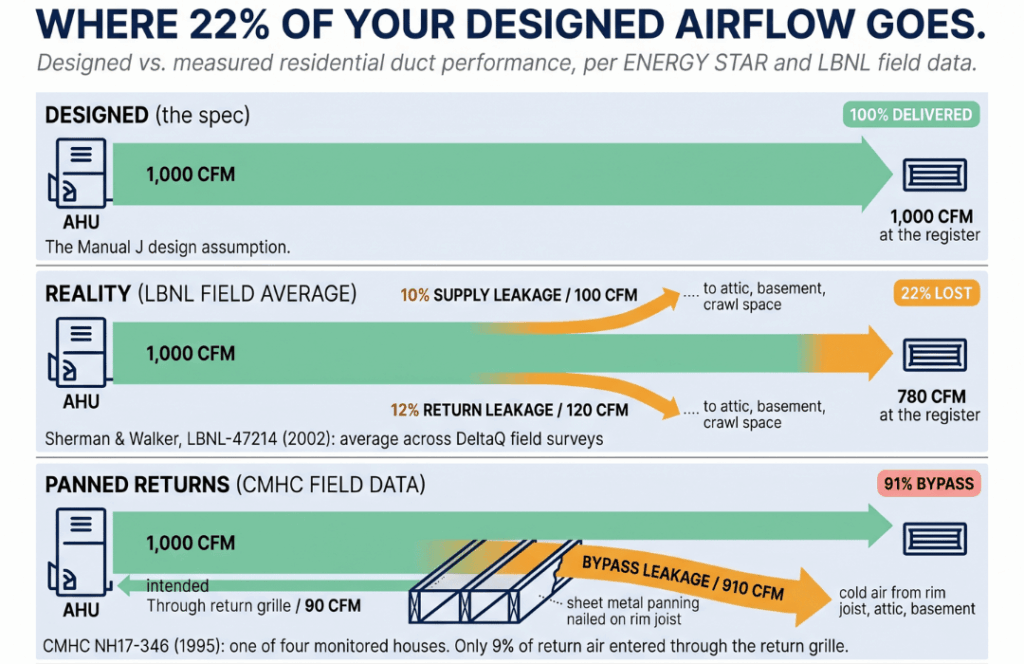
The practical takeaway: a panned return is a pressure pathway, not an airflow measurement point. Designed roughly 50% oversize on purpose. You will not see meaningful CFM at the grille. You will not fix a comfort complaint by adding a second one. If the homeowner is paying for room-level airflow, the only honest answer is a fully ducted return sealed to the same standard as the supply.
What 30% Leakage Costs in the Field
Static pressure is the first casualty. ACCA Manual D and ANSI/ACCA 5 require Total External Static Pressure measured against the manufacturer-rated maximum (typically 0.5 inches of water column for PSC blowers). A leaky duct acts as a low-resistance bypass. Air escapes upstream of the registers, the blower sees less restriction than the design assumed, and the TESP reads artificially low. The tech reads 0.35 inches, decides the duct is fine, and moves on. Meanwhile, the room at the end of the run never gets enough air because half the design CFM leaked out between the plenum and the boot.
Manual J infiltration is the second casualty. EPA/ENERGY STAR puts air leakage at 25% to 40% of heating and cooling energy use in a typical home¹⁰. ASHRAE Standard 152-2014 codifies the distribution-efficiency framework, but explicitly notes that it does not address whether any specific room actually gets the air it needs. A house can pass a 152 efficiency target and still leave the back bedroom cold. Our Heat Pump Oversizing post extends the sizing-math implications.
How to Find Leaks Without Specialty Gear
Sixty seconds, every job. Start at the air handler cabinet and work outward. Every takeoff, every elbow, every plenum penetration, every joist-cavity return. Watch for daylight, dust streaks at joint edges, mastic gaps, peeling tape. Flag them by probable severity.
Smoke pencil at every flagged joint with the fan running. Smoke that gets sucked in or pushed out is a leak. Smoke that hangs in place tells you the joint is sealed.
Measure TESP before and after the obvious sealing work using the same supply and return locations both times. The post-seal reading should increase toward the design value, not decrease. That increase is the signal air is now traveling through the duct instead of out of it.
Hand the job to an Aeroseal contractor when there are three or more inaccessible boots, panned returns that cannot be replaced economically, or systems still testing above 15% after the obvious fixes. DOE/Building America journal data documents Aeroseal sealing 70% to 90% of duct leakage in residential applications¹¹.
One note on materials. LBNL’s accelerated-aging study (LBNL-57225, 2005) found cloth-backed duct tape “failed consistently, and often catastrophically” within days under thermal cycling, while mastic and aerosol sealant showed no measurable degradation¹². Use mastic or metal-backed foil tape per ENERGY STAR. Never cloth duct tape.
Job Inputs
ENERGY STAR reports the typical U.S. duct system loses 20% to 30% of conditioned air. LBNL field surveys put the average at 22% of air-handler flow. The leakiest quartile (attic ducts + panned returns) regularly tests above 35%.
Quick Presets
Annual Loss to Duct Leakage
If You Seal The Ducts
Savings (→ 10%)
—
$ / year
Aeroseal payback
—
at $2,000 seal job
DIY mastic payback
—
at $350 in materials
Field math: DOE / Building America journal data documents Aeroseal sealing 70% to 90% of duct leakage, saving $600 to $850 per year in average household energy costs. The numbers above are for this specific home.
The Calibration Shift
The 30% rule is not pessimism. It is calibration. Built into your default assumptions, every diagnostic sharpens. Manual J accounts for measured infiltration. TESP carries a leakage interpretation. The flow-hood reading gets validated against what should be arriving.
The regulatory floor is moving the same direction whether you adjust or not. California Title 24’s 2025 cycle, effective January 1, 2026, tightened the single-family duct leakage limit to 5% of total airflow with mandatory HERS verification¹³. ENERGY STAR Single-Family New Homes Rev. 14 caps total duct leakage at 4 CFM25 per 100 square feet. Our Multi-Zone HVAC Systems: Design and Installation Guide anchors the duct-integrity conversation for zoned work.
Next service call, before anything else, look at every takeoff. Sixty seconds. Bring mastic, a smoke pencil, a manometer. The leakiest 25% of the systems you touch are paying for their own retrofit several times over. Field measurement closes the gap.
Additional Sources
- “Duct Sealing with ENERGY STAR” (print PDF), U.S. Environmental Protection Agency, Program Brochure, 2024.
- “Air Distribution System Leakage in Single-Family Detached Houses” (LBNL-47214), Iain Walker and Max Sherman, Lawrence Berkeley National Laboratory, Technical Report, 2002.
- “Ventilation Control in Medium Air Tightness Houses” (NH17-346), Canada Mortgage and Housing Corporation and Consumers Gas, Research Report, 1995.
- “BSC Information Sheet 603: Air Sealing Stud Cavities,” Building Science Corporation / DOE Building America Program, Technical Information Sheet, 2010.
- “ANSI/ASHRAE Standard 152-2014: Method of Test for Determining the Design and Seasonal Efficiencies of Residential Thermal Distribution Systems,” American Society of Heating, Refrigerating and Air-Conditioning Engineers, Consensus Standard, 2014.
- “Air Distribution System Leakage in Single-Family Detached Houses” (LBNL-47214), Sherman and Walker, Lawrence Berkeley National Laboratory, Technical Report, 2002.
- “Field Testing of Duct Aerosol Sealant in California,” Walker, Sherman, and others, Lawrence Berkeley National Laboratory / ACEEE Summer Study Proceedings, Conference Paper, 1996.
- “Ventilation Control in Medium Air Tightness Houses” (NH17-346), Canada Mortgage and Housing Corporation and Consumers Gas, Research Report, 1995.
- “Wall Cavity / Panned Joist Returns” (Application Note 013), Aeroseal LLC, Technical Bulletin, July 2024.
- “Energy Savings from Air Sealing and Insulation: Methodology,” U.S. Environmental Protection Agency / ENERGY STAR Program, Program Methodology, 2024.
- “Performance, Comfort, and Cost Improvements with Aerosol Duct Sealing” (OSTI 1503810), Brennan Less, Iain Walker, and Marc Hoeschele, U.S. Department of Energy / Building America Program, Journal Article, 2019.
- “Reducing Duct Sealant Performance Variability” (LBNL-57225), Iain Walker and Max Sherman, Lawrence Berkeley National Laboratory, Technical Report, 2005.
- “California 2025 Energy Code, Title 24 Part 6,” California Energy Commission, Regulatory Code, Effective January 1, 2026.
- “ENERGY STAR Single-Family New Homes National Program Requirements, Rev. 14,” U.S. Environmental Protection Agency, Program Specification, 2024.
Whether you require installation, repair, or maintenance, our technicians will assist you with top-quality service at any time of the day or night. Take comfort in knowing your indoor air quality is the best it can be with MOE heating & cooling services Ontario's solution for heating, air conditioning, and ventilation that’s cooler than the rest.
Contact us to schedule a visit. Our qualified team of technicians, are always ready to help you and guide you for heating and cooling issues. Weather you want to replace an old furnace or install a brand new air conditioner, we are here to help you. Our main office is at Kitchener but we can service most of Ontario's cities
Source link