
Key Takeaways
- Match the method to the box, not the box to the method: Five defrost types show up in the field, split into positive (adds heat) and non-positive (no added heat). Picking the wrong one for the temperature and load is what ices coils and generates callbacks.
- Hot gas is the fastest positive method but it punishes piping and head pressure: Discharge gas near 150°F to 200°F hitting a low-temp coil is a thermal shock risk, and defrosting too many coils at once drops head pressure and starves the coils still trying to cool.
- Non-positive defrost only works above freezing: Off-cycle and off-time defrost lean on the box’s own air to melt frost, so they belong on medium-temp coolers, never on a freezer.
- Timed defrost is the old default, demand defrost is the upgrade: Adaptive controllers already exist for refrigeration and cut unnecessary cycles, trimming energy in the 15% to 20% range while easing the load on the compressor.
Defrost is one of those systems a tech inherits without ever choosing it. The box came with a method bolted on years ago, and most of us only think about it when the coil turns into a block of ice on a Friday afternoon. That is a mistake.
The method on the box decides how much of the day you keep cooling, how hard the compressor works, and whether the piping cracks in five years. Any evaporator running below freezing grows frost, and frost has to come off. Five methods do that job, and here is which box each one belongs on.
When a Coil Actually Needs Defrost
Frost forms when the coil surface sits below the surrounding air’s dew point and below 32°F (0°C) at the same time.¹ Watch the coil surface temperature or the saturated suction temperature, not the box air, because a medium-temp coil can run below freezing while the room stays warmer. The first thin, feathery layer (hoar frost) actually bumps heat transfer for a few minutes by adding surface area. Then it densifies into an insulating blanket that chokes airflow, drags the coil colder, and grows even more frost.¹ Left alone, that feedback loop ends in a solid block.
That gives you the single most important line in this whole topic: a defrost cycle is built to melt frost, not to clear ice. Once a coil has iced into a block from a failed part, a bad drain, or a stack of missed cycles, no normal cycle will save it. You are clearing that one by hand. If you want the freeze-up mechanics broken down on their own, we covered why evaporator coils freeze separately.
The Three Positive Methods
Positive defrost adds heat to the coil. Three methods do it, and they trade speed, cost, and stress on the equipment.
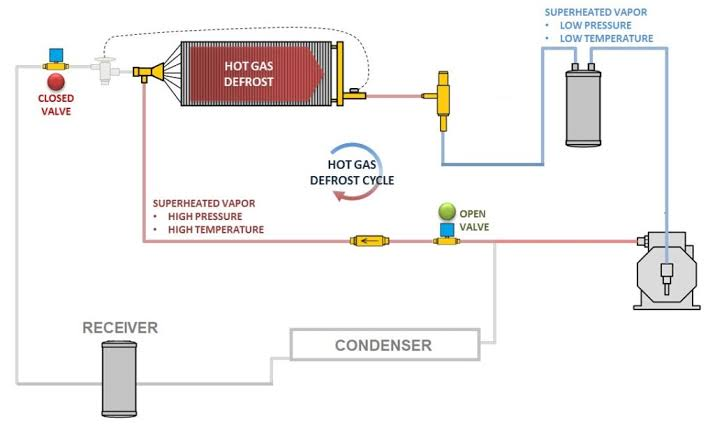
Hot gas defrost reroutes hot, high-pressure discharge gas from the compressor back into the evaporator through a solenoid and valve group, warming the coil from the inside out.² It is the fastest option, which matters: a faster defrost means the box spends more of the day cooling, often better than 20 hours.¹ The catch is temperature. Discharge gas runs roughly 150°F to 200°F, so pushing it into a minus 20°F freezer coil swings the metal a couple hundred degrees in minutes, and that thermal shock cracks braze joints and opens slow leaks over time.¹
Hot gas also leans on head pressure to work, which is where the head pressure death spiral bites. Put too many coils into defrost at once and system head pressure sags, the coils still trying to cool lose the pressure drop their metering devices need, and the whole rack starts underfeeding.² Stagger defrost times across the rack so no group robs the others. Done right, hot gas is the most efficient method because it reuses compressor heat instead of buying resistance watts. It also costs the most to pipe and has to be commissioned correctly.
Cool gas defrost solves the thermal shock problem by pulling saturated vapor off the top of the receiver instead of full discharge gas.² The coil still warms enough to shed frost, but without the violent expansion and contraction, so the piping lives longer. The trade is time. Cooler gas carries less heat, so the defrost runs longer and eats more minutes per day.
Electric defrost stabs resistance heating elements straight through the fin block, anywhere from a handful to twenty-plus depending on coil size, usually as a factory option under the coil maker’s warranty.³ It skips the thermal shock problem and installs cheaper than hot gas because there is no extra piping. The bill shows up on the power meter, since resistance heat is expensive and every watt of it also dumps heat into the box that you then have to pull back out.³ Watch the drain side. When a drain-pan or drain-line heater quits, meltwater refreezes, the pan overflows, and the coil re-ices into a block that is miserable to clear with product still in the box.³
The Two Non-Positive Methods
Non-positive defrost adds no heat at all. It stops cooling and lets the box’s own air melt the frost, which only works when that air stays above freezing.¹
Off-cycle defrost shuts off refrigerant flow but keeps the evaporator fan running, pushing above-freezing box air across the coil. It is the most common approach on medium-temp coolers, and it is why plenty of walk-in coolers ship with no defrost clock at all.
Off-time defrost goes further and lets the whole system sit idle during its normal cycle-off periods, clearing the light condensation before the next call for cooling. Both are limited to boxes above 32°F. On a freezer the air never gets warm enough, so you are back to a positive method. For the cooler-specific side of this, see walk-in cooler troubleshooting and how coil placement and door habits change the picture.
Scheduling, Termination, and Dialing It In
The old default for a freezer is four defrosts a day, spaced about every six hours, running 30 to 45 minutes.³ A cycle that regularly runs the full clock without quitting early is telling you something is wrong. That early quit comes from defrost termination: a temperature sensor on a coil return bend ends the cycle once the coil reaches roughly 50°F to 55°F, so you stop heating the box the moment the frost is gone.³ The classic control is the mechanical Paragon 8145 time clock, the one with trip pins around a 24-hour dial, and digital controllers have been replacing it for years.
Either way, the schedule is a lever, not a fixed setting. Push the first defrost earlier so the box recovers before a morning shift props the door open. Add cycles in summer for a freezer against an open, unconditioned dock. Run more, shorter cycles to flatten temperature swings in a tightly-spec’d pharmaceutical box. The evaporator temperature difference will tell you when a coil is loading up with frost between cycles and needs the schedule adjusted.
Timed vs Demand Defrost
Timed defrost fires on the clock whether the coil needs it or not, so it burns energy on dry defrosts and hammers the compressor with a hot, high-load pull-down right after each one. That repeated stress is a quiet contributor to premature compressor failure. Demand, or adaptive, defrost fixes it by watching coil efficiency or airflow and defrosting only when frost has actually built up.

Controllers like KE2 Therm’s Evaporator Efficiency and Danfoss adaptive defrost are commercially proven, with third-party-validated energy savings in the 15% to 20%-plus range and far fewer cycles per day.⁴ The technology is on the shelf. Refrigeration just does not run it by default the way a heat pump does. When a customer is fighting energy cost or product temperature swings, this is the upgrade path worth quoting.
None of this is a footnote on the power bill. Refrigeration eats 40% to 60% of a supermarket’s electricity, and defrost is a real slice of that.¹ New systems are also moving to lower-GWP refrigerants under the EPA HFC phase-down, which keeps reclaimed R-404A in demand and makes wasted refrigerant from a botched defrost more expensive than it used to be.⁵
Match the Method to the Box
Pick by the box in front of you. A low-temp rack with a lot of coils and a tight energy budget leans toward hot gas, staggered across the day with enough head pressure to feed it. A box where thermal shock keeps opening joints is a cool gas candidate. A single freezer where install cost matters and runtime is fine gets electric. An above-freezing cooler often needs nothing more than off-cycle. Then let termination, and demand controls where they pay, trim the waste.
Get that match right and defrost stops icing your coil, cracking your piping, or washing the oil off your compressor bearings, and goes back to being the quiet background cycle it should be. If you are selecting or servicing the coil itself, the fundamentals in understanding evaporator coils pair with everything above.
Quick Presets
Your System
Tip: Start with a preset, then adjust to match your actual job. The selector uses the same logic from the blog post: positive methods for below-freezing boxes, non-positive for above.
Recommendation
Suggested Cycles
—
per day
Termination
—
coil return bend
Select your system above
Fill in the inputs or tap a preset to get a recommendation.
Alternative to Consider
—
Additional Sources
- “ASHRAE Handbook: Refrigeration”, ASHRAE, Reference Handbook, 2022.
- “Bulletin 90-50: Defrost Differential Pressure Regulating Valves”, Sporlan Valve Company (Parker Hannifin), Technical Bulletin, 2004.
- “Installation and Operation Manual: Unit Coolers”, Heatcraft Refrigeration Products, Product Manual, 2021.
- “KE2 Evaporator Efficiency: Product Information and Energy Studies”, KE2 Therm Solutions, Manufacturer Documentation, 2023.
- “HFC Technology Transitions Under the AIM Act”, U.S. Environmental Protection Agency, Federal Rule, 2024.
Whether you require installation, repair, or maintenance, our technicians will assist you with top-quality service at any time of the day or night. Take comfort in knowing your indoor air quality is the best it can be with MOE heating & cooling services Ontario's solution for heating, air conditioning, and ventilation that’s cooler than the rest.
Contact us to schedule a visit. Our qualified team of technicians, are always ready to help you and guide you for heating and cooling issues. Weather you want to replace an old furnace or install a brand new air conditioner, we are here to help you. Our main office is at Kitchener but we can service most of Ontario's cities
Source link