Key Takeaways
- The audience decides the content, not the platform: An HVAC owner posting to homeowners needs finished-job photos, before-and-after shots, and community moments. The technical content that wins on creator feeds is the wrong fit for a homeowner audience. Pick the audience first, then everything else gets easier.
- Document, do not produce: Treat social media as a documenting tool, not a content studio. Owners who post 90 seconds of what they did today outpace owners who try to plan a content calendar and never post.
- Frequency beats polish for small accounts: Crystal Williams, co-founder of Lemon Seed Marketing, has put it plainly: likes and followers create visibility, but trust and consistency are what actually drive HVAC service calls.¹ A 30-post month of amateur quality outperforms a 3-post month of agency quality on any small business feed.
- The compounding effect is invisible until month four or five: Owners quit too early because nothing happens in week two. Ninety seconds a day for a year is about nine hours of total work, spread across 365 customer touches. The homeowner who books in November remembers seeing you in July.
A homeowner books a tune-up. When you ring the doorbell, they say, “Oh yeah, I see you guys online all the time.” That call closes in eight minutes. The same job sold cold takes thirty.
The difference is not a marketing budget. It is a daily habit that takes 90 seconds, and it is the single most underused growth lever for owner-operators running one to five trucks.
Why Owners Stall (And Why Stalling Costs More Than Posting Would)
Most owners stall in one of four ways. Perfectionism: waiting for the right camera, the right lighting, the right script. Strategy paralysis: spending three weeks on a “content plan” that never produces a single post. No time: a real constraint, but usually a stand-in for the other three. Camera fear: the gut tightening when you imagine your friends seeing your face on Facebook with a caption you wrote yourself.
The cost of the stall is not zero. It is the homeowner two streets over who needed an HVAC tech this month and called a stranger off Google because they had never heard your name. It is the 45 percent of consumers who now use AI tools to find local businesses,² and the 75 percent who still read reviews and look for evidence of who you are before they pick up the phone. If you are invisible on those surfaces, you are paying for the invisibility in customers you will never know you missed.
Word of mouth alone caps your business at the ceiling of your existing customers’ social circles. Owners who treat that as cheap marketing are leaving the broader market on the table. For the broader playbook on cheap, organic acquisition, see Your First 10 Customers: The Zero-Budget Marketing Playbook.
The “Just Document It” Framework
The fix is not strategy. It is a habit. Three steps, repeated daily.
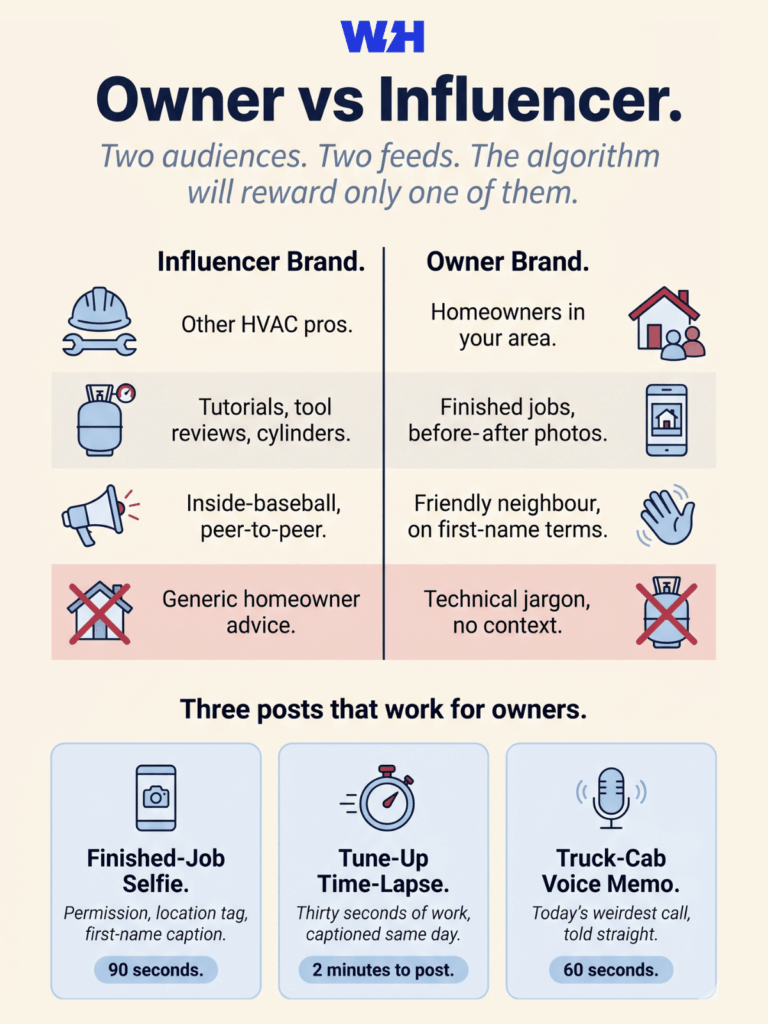
Step 1: Pick your audience. Homeowners in your service area. Or small commercial property managers. Write the choice on a sticky note and put it on the dash. Every post answers to that audience. The reversing valve tutorials and refrigerant memes that win on industry creator feeds are noise to a homeowner. The content type that converts depends on who you are talking to.
Step 2: Capture one moment per workday. A selfie at a finished install with the customer’s permission. A before-and-after photo of an attic. A 30-second time-lapse of a tune-up. A truck-cab voice memo about today’s strangest call. The phone in your pocket is enough. Use it.
Step 3: Post the same day. No editing. For the first 30 days, the friction of editing is what kills the habit. Crystal Williams sums up the principle: trust and consistency drive service calls, not viral hits.¹ Consistency only happens when the friction of posting drops near zero.
Owners who hit 30 consecutive days of documenting almost always keep going. Owners who try to “plan a month of content” almost never post day one. Cadence beats quality at this stage. Polish comes later, after the habit is real.
What an Owner Should Actually Post
This is the part most owners get wrong. They scroll HKIA, AC Service Tech, or HVACR School, see what gets engagement, and try to copy it. Cutaway shots of a filter drier. Reversing valve tutorials. Brazing-quality memes. That content works for those accounts because the audience is other technicians.
Your audience is the person whose furnace is making a noise.
Eight starter formats that work for homeowners:
- Finished-job selfie at the customer’s house, with the customer’s permission and the customer’s first name in the caption.
- Before-and-after attic, basement, or crawlspace photo.
- Time-lapse of an install or a tune-up, captioned with the type of system and the neighborhood.
- The customer’s pet doing something at the job site (with a photo release).
- Truck-cab voice memo after the last call about the weirdest thing you saw all day.
- Photo at a local restaurant or supply house after a long day, geo-tagged.
- Community shout-out: a chamber event, a school fundraiser, a Little League sponsorship.
- The “today I helped a family avoid a $6,400 quote” story, told as a 60-second voice memo.
Notice that none of these require equipment or editing software. Notice that none of them are technical content. The point is to be visible, recognizable, and human, in a feed full of polished business pages that homeowners scroll past. For more on visual differentiation that works at the local level, see The Flame and Snowflake Trap.
The Personal-Page Multiplier
A new business page on Facebook or Instagram has almost no organic distribution. Industry data puts business-page reach at 1 to 2 percent of followers as of 2026, down from 16 percent in 2012.³ Your first 100 followers will see almost nothing you post.
Personal profile reach is dramatically higher because the algorithm treats person-to-person engagement signals very differently from page-to-person ones. Posting from your personal page, where your high school class, supply house contacts, and family already follow you, multiplies the warm-network reach of every post. When your business page posts something, hit Facebook’s native Share button and push it to your personal feed too.
A note on the rules. Meta’s terms of service prohibit using a personal account to represent a business. The right move is to operate the business page as the business, share its posts to your personal feed using the platform’s share button, and post natively from your personal page about your life and work without trying to convert it into a fake business profile. The leverage is real, but stay inside the lines.
The other underused channel is local Facebook groups. Join the neighborhood and town groups in your service area as yourself, not as your business. Comment helpfully on threads. When someone asks for an HVAC recommendation, your existing customers can tag you. Because Facebook indexes group posts, an answer you leave today on an old “anyone know a good HVAC tech” thread can return inbound calls for months. That is leverage no paid ad can match.
For more on the trust-building side of local digital presence, see The 24-Hour Rule: How Fast Review Responses Build Trust.
The 14-Day Streak
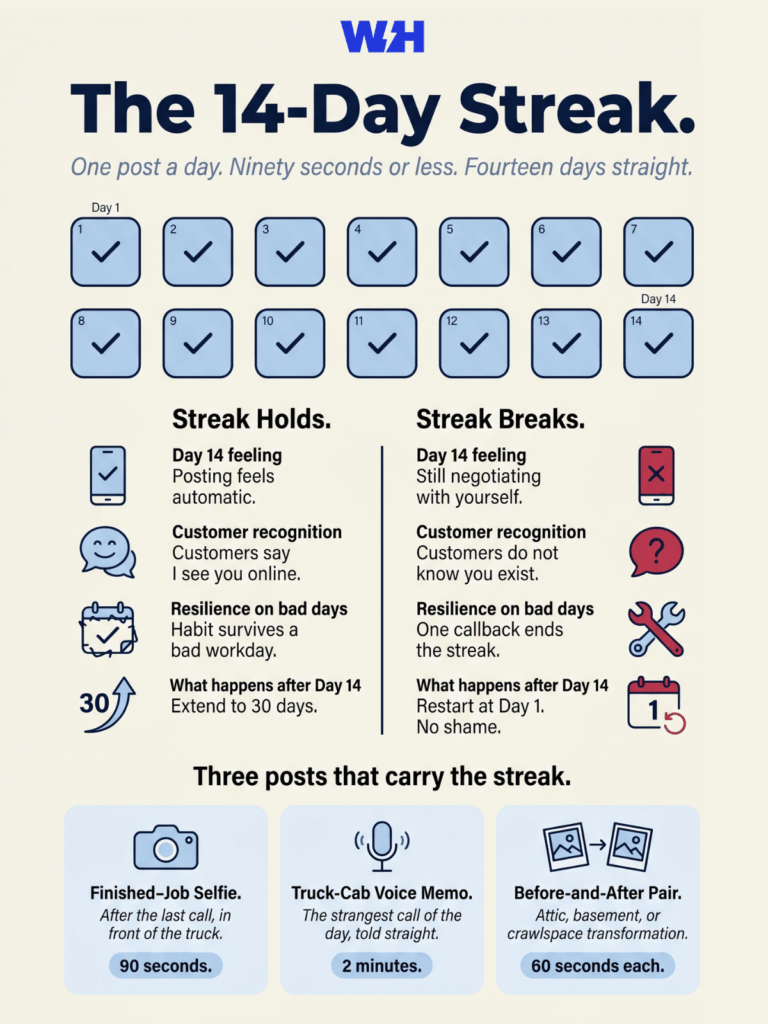
The best way to start is to commit to a streak. Pick a date this week. Post one piece of documenting content per day for 14 consecutive days. No skips, no batching, no caching. The point is the streak, not the content.
A practical 14-day starter:
| Day | Post Type | Time Budget |
|---|---|---|
| 1 | Finished-job selfie | 90 seconds |
| 2 | Truck-cab voice memo on a strange call | 2 minutes |
| 3 | Before photo of an attic, basement, or crawlspace | 60 seconds |
| 4 | After photo of the same job | 60 seconds |
| 5 | Selfie at the supply house | 60 seconds |
| 6 | Community moment (local restaurant, event, sponsor) | 90 seconds |
| 7 | Customer’s pet (with permission) | 60 seconds |
| 8-14 | Repeat any of the above | 90 seconds each |
If you finish 14 of 14, extend to 30. If you do not, the work is identifying which excuse killed the day you missed. Most owners stop posting on the day they get a callback or a refrigerant leak. The whole point of the 90-second budget is that bad days do not break the habit.
For broader context on the systems that hold a one- to five-truck business together while you build the habit, see QuickBooks, FSM, and a Bookkeeper: What New HVAC Owners Need on Day One and Should I Start My Own HVACR Business?.
The owners who win on social do not have bigger budgets than you. They have a smaller habit, repeated daily, for a year. Brand-familiarity research shows roughly 60 percent of consumers stick with brands they already know,⁴ and that effect is even stronger in home services where the buying decision involves letting a stranger into the home. Every documented day is one more touch with the customer who calls you in November because they remember seeing you in July.
This article was inspired by the Jen McKee interview on the HVAC Know It All Business Edition Podcast. Listen to the full conversation for the unfiltered version of the philosophy.
Additional Sources
- “Stop Chasing Virality: The Social Media Strategy HVAC Contractors Actually Need,” Nicole Krawcke, Contracting Business, April 17, 2026.
- Local Consumer Review Survey 2026, BrightLocal, 2026.
- “Average Reach: TikTok vs Facebook,” Napolify, July 2025; “Facebook Page 2026 Update,” Neon Goldfish, December 2025.
- Brand Familiarity and Consumer Preference, Mintel (cited in FifthColor brand-familiarity analysis), 2024.
Whether you require installation, repair, or maintenance, our technicians will assist you with top-quality service at any time of the day or night. Take comfort in knowing your indoor air quality is the best it can be with MOE heating & cooling services Ontario's solution for heating, air conditioning, and ventilation that’s cooler than the rest.
Contact us to schedule a visit. Our qualified team of technicians, are always ready to help you and guide you for heating and cooling issues. Weather you want to replace an old furnace or install a brand new air conditioner, we are here to help you. Our main office is at Kitchener but we can service most of Ontario's cities
Source link