Supermarket refrigeration is evolving alongside the grocery industry itself. As retailers expand online ordering, omnichannel fulfillment, and smaller-format stores, they need refrigeration systems that are more flexible, efficient, and easier to operate. To meet those demands, manufacturers are redesigning refrigeration systems around low-GWP refrigerants and artificial intelligence (AI) — two trends that promise to improve both sustainability and performance.
Among today’s low-GWP refrigerant options, CO₂ (R-744) is widely viewed as the technology most likely to shape the future of supermarket refrigeration. While A2L refrigerants and lower-GWP HFO/HFC blends will continue to play an important role, Todd Ernest, executive chairman of Climate Pros, a commercial refrigeration and HVAC contracting firm based in Chicago, sees them as bridge technologies rather than the industry’s final destination. He advises food retailers to be cautious about investing in any refrigerants that could ultimately be stranded by future regulations, supply constraints, or broader environmental concerns surrounding fluorinated refrigerants.
“CO₂ refrigeration will likely have the greatest long-term impact,” said Ernest. “It is already moving from early adoption into broader fleet planning, especially for retailers that want a long-life refrigerant strategy that is future proof from EPA regulations. CO₂ has an ultra-low GWP, is nonflammable, and gives retailers a path that is less exposed to future HFC restrictions.”
While CO₂ offers significant long-term advantages, Ernest noted that it requires a different approach to system design and operation. Features such as parallel compression, ejectors, adiabatic gas coolers, and heat reclaim are also becoming increasingly common in warmer climates, where they help improve system efficiency.
Danfoss also expects CO₂ — and other natural refrigerants — to remain the industry’s most significant long-term refrigerant, said Dean Groff, natural refrigerant business development manager at Danfoss, because “it avoids risks tied to ozone depletion, GWP, PFAS restrictions, and flammability concerns associated with synthetic refrigerants.” He added that distributed and microdistributed architectures that reduce refrigerant charge and simplify service will also become more prevalent.
LONG-TERM CHOICE: Danfoss expects CO₂ — and other natural refrigerants — to remain the supermarket industry’s most significant long-term refrigerant. (Courtesy of Danfoss)
CO2 will continue to reshape the refrigeration equipment landscape, noted Justin Miles, senior market manager of food retail at Copeland, including technologies that will exploit the full sustainability potential of CO2 such as heat reclaim. He added that mini-rack CO2 systems will also give retailers a more flexible alternative to large, centralized CO2 racks.
“With the emergence of distributed CO2 architectures (i.e., mini racks) and condensing units, retailers will have a greatly expanded range of options to support system retrofits, replacements and new construction,” said Miles. “For example, distributed CO2 systems can support a phased conversion from a legacy HFC system to an ultra-low-GWP architecture. Many retailers have deployed this retrofit strategy to phase out portions of their existing system and install distributed CO2 units, enabling them to convert their entire store refrigeration at their own pace.”
Looking for quick answers on air conditioning, heating and refrigeration topics?
Try Ask ACHR NEWS, our new smart AI search tool.
Ask ACHR NEWS
Keith Wennik, business development manager at Dover Food Retail, a Hillphoenix company, agrees, noting, “Over the next five to 10 years, I think the biggest impact will come from systems becoming more modular, more compact, and more energy efficient. We’re moving toward more distributed architectures because they give retailers more flexibility and scalability. That matters a lot, especially as stores remodel in phases and try to minimize disruption.” He also believes CO2 will become the refrigerant of choice for many food retailers.

SUSTAINABLE SOLUTION: The Hillphoenix AdvansorFlexMax platform delivers high-capacity, sustainable CO₂ refrigeration for large-scale retail environments. (Courtesy of Hillphoenix)
While CO2 is gaining in popularity, food retailers will likely pursue different refrigerant strategies depending on their priorities. Some will look beyond current regulations to meet broader sustainability goals, while others will focus on maintaining compliance and keeping stores operational, said Kyle Klahre, director of refrigeration at the engineering firm Cuhaci Peterson. As a result, he expects continued use of a variety of technologies, including transcritical CO₂ systems, cascade systems, self-contained hydrocarbons, HFC/HFO blends, and distributed architectures.
“Refrigerant solutions are sure to be a mixed bag over the next five to 10 years,” he said.
Smarter Systems
While refrigerant technologies continue to evolve, AI is expected to play an increasingly important role in refrigeration system management, energy optimization, and maintenance, helping retailers address the megatrends and challenges impacting the food retail industry, said Miles.
“AI-driven supervisory and facility management tools enable continuous optimization of refrigeration and site- and enterprise-wide energy management,” he said. He added that intelligent controls will also be essential in addressing the critical technician shortages and skills gaps that are impacting supermarket operators’ ability to start up, support, and maintain supermarket refrigeration systems.
“Continued AI integration into these controls will help automate system performance, ultimately reducing the burden on technicians while improving system reliability,” he said.

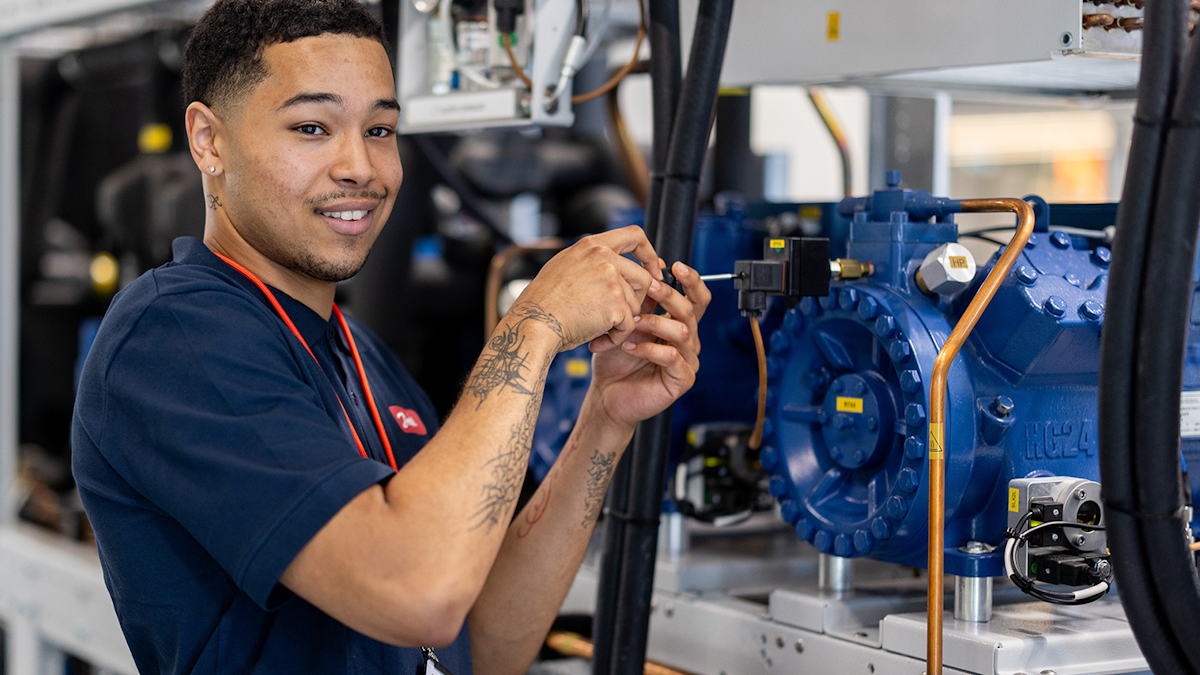
ANALYZING DATA: A contractor analyzes data from a CO2 refrigeration rack system with the Copeland E3 supervisory controller. (Courtesy of Copeland)
Wennik also expects AI to play an increasingly important role in servicing refrigeration equipment.
“Smarter controls and remote diagnostics are becoming more important because service teams want actionable information before they even arrive onsite. Anything that saves time and reduces uncertainty has real value today,” he said.
AI can help service teams identify issues faster, prioritize likely causes and improve troubleshooting, Wennik said. “That’s going to help retailers improve uptime, reduce service uncertainty and manage stores more proactively.”
Because refrigeration is both energy intensive and mission critical, Ernest believes advanced controls, leak detection, remote monitoring, and predictive software will soon become standard features rather than premium options.
“Refrigeration can account for up to 40% of a grocery store’s total energy use, so even small improvements in control logic, defrost management, floating head pressure, case performance, and setpoint discipline can matter across a fleet,” he said. As HFC supplies tighten and service costs rise, retailers will also increasingly expect systems that identify problems before product is lost or an after-hours service call is required. This is where predictive software comes in, he added.
“The biggest gains come when the company servicing the equipment also writes the software,” said Ernest. “Our technicians generate the data that sharpens the software, and the same team that knows the site fixes the problem before product is lost. The retailer gets uptime and lower energy cost, while we gain efficiency and a higher first-time-fix rate. It’s one of the few cases where what benefits the customer benefits the provider in equal measure.”
While many technologies are reshaping supermarket refrigeration, Ernest believes the industry’s future will not be driven by any single innovation.
“It will come from the combination of lower-GWP refrigerants, lower-charge system architectures, smarter controls, and equipment that is easier to service in the field. The direction is clear: Retailers are moving toward systems that reduce refrigerant risk, energy use, and service complexity.”
Whether you require installation, repair, or maintenance, our technicians will assist you with top-quality service at any time of the day or night. Take comfort in knowing your indoor air quality is the best it can be with MOE heating & cooling services Ontario's solution for heating, air conditioning, and ventilation that’s cooler than the rest.
Contact us to schedule a visit. Our qualified team of technicians, are always ready to help you and guide you for heating and cooling issues. Weather you want to replace an old furnace or install a brand new air conditioner, we are here to help you. Our main office is at Kitchener but we can service most of Ontario's cities
Source link