
Key Takeaways
- Missed calls cost the average HVAC company $126,000 a year: Between 35% and 50% of inbound service calls go unanswered in a typical shop, and 85% of callers who reach voicemail never call back. Those unanswered calls are revenue that walked to a competitor.
- CSR training is the highest-ROI investment most shops never make: Untrained customer service reps book at 42%. Trained CSRs hit 90%. A 5-percentage-point improvement in booking rate adds roughly $100,000 in annual revenue for the average residential shop.
- More than half of residential contractors are unprofitable without knowing it: The APB’s 2026 industry survey found that 51.4% of residential builders are effectively unprofitable once accurate accounting is applied, and 79.2% miscalculate their work-in-progress adjustments.
- An office manager at $55,000 a year pays for herself before the end of Q1: Between recovered missed calls, improved booking rates, tighter receivables, and fewer scheduling errors, the return on this hire typically exceeds 3x the salary within the first year.
Every HVAC owner started the same way: one truck, one phone, and the assumption that good technical work is enough to build a business. Then the phone starts ringing more than one person can handle, invoices start slipping, and the very growth you chased becomes the thing that buries you.
The next hire that changes this trajectory is the person managing everything between the customer’s first call and the tech’s last invoice.
The $126,000 Voicemail Problem
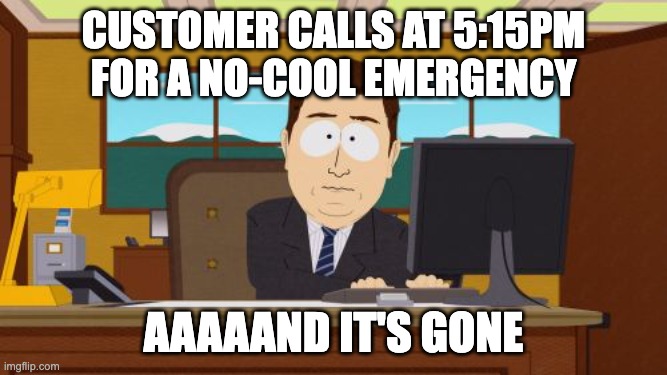
Between 35% and 50% of inbound calls to HVAC companies go unanswered.¹ That number gets worse after 5pm, when 35% to 45% of service calls still come in but most shops have already closed the office.² The customers on the other end of those missed calls do not leave a message and wait. Research from 2026 shows that 85% of callers who reach voicemail never call back.³ They call the next contractor on the list.
The revenue math is uncomfortable. Industry data pegs the average cost of a missed service call at $300 to $500 in lost revenue.¹ Across a year, that adds up to approximately $126,000 for a shop running two to four trucks.¹ That lost call does not just cost you one job. It costs you the referrals, the reviews, and the repeat work that customer would have generated.
Before spending another dollar on Google Ads or LSA, pull your phone records for the last 90 days. Count how many calls went unanswered, went to voicemail, or rang more than four times. That number represents cash flow you already earned but never collected.
CSRs Are Revenue Drivers, Not Order Takers
The person answering your phone is your highest-volume salesperson. An untrained CSR (customer service representative), one who takes messages and reads available time slots, books at 42%.⁴ A CSR who has been trained to listen, qualify the call, present options, and offer a maintenance agreement books at 90%.⁴
That spread is worth more than most owners realize. ServiceTitan’s data shows that a 5-percentage-point improvement in booking rate translates to roughly $100,000 in additional annual revenue for the average residential HVAC company.⁴ The training itself costs a fraction of that, and the skills transfer to every call that comes in: emergency repairs, maintenance renewals, quoted replacements, and the after-hours calls that would otherwise go to voicemail.
The same CSR who books the call is also in the best position to present agreements, collect reviews, and schedule follow-ups. Shops that treat the front desk as a cost center are leaving revenue on every call.
The Cash Flow Autopsy
The statistic that 82% of small business failures trace to cash flow problems⁵ has been circulating for years, and most HVAC owners have heard it. What most have not seen is the APB’s 2026 survey data showing that 51.4% of residential builders are effectively unprofitable once accurate accounting is applied, and 79.2% miscalculate their work-in-progress adjustments.⁶
WIP (work-in-progress) adjustments are the difference between what you have billed and what you have actually earned on in-progress jobs. Get that number wrong and the profit on your books is fictional. The owner thinks the business made $200,000 last year. The accountant finds $80,000 in unbilled work, uncollected receivables, and warranty costs that were never tracked. This is where shops that look busy at $1.2M in revenue go broke in practice.
A competent office manager catches these gaps weekly, not once a year at tax time. Receivables aging, invoice follow-ups, job costing reviews, and reconciliation against the right software stack are the difference between a business that scales and one that stalls.
What a Real Office Manager Actually Manages
The title “office manager” undersells the role. In a $1M to $3M HVAC shop, this person runs dispatch, manages the CSR team, tracks receivables, handles vendor accounts, coordinates scheduling, manages the maintenance agreement renewal calendar, and serves as the communication bridge between the field and the office. When the owner is still in the field, the office manager is the person keeping the business side from falling apart.

The salary data puts this hire at $50,000 to $70,000 in the US and approximately $55,000 CAD in Canada.⁷ Compare that to the $126,000 in missed-call revenue, the receivables that slip past 90 days, and the scheduling errors that send two trucks to the same job. The math works in the first quarter.
For owners not yet ready for the full-time hire, AI voice agents now handle after-hours calls for $49 to $199 per month.⁸ They answer, qualify, and book. They serve as a bridge until the revenue justifies the hire. There is a reason most shops hit a ceiling at three trucks: the owner runs out of hours before the business runs out of demand. The office manager is the hire that buys those hours back.
The owners who started in the field know how to fix equipment. The ones who build lasting businesses learn that the office deserves the same attention as the mechanical room.
Your Call Volume
Note: “Never call back” defaults to 85% based on Opus Labs 2026 voicemail abandonment research. Adjust if you use an answering service or AI voice agent.
Unanswered Call Rate
Benchmark: 35-50% of inbound calls to HVAC companies go unanswered (Invoca 2026). After 5pm, 35-45% of service calls still come in but most shops have closed the office (ServiceTitan 2025).
Revenue Impact
Annual Revenue Lost
–
per year to missed calls
Calls Lost Forever
–
per year (never call back)
Revenue Lost / Day
–
every operating day
Loss Per Missed Call
–
expected revenue at risk
Recovery Potential
Revenue Recoverable
–
per year with improvement
Monthly Recovery
–
additional revenue / month
CSR benchmark: Trained CSRs book at 90% vs 42% untrained (ServiceTitan 2025). A 5-point improvement in booking rate adds roughly $100,000 in annual revenue for the average residential shop.
Additional Sources
- “The True Cost of Missed Calls for Home Service Businesses”, Invoca, Industry Report, 2026.
- “After-Hours Call Volume in Residential HVAC”, ServiceTitan, Industry Data, 2025.
- “Voicemail Abandonment Rates in Service Industries”, Opus Labs, Research, 2026.
- “CSR Booking Rate Benchmarks and Training ROI”, ServiceTitan, Industry Analysis, 2025.
- “Small Business Cash Flow Statistics”, US Bank / SCORE, Research.
- “Annual Survey of Residential Construction Industry (SORCI)”, Association of Professional Builders, Industry Report, 2026.
- “HVAC Office Manager Salary Data”, ZipRecruiter, Compensation Survey, 2026.
- “AI Voice Agents for Home Service Businesses”, Service Autopilot / Opus Labs, Market Analysis, 2026.
Whether you require installation, repair, or maintenance, our technicians will assist you with top-quality service at any time of the day or night. Take comfort in knowing your indoor air quality is the best it can be with MOE heating & cooling services Ontario's solution for heating, air conditioning, and ventilation that’s cooler than the rest.
Contact us to schedule a visit. Our qualified team of technicians, are always ready to help you and guide you for heating and cooling issues. Weather you want to replace an old furnace or install a brand new air conditioner, we are here to help you. Our main office is at Kitchener but we can service most of Ontario's cities
Source link