
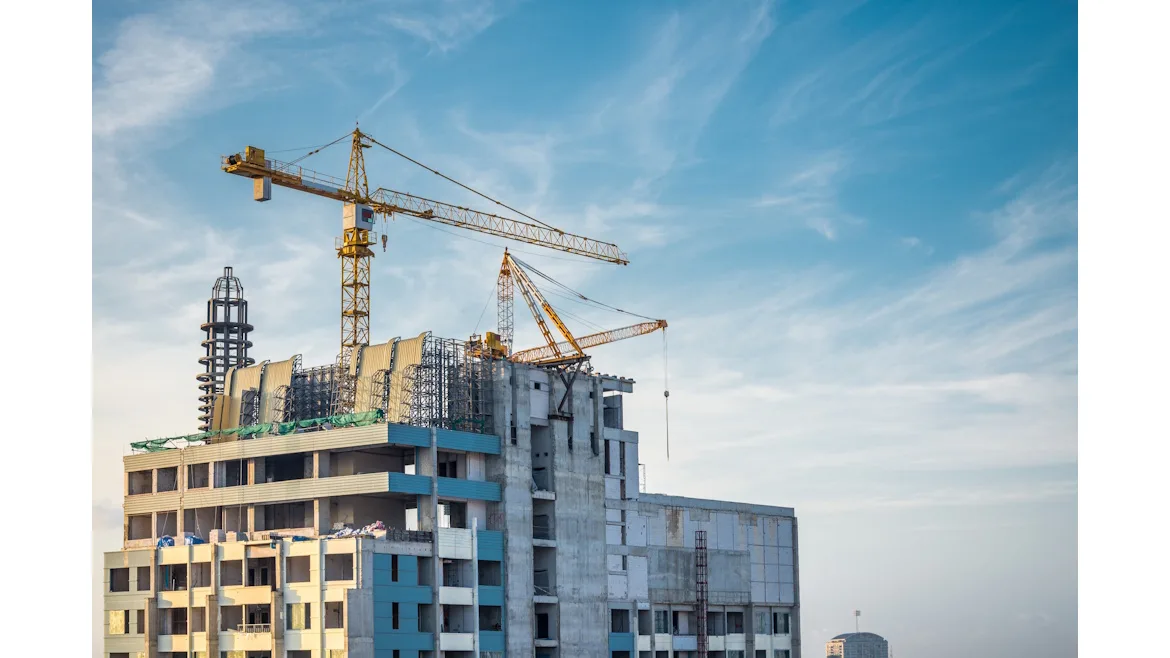
We will continue to see the evolution of the jobsite driven by advancements in automation and robotics, with physical AI providing the spatial data that enables humans and machines to work safely together in real-world environments. Expect to see advancements in autonomy move beyond machine-level automation to site-level automation, with human-operated and autonomous machines working side-by-side. Watch for advancements in AI to continue to deliver enhanced intelligence that allows machines to react to unforeseen obstacles and changing site dynamics quickly and easily. The combination of better-connected, more autonomous jobsites together with the power of AI will make it easier for site superintendents to adjust to everything from equipment issues to bad weather on the fly, which means more efficient and more profitable jobsites. – Elwyn McLachlan, vice president, civil construction product & strategy, Trimble
New infrastructure that will power the modern economy depends on connected construction
The construction sector is undergoing a shift in infrastructure construction as expectations and requirements continue to change. The rapid growth of AI is driving investment in data centers, fiber networks, renewable energy and next-generation nuclear power, while infrastructure needs are growing and changing, requiring better technology for long-overdue repairs to aging roads, bridges and other infrastructure assets. Contractors will increasingly rely on connected digital processes for real-time visibility, collaboration, and data sharing and analysis to improve efficiency and productivity, protect already-thin margins and keep complex projects on track. – Scott Crozier, senior vice president, civil construction, Trimble
AI and data-driven tools will boost intelligence to minimize business risk
AI is poised to become one of the construction industry’s most important risk management tools. As projects become larger, more complex and less forgiving of mistakes, risk intelligence will emerge as one of AI’s most valuable applications. This is further compounded by a shifting labor landscape: as seasoned professionals retire, decades of subject matter expertise are departing the industry, leaving a less experienced workforce to handle increasingly intricate challenges. Contractors will increasingly use AI to bridge this gap, leveraging the vast amounts of data generated throughout a project to identify and mitigate risks before they become costly problems, instead of relying solely on institutional memory to spot them. Rather than analyzing documents in isolation, AI will uncover risks hidden in the relationships between contracts, schedules, drawings, RFIs, financial data and field reports. By anticipating potential delays, cost overruns and contractual exposures before they escalate, AI will provide a safety net and foresight that used to take decades of field experience to cultivate. As delivery timelines shrink and margins remain tight, this ability to proactively spot and mitigate risk will become a critical competitive advantage. – Josh Levy, vice president of Trimble Risk and Compliance Solutions and co-founder of Document Crunch
Construction AI will shift from generic LLMs to specialized, agentic ecosystems
The future of AI in construction will not be defined by general-purpose or standalone, off-the-shelf LLMs. To become truly useful on a project, AI needs to understand the context of construction, including its processes, project requirements, physical environment, and the relationships between the data and decisions that move work forward. That’s why the next wave will be industry-specific, agentic AI grounded in trusted construction data. AI is moving beyond answering questions and generating content to coordinating actions across connected construction systems. These specialized agents will help teams identify issues, analyze their impact, and initiate next steps using real-time project context. The biggest gains won’t come from adding another standalone tool to the tech stack, but from embedding intelligence into the systems contractors already rely on. AI will take on repetitive coordination and analysis while people remain responsible for decisions that require experience and judgment, making AI part of everyday project execution without adding tech complexity. – Mark Schwartz, group president, AECO Software, Trimble
Hybrid skill development and technology integration will reshape the construction workforce
The construction industry’s labor shortage and skills gap challenges are pushing construction companies to completely revamp their approach. To attract new talent, they will increasingly position jobs around cutting-edge technology, such as operating autonomous equipment, incorporating AI agents, supervising automated geomatics capture, and using augmented reality for site layout as they move away from traditional recruitment channels to partner directly with tech academies, career technical educational pipelines, and universities. At the same time, companies will rely on AI-guided training and immersive virtual reality simulations to upskill current workers, shortening the time required to master complex machinery and modern assembly techniques. Ultimately, technology integration will be the primary strategic imperative for companies to maintain capacity and deliver projects on schedule. – Ian Warner, director of industry workforce development & innovation at Trimble
Technology will increasingly level the playing field for small- and medium-size contractors
The technology gap between large and small contractors will continue to narrow as connected solutions, subscription pricing and intuitive, mobile-first applications make enterprise-level capabilities more accessible. In the past, high-tech tools like high-precision GNSS, drone mapping and laser scanning – as well as machine guidance and sophisticated project estimating, operations and management – were often too complex and cost-prohibitive for most smaller businesses. Today, these technologies are highly intuitive, accessible and built specifically for smaller contractors.
Subscription-based purchasing models will continue to replace large upfront technology investments, making the cash flow and ROI equation more favorable for smaller contractors. This can range from specialized construction financial and accounting platforms to field-focused project management systems tailored for growing SMB contractors, helping them adopt connected capabilities incrementally, paying only for what they need as their businesses grow. This broader accessibility will have important implications for the industry. Smaller contractors will be able to grow faster and complete larger, more complex projects with access to similar levels of operational technology and visibility, financial control and connected processes that larger contractors deploy. – Lawrence Smith, senior vice president, construction management solutions at Trimble
Trust and proven performance will define the future contractor market
The way contractors choose technology is changing quickly. Security risks are rising, and global rules are tightening, meaning contractors who verify their technology beforehand will win jobs based on trust, while those who do not will be left competing on price alone. Instead of just comparing starting prices, contractors will need to stress test their systems under real-world conditions as a standard bidding requirement. They will have to verify how fast crews can learn tech, what happens if a system goes down, and who owns and protects their data. Smart companies will look at the total cost over time rather than just the initial invoice, and ultimately, this shift to proven performance will split the market. – Scott Crozier, vice president, civil construction, Trimble
Looking for quick answers on air conditioning, heating and refrigeration topics?
Try Ask ACHR NEWS, our new smart AI search tool.
Ask ACHR NEWS
Whether you require installation, repair, or maintenance, our technicians will assist you with top-quality service at any time of the day or night. Take comfort in knowing your indoor air quality is the best it can be with MOE heating & cooling services Ontario's solution for heating, air conditioning, and ventilation that’s cooler than the rest.
Contact us to schedule a visit. Our qualified team of technicians, are always ready to help you and guide you for heating and cooling issues. Weather you want to replace an old furnace or install a brand new air conditioner, we are here to help you. Our main office is at Kitchener but we can service most of Ontario's cities
Source link
