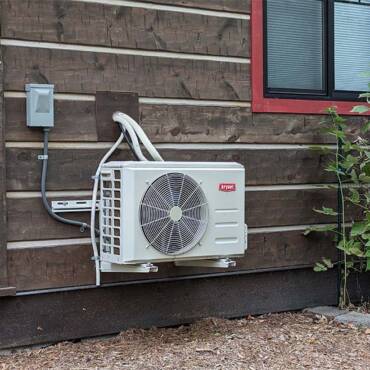
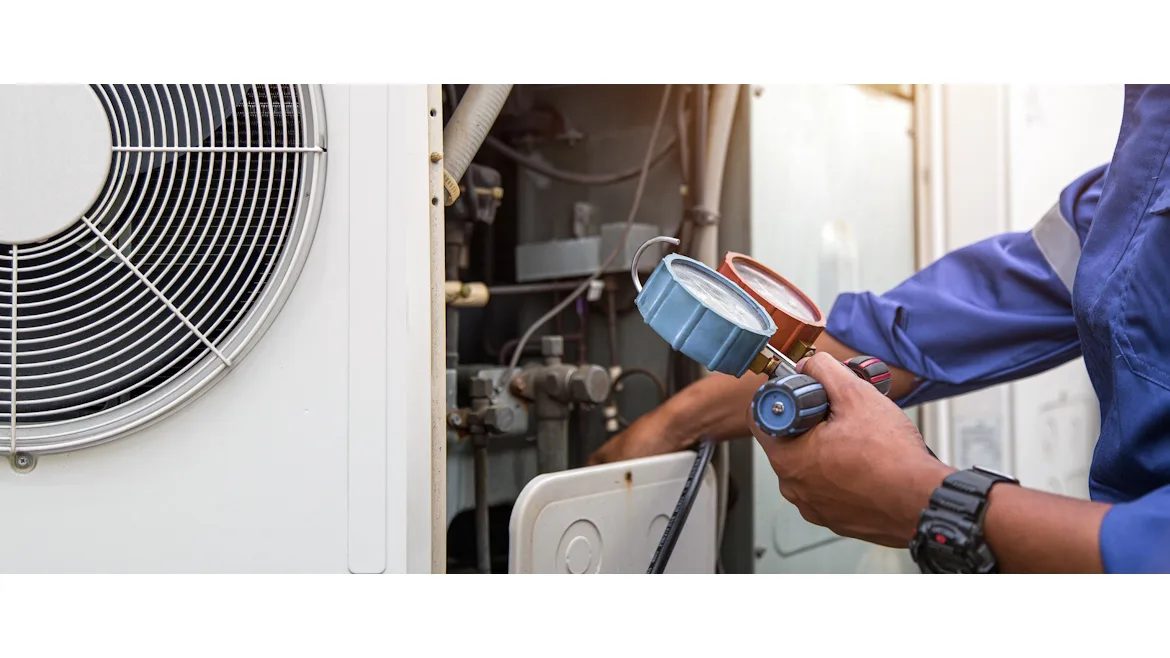
As the seasons change, tips for tune-up do not. Refrigerant charging is one of the most routine maintenance services HVACR contractors perform, any time of year.
Done at new installations, and in response to refrigerant leaks, charging must be completed accurately to ensure adequate and efficient cooling for the customer. Improper refrigerant charging remains a prevalent issue in the field — with systems sometimes being undercharged or overcharged.
Anthony Maynor of RightTek HVAC Training and Rocky Berger of ARS/Rescue Rooter shine a light on the most common charging mistakes and offer guidance on how to charge a system correctly.
Prerequisites for Accurate Charging
Charging isn’t as simple as adding refrigerant until the pressure gauge reads an acceptable value. At new installations, Berger emphasized the importance of weighing in refrigerant to account for the length of line sets that aren’t visible. When recharging existing systems, technicians must also consider the variables that affect the accuracy of refrigerant level measurements, such as airflow and ambient temperatures.
Adequate Airflow
Every manufacturer’s performance chart assumes a certain amount of airflow is present at the indoor coil. Airflow before charging (ABC) is a golden rule of the HVACR industry that contractors should always fall back on. Before charging and taking measurements, confirm that filters are clean and that blower volume is set correctly. “If you are significantly off for the proper amount of airflow, then that obviously is going to throw off your pressures, your temperatures, and lead to a situation where you may misdiagnose something,” Maynor said.
Proper Indoor and Outdoor Conditions
In addition to airflow, air conditioning equipment requires specific environmental conditions to give accurate superheat and subcooling measurements. Both indoor and outdoor temperatures should be at least 70 degrees Fahrenheit before evaluating an air conditioner’s refrigerant levels.
Maynor called this the “70/70 rule.” If the temperatures at your indoor evaporator coil and outdoor condenser coil are too low, this will result in a lower-than-standard pressure reading.
Looking for quick answers on air conditioning, heating and refrigeration topics?
Try Ask ACHR NEWS, our new smart AI search tool.
Ask ACHR NEWS
Additionally, technicians should always run the system for at least 15 to 20 minutes before taking measurements. This allows temperatures and pressures to stabilize for an accurate reading.
Superheat and Subcooling Measurements
Pressure alone should never be used to get an accurate charge. When checking refrigerant levels before a refrigerant charge, “the only truly accurate and most precise way of evaluating it is by evaluating the superheat and/or the subcooling,” said Maynor. Still, there are misunderstandings technicians have about how to measure these values.
One of the most important things contractors need to know is when to measure superheat and when to measure subcooling. Both are important, but as Maynor described, “one is primary, one is supporting.” The customer’s metering device determines this, so technicians need to confirm what type of equipment they’re working with before recharging a system. For example:
- Thermostatic expansion valves (TXVs) and electronic expansion valves (EEVs) modulate the evaporator outlet’s size to maintain consistent superheat. Therefore, adding or removing refrigerant won’t change the superheat value, so subcooling is used as the primary measurement.
- Fixed-orifice metering devices (most commonly piston) have a fixed opening that does not modulate. Therefore, adding refrigerant lowers the superheat, and removing refrigerant raises it, so you can accurately use superheat as the primary measurement.
Wet Bulb’s Role in Superheat Calculations
One of the most commonly overlooked elements of superheat evaluation is the wet bulb temperature at the indoor coil. Air with higher humidity has more BTUs per pound, so it increases the total load. This means the evaporator boils more refrigerant and removes more energy. To compensate for this, manufacturers increase the target superheat value to ensure that the evaporator is not starved of refrigerant.
Maynor stressed that superheat calculations are never fixed, despite the industry’s common misconception of always charging to 10 degrees; they are a dynamic, moving number that changes based on environmental conditions.
In his training classes around the country, Maynor said he has seen a shocking number of contractors who don’t have a meter with a wet bulb thermometer. Having the correct tools and strictly following a manufacturer’s charging chart is essential for correct charging.
Understanding Refrigerant Blends and Glide
Refrigerant blends can create additional confusion for HVACR contractors. These blends are a mix of multiple refrigerants, each with a different boiling point. As the refrigerant begins to boil at the evaporator, certain refrigerants in the blend vaporize sooner than others. Berger likens this to cooking wine — the alcohol in it will boil faster than the water.
The temperature at which the first refrigerant starts to boil is called the bubble point. The temperature at which the last refrigerant has finished boiling is called the dew point. The difference between these two temperatures is called glide.
Berger explained that you have to keep this temperature distinction in mind when charging a system that uses a refrigerant blend,
“Instead of one single temperature for saturation point, we’ve got to look at the dew point when we’re measuring superheat, and then the bubble point when we’re measuring subcooling, to avoid misdiagnosing the system,” he said.
Working with blends isn’t necessarily complicated. Technicians just need to ensure they are following the refrigerant manufacturer’s PT charts and correctly targeting the dew point or bubble point based on their customer’s metering device. Confusing the two can result in incorrect charging.
Techniques for Accurate Charging from ACCA
HVACR contractors often rely on rule-of-thumb techniques for refrigerant charging. This can lead to inaccurate measurements that affect the performance of customer equipment. Professional training from licensed instructors ensures that technicians are following the specific processes and techniques required for a correct charge.
To facilitate this, the Air Conditioning Contractors of America offers flexible training programs for every experience level. Learn how to charge correctly and reduce callbacks. Register for in-person training, or sign up for live, virtual training today to get started.
Whether you require installation, repair, or maintenance, our technicians will assist you with top-quality service at any time of the day or night. Take comfort in knowing your indoor air quality is the best it can be with MOE heating & cooling services Ontario's solution for heating, air conditioning, and ventilation that’s cooler than the rest.
Contact us to schedule a visit. Our qualified team of technicians, are always ready to help you and guide you for heating and cooling issues. Weather you want to replace an old furnace or install a brand new air conditioner, we are here to help you. Our main office is at Kitchener but we can service most of Ontario's cities
Source link