

We’re all familiar with the dangers of carbon monoxide, but high CO2 levels (carbon dioxide) can be dangerous as well. If you’re feeling unusually tired at home, or you’re noticing employee performance dipping and people drowsing at their desks in the office, it’s smart to check the CO2 levels in the air.
Here’s what you need to know about safe CO2 levels and what to do if carbon dioxide is high.
High CO2 levels in air: what are the risks?
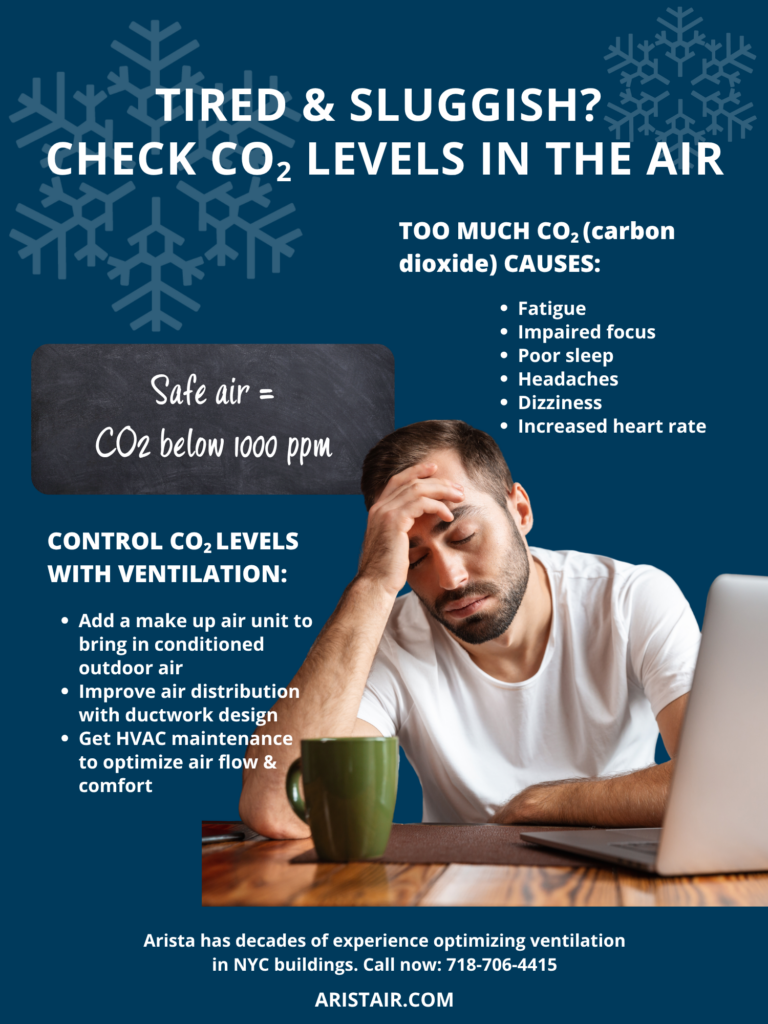
According to ASHRAE (American Society of Heating, Refrigerating and Air Conditioning Engineers), safe indoor air has a carbon dioxide level below 1,000 ppm. Elevated CO2 levels are an indicator of poor indoor air quality, and can cause symptoms such as sleepiness, headaches, and poor performance at tasks. Extremely high levels can be deadly.
- 1,000 to 2,000 ppm CO2 causes drowsiness, difficulty concentrating, and poor sleep quality.
- 2,000 to 5,000 ppm CO2 causes headaches, nausea, dizziness, extreme fatigue, and increased heart rate.
- Above 40,000 ppm CO2 is life threatening.
For businesses, consistently high CO2 levels can easily impact the bottom line. Harvard’s Healthy Buildings program studied workers in a controlled environment where they varied the VOC and carbon dioxide levels in the air, and found that decision-making, strategizing and planning all improved when workers were breathing better air.
How can you tell if the carbon dioxide level in your home or workplace is safe? Install thermostats with CO2 sensors, or get a dedicated indoor air quality monitoring device with an NDIR (Non-Dispersive Infrared) sensor.
What causes CO2 levels to get too high?
- High occupancy. People breathe out CO2 when they exhale. When there are a lot of people in an enclosed space with poor ventilation (such as a conference room or classroom), CO2 levels in the air can rise quickly.
- Inadequate ventilation. Even without high occupancy, carbon dioxide levels can build up when a space doesn’t have a source of fresh air (such as sealed buildings without windows that open or mechanical ventilation).
- Fuel-burning appliances. Cooking and heating appliances such as woodburning stoves, furnaces, fireplaces, gas ranges, and space heaters can increase CO2 levels in the air if they are unvented or poorly vented.
- HVAC issues. CO2 levels can climb due to reduced air flow in the HVAC system. That can happen if supply or return registers are closed or blocked. Setting the system to recirculate rather than bring in outdoor air can also lead to high carbon dioxide levels.
Reduce CO2 in the air with proper ventilation
Controlling CO2 levels in indoor air is all about ensuring adequate ventilation, especially in spaces without windows or sealed buildings where the windows don’t open. That means installing mechanical ventilation to bring in fresh outdoor air and distribute it throughout the space.
- Add make up air units. A make up air unit is an HVAC device that pulls outdoor air into the space and heats or cools it to the set indoor temperature. They are particularly useful in sealed commercial buildings as well as kitchens with powerful exhaust fans.
- Improve air distribution. Poor ductwork design is a common problem that often leads to inconsistent HVAC performance as well as stuffy air and rising CO2 levels in the space. If your space has been renovated without re-routing the ducts, or the usage of the space has changed since the HVAC system was installed, adding or moving duct runs can make a big difference in comfort and air quality.
- Optimize HVAC performance with maintenance. Clogged filters, dirty coils, fan problems, and obstructions in the system can impede HVAC air flow in your space. Poor air flow can lead to high CO2 levels as well as reduced cooling and eventually equipment breakdowns. Regular HVAC maintenance takes care of these issues to keep your equipment operating effectively and efficiently.
Learn more: 7 Signs You Need AC System Maintenance
Arista can help improve ventilation in NYC buildings
Arista has decades of experience optimizing ventilation in NYC’s commercial and residential buildings, and thousands of businesses and luxury homeowners trust us to maintain and service their equipment. If you’re in the NYC metro area, contact us today to improve comfort and air quality in your space.
Whether you require installation, repair, or maintenance, our technicians will assist you with top-quality service at any time of the day or night. Take comfort in knowing your indoor air quality is the best it can be with MOE heating & cooling services Ontario's solution for heating, air conditioning, and ventilation that’s cooler than the rest.
Contact us to schedule a visit. Our qualified team of technicians, are always ready to help you and guide you for heating and cooling issues. Weather you want to replace an old furnace or install a brand new air conditioner, we are here to help you. Our main office is at Kitchener but we can service most of Ontario's cities
Source link

