

The Short Answer: An AC blowing hot air usually points to one of a few things, like a thermostat set to the wrong mode, a clogged air filter, an outdoor unit that lost power, or low refrigerant from a leak. A couple of these are an easy fix you can handle yourself, while the rest need a licensed technician to test and repair the AC system safely.
Few things are more frustrating than warm air pouring from your vents during summer, especially in Central Florida. The good news is that hot air from an air conditioner is a common issue with a short list of likely causes. Some you can rule out in a few minutes, while others call for a trained set of hands.
The 7 Culprits
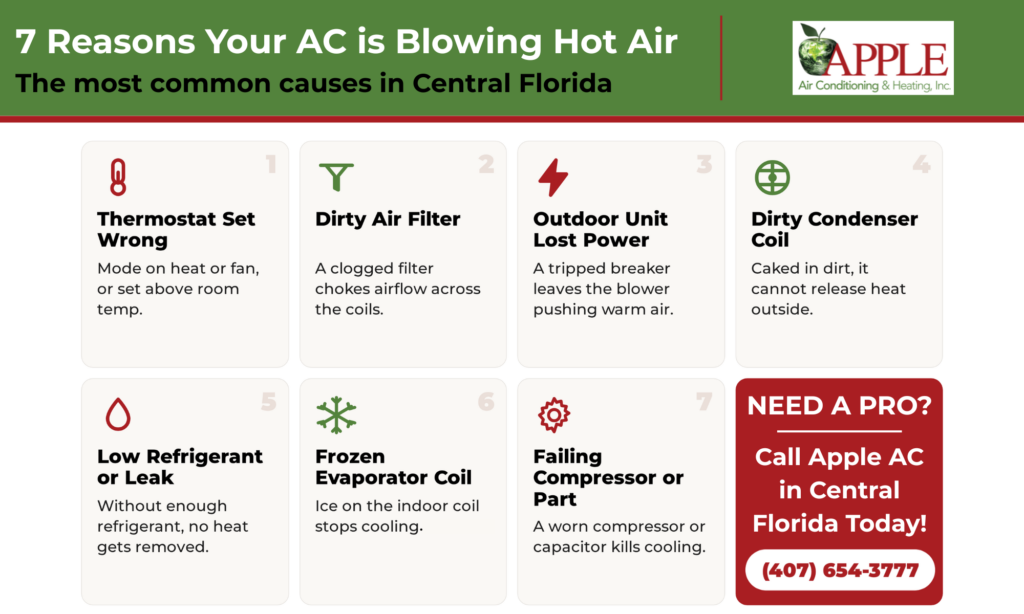
When your AC starts blowing hot air, these are the likely culprits:
- Thermostat settings are off
- A dirty air filter is choking airflow
- The outdoor unit lost power
- A dirty condenser coil cannot release heat
- Low refrigerant or a refrigerant leak
- A frozen evaporator coil
- A failing AC compressor or electrical part
Some of these have a quick fix you can handle in a few minutes, while others need a technician. Here is how to spot each one and what to do about it.
1. Your Thermostat Settings Are Off
Before you worry about parts, check the thermostat. It is the most common issue we see, and usually the easiest fix.
- Mode: Set it to cool, not heat or fan.
- Temperature setting: Drop it a few degrees below the room’s ambient temperature so the system kicks on.
- Fan: Set the fan to auto instead of on. Left on, the fan keeps pushing room-temperature air between cooling cycles, which feels like warm air at the vent.
- Power: A smart thermostat with a dead battery or an error code on the screen may stop calling for cool air.
If the air conditioning blows cold air again after a quick thermostat change, you are done. If not, move on to the next cause.
2. A Dirty Air Filter Is Choking Airflow
A clogged air filter is one of the most overlooked reasons an air conditioner stops cooling. When the filter fills with dust, air cannot move across the coils, and weak, warm air is what reaches your rooms. ENERGY STAR notes that a dirty filter slows airflow and makes the system work harder, so a clean filter helps your AC run more efficiently.
Check your air filter once a month during cooling season.
- Replace it every one to two months, sooner if you have pets.
- A clean filter also protects your air quality and helps the whole system run cooler.
For homes that battle dust and allergens, our indoor air quality products help keep the air cleaner between filter changes.
3. The Outdoor Unit Lost Power
Your system has two main parts: an indoor unit that moves air through the house, and an outdoor unit that holds the compressor and condenser coil. If the outdoor unit loses power, the indoor blower keeps running and pushes uncooled, warm air through the vents.
- Check your breaker panel for a tripped breaker and reset it once.
- Look at the outdoor unit. The fan on top should be spinning when the AC runs.
- If the breaker trips again, stop. A breaker that keeps tripping points to an electrical fault that needs a technician.
4. A Dirty Condenser Coil Cannot Release Heat
The outdoor unit’s job is to release the heat your AC pulls from inside. The condenser coil does that work. When it is caked in dirt, grass clippings, or leaves, the heat has nowhere to go, and your air conditioner sends warm air back indoors.
- Keep at least two feet of clear space around the outdoor unit.
- Trim back shrubs and rinse off loose debris with a gentle hose spray.
- Avoid pressure washers, which can bend the coil fins.
Florida pollen, lawn dust, and afternoon storms make this a year-round task. A yearly tune-up through Apple AC’s maintenance and service plans keeps the condenser coil and evaporator coil clean so the system holds its cooling power.
5. Low Refrigerant or a Refrigerant Leak
Refrigerant is the fluid that carries heat out of your home. If the refrigerant level drops, usually because of a refrigerant leak, the system cannot absorb heat at the evaporator coil, and the air turns warm.
Low refrigerant is not a refill-and-go job. Adding more without fixing the leak only delays the next breakdown. A licensed technician will:
- Connect a manifold gauge to the service port, called the Schrader valve, and read the low side pressure.
- Find the leak, often at a coil, a fitting, or the expansion valve.
- Repair the leak, then recharge the system to the maker’s spec.
Handling refrigerant takes training and EPA Section 608 certification, so this is a call for the pros. The EPA also recommends having the technician find and repair the leak rather than just topping off the refrigerant, which saves you repeat service calls.
6. A Frozen Evaporator Coil
It sounds backward, but ice on your indoor coil leads to hot air at the vents. When airflow drops or refrigerant runs low, the evaporator coil gets so cold that moisture freezes on it. That block of ice then stops the system from cooling at all.
- Turn the AC off and let the coil thaw fully, which can take a few hours.
- Replace a dirty air filter, since poor airflow is a frequent root cause.
- Set the fan to on (not cool) to help the ice melt faster.
If the coil freezes again after it thaws, the root cause is deeper, often low refrigerant or a blower problem, and a technician should take a look.
7. A Failing AC Compressor or Electrical Part
The air conditioning compressor is the heart of the system. It pumps refrigerant between the indoor and outdoor units. When the compressor or a related part starts to fail, cooling drops off and warm air takes over.
Parts that can cause this include:
- The AC compressor itself, which may struggle or quit
- A start capacitor or contactor that no longer powers the compressor
- A pressure switch that shuts the system down to protect it
A worn compressor is one of the costlier repairs. If your unit is older and a new compressor is on the table, a full replacement may be the smarter spend. Our team can compare a repair against a new AC installation and lay out the numbers first. Newer systems also come with better financing and extended warranty options. If you are building or replacing a system, our new construction HVAC guide walks through what to plan for.
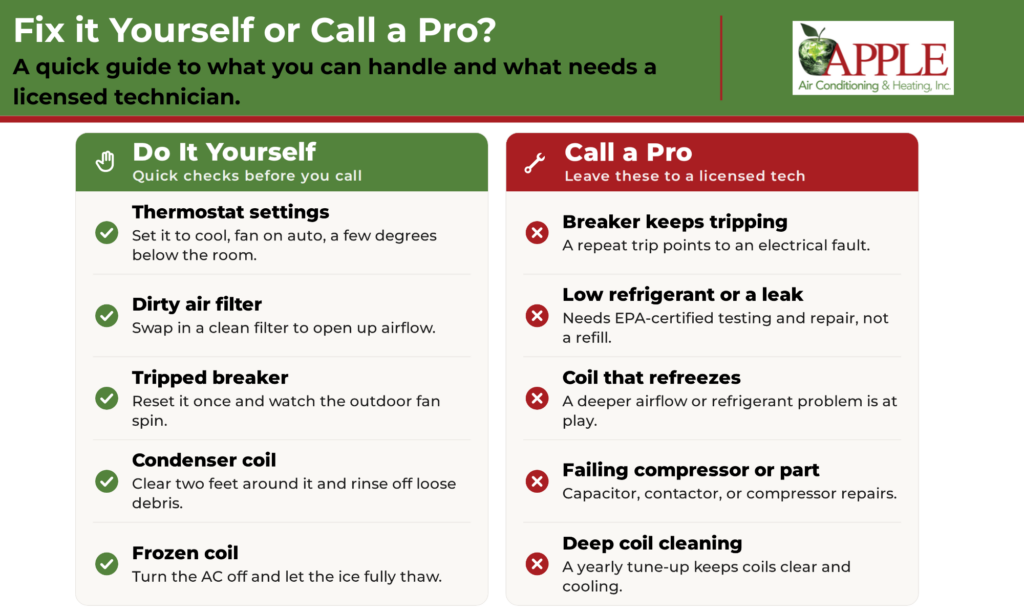
Can You Fix It Yourself, or Is It Time to Call a Pro?
Pro Tips to Keep Cold Air Coming
- Change your air filter on a set date each month so it never slips your mind.
- Book a tune-up before summer so small problems get caught the first time, not in a July heat wave.
- Keep the outdoor unit clear of weeds, fence panels, and stored items.
- Set a smart thermostat to hold a steady temperature setting instead of big swings. That eases the load on the AC system and keeps your climate control steady.
When to Call Apple AC
When your AC is blowing hot air, start simple. Check the thermostat settings, look at the air filter, and make sure the outdoor unit has power. Those three cover most cases and are an easy fix. If the air stays warm after that, the cause is likely low refrigerant, a frozen evaporator coil, or a tired compressor, and those should be handled by a trained technician.
That is where we come in. Apple AC is a family-owned, NATE-certified team that has kept Central Florida homes and businesses cool since 1997, with 24/7 service across Central Florida counties. We show up on time, explain the root cause in plain terms, and fix it right the first time. Ready for cold air again? Schedule service or get a free estimate and let our team take it from there.
Whether you require installation, repair, or maintenance, our technicians will assist you with top-quality service at any time of the day or night. Take comfort in knowing your indoor air quality is the best it can be with MOE heating & cooling services Ontario's solution for heating, air conditioning, and ventilation that’s cooler than the rest.
Contact us to schedule a visit. Our qualified team of technicians, are always ready to help you and guide you for heating and cooling issues. Weather you want to replace an old furnace or install a brand new air conditioner, we are here to help you. Our main office is at Kitchener but we can service most of Ontario's cities
Source link