Why Whole Home Air Purifiers Are Worth Your Attention
Whole home air purifiers are systems that clean the air across your entire house, not just a single room, by working with your existing HVAC system to continuously remove dust, allergens, mold, bacteria, VOCs, and odors.
Here are the top whole home air purifier options to compare:
| Type | Best For | Coverage | Key Technology |
|---|---|---|---|
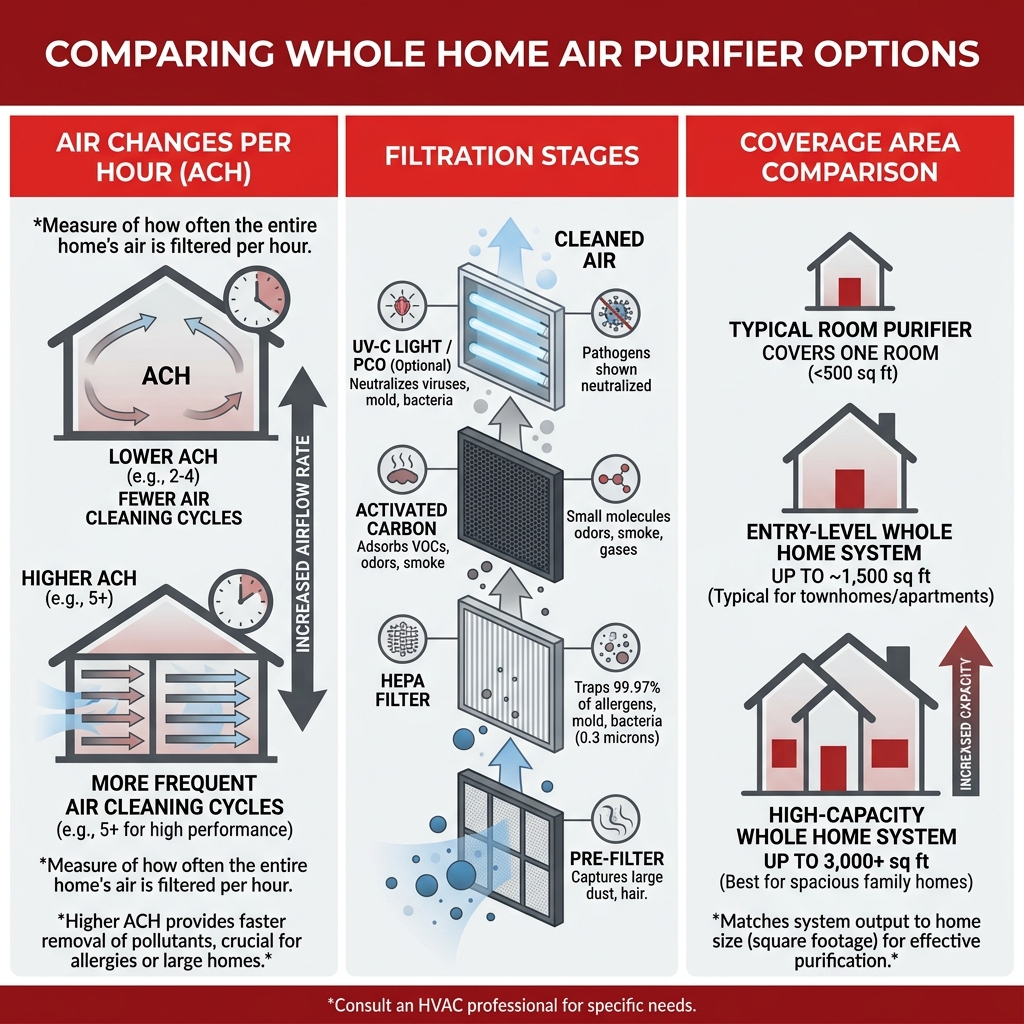
| HEPA Media Filters | Allergens, dust, mold spores | Up to 3,000+ sq ft | True HEPA (99.97% @ 0.3 microns) |
| UV-C In-Duct Systems | Bacteria, viruses, mold on coils | Whole home | Germicidal UV-C light |
| PCO Systems | VOCs, odors, surface pathogens | Up to 3,000 sq ft | Photocatalytic oxidation |
| Carbon Filtration | Chemicals, odors, gases | Whole home | Activated carbon bed |
| Combination Systems | Comprehensive coverage | Varies | HEPA + UV + Carbon |
Here’s the issue many Columbus homeowners face: the air inside your home can be more polluted than the air outside. Dust, pet dander, mold spores, and chemical fumes from everyday household products can build up over time, and a standard HVAC filter usually removes only a small portion of them.
A single portable room purifier helps in one space. But the moment you move to another room, you’re back to breathing unfiltered air. Whole home systems solve this by treating every cubic foot of air that moves through your ductwork.
We can survive only a few minutes without air, yet many of us pay more attention to filtering our drinking water than the air our families breathe every day.
I’m Steven Alexander, President of Aire-Flo Heating, Cooling & Generators, and with decades of HVAC experience serving central Ohio, I’ve helped countless homeowners evaluate and install whole home air purifiers as part of a complete indoor air quality solution. In this guide, I’ll walk you through the top-rated options so you can find the right fit for your home and budget.
Understanding Whole Home Air Purifiers vs. Portable Units
When we talk about whole home air purifiers, we are looking at systems that are a permanent part of your home’s infrastructure. Portable room units are great for a small office or a nursery, but they have significant limitations. A portable unit only cleans the air in its immediate vicinity. To cover a 2,500-square-foot home in Upper Arlington or Bexley, you would need five or six high-end portable units, all humming away, taking up floor space and requiring individual filter changes.
In contrast, a whole-home system integrates directly into your ductwork. It uses the powerful blower motor of your furnace or air handler to circulate every drop of air in the house through a centralized cleaning station. This ensures that the air in your basement is just as clean as the air in your primary bedroom.
The effectiveness of these systems often comes down to how well they handle particulate removal. While a standard 1-inch pleated filter is designed mostly to protect your HVAC equipment from large dust bunnies, whole home air purifiers are designed to protect you. They target microscopic invaders like pollen, pet dander, and even viruses.
If you aren’t sure where to start, learning how to test indoor air quality is a great first step. By identifying whether your main issue is dust, high humidity, or chemical odors, we can help you choose the system that provides the best coverage area for your specific floor plan.
How Whole Home Air Purifiers Integrate with HVAC
Integration is where the magic happens. Most whole home air purifiers are installed in one of three ways:
- Return Plenum Installation: The unit is placed in the main “return” duct where air enters the HVAC system. This ensures all air is scrubbed before it ever reaches your heating or cooling coils.
- Supply Duct Installation: Often used for UV-C lamps or PCO systems, these are placed after the air has been conditioned, sending purified air directly into your living spaces.
- Bypass Installation: For heavy-duty HEPA systems, a “bypass” loop is created. A portion of the air is pulled out of the return duct, pushed through a high-density filter by a dedicated fan, and then fed back into the system. This prevents “static pressure” or airflow resistance, which can strain your blower motor if the filter is too thick.
Advanced Filtration Technologies for Your Home
Not all whole home air purifiers clean air the same way. Depending on your needs, like asthma support or better odor control, one filtration technology may be a better fit for your home.
- HEPA Filtration: High-Efficiency Particulate Air filters are the gold standard. To be called “True HEPA,” a filter must trap 99.97% of particles as small as 0.3 microns. This includes smoke, dust mites, and most bacteria.
- UV-C Light: This germicidal light doesn’t “trap” particles; it destroys them. By penetrating the cell walls of viruses and mold spores, it renders them unable to reproduce. It’s like having a permanent disinfectant cycle running in your ducts.
- Photocatalytic Oxidation (PCO): This is space-age tech. When UV light hits a specially coated titanium dioxide screen, it creates a reaction that breaks down Volatile Organic Compounds (VOCs) and odors into harmless water vapor and CO2. It’s incredibly effective for getting rid of “new carpet” smells or cooking odors.
- Carbon Filtration: If you live near a busy road in Columbus or have indoor pets, carbon is your best friend. Activated carbon beds (some units use up to 18 lbs of it!) adsorb gases and chemicals that HEPA filters can’t catch.
One vital thing to check is ozone-free certification. Some older air cleaners produced ozone as a byproduct, which can irritate the lungs. Modern, high-quality systems are certified to UL 2998 for zero ozone emissions, making them safe for everyone.
Top-Rated Whole Home Air Purifier Models for 2026
When we look at the best performers for our Ohio climate, a few names consistently rise to the top. Because we experience everything from humid summers to bone-dry winters, your air purifier needs to be a workhorse.
- Lennox PureAir™ S: This is a “smart” system that removes 99% of virus-sized particles and 90% of odors. It’s particularly effective because it doesn’t just filter; it actively cleans. It’s a top choice for families who prioritize health, especially given that better indoor air quality is essential to healthy living in Ohio.
- Bypass HEPA Systems (e.g., Amaircare or Airpura): These are the heavy hitters. If you have severe allergies, these units can cover up to 5,000+ square feet. They feature massive carbon beds and true HEPA filters that can last up to five years.
- In-Duct UV Purifiers: For homeowners on a budget who want to kill germs and mold, a simple in-duct UV lamp system is a fantastic “set it and forget it” solution. These can often be installed in as little as 15 to 30 minutes by a professional.
Selection Criteria: CFM, ACH, and Coverage
Choosing a whole home air purifier isn’t just about the brand; it’s about the math. Here are the three acronyms you need to know:
- CFM (Cubic Feet per Minute): This measures how much air the purifier can move. A system with 500 CFM is significantly more powerful than one with 200 CFM.
- ACH (Air Changes per Hour): This tells you how many times the system can cycle all the air in a room through the filter. For healthy people, 1–2 ACH is usually fine. For those with respiratory issues, we often aim for 4–5 ACH.
- CADR (Clean Air Delivery Rate): This is a standardized rating of how quickly the unit removes smoke, dust, and pollen.
Comparative Coverage and Ratings
| Model Type | Max Coverage (Sq Ft) | Typical CFM | MERV Equivalent |
|---|---|---|---|
| Standard Media Cleaner | 2,000 | 1,200 (HVAC dependent) | MERV 11-13 |
| Bypass HEPA | 3,000 – 5,000 | 300 – 600 (Independent) | MERV 17+ |
| Advanced PCO/UV | Whole Home | N/A (Flow-through) | N/A (Germicidal) |
Energy efficiency is another factor. Look for Energy Star certified models to ensure your quest for clean air doesn’t lead to a massive spike in your electric bill. Many modern units also feature smart sensors that adjust the fan speed based on real-time air quality readings.
Maintenance for Whole Home Air Purifiers
To keep these systems running at peak performance, you can’t just install them and walk away.
- Filter Replacement: Standard media filters usually need changing every 6–12 months. High-end HEPA filters in bypass systems can last 2–5 years, but the “pre-filters” (which catch the big chunks of dust) need to be swapped every 6 months.
- UV Bulb Lifespan: Most UV-C lamps stay “on” 24/7. While the light might still look blue after a year, the germicidal effectiveness usually drops off significantly after 9,000 hours (about 12 months). We recommend annual replacement.
- Carbon Bed Saturation: Once carbon is “full,” it can’t take in any more odors. If you start smelling yesterday’s dinner again, it’s time for a new carbon canister.
Professional annual servicing ensures that pressure seals are tight. If air can leak around the filter rather than going through it, the purifier isn’t doing its job.
Professional Installation and Cost Considerations
One of the most common questions we get at Aire-Flo is: “Can I do this myself?”
While there are some “plug-and-play” UV sticks, most whole home air purifiers require cutting into your existing sheet metal ductwork and potentially wiring into your furnace’s control board. If done incorrectly, you could restrict airflow so much that you freeze your AC coil or crack your furnace’s heat exchanger.
Cost Breakdown:
- Upfront Costs: A quality whole-home system can range from $500 for a high-end media cleaner to $3,500+ for a fully integrated HEPA/PCO/UV system.
- Operational Expenses: Most systems use about as much electricity as a standard light bulb. Filter replacements can range from $50 to $200 per year depending on the model.
At Aire-Flo Heating, Cooling & Generators, we’ve been serving the Columbus area for 75 years. We know the specific ductwork styles found in older Bexley homes and the high-efficiency needs of new builds in Westerville. Our 100% satisfaction guarantee means we don’t just “install a box”—we ensure your air is actually cleaner.
Frequently Asked Questions about Whole House Air Purification
Do whole home air purifiers produce ozone?
High-quality modern systems, especially those we recommend, are certified ozone-free. In fact, systems like the Lennox PureAir™ actually reduce the amount of ozone already present in your home. Always look for the UL 2998 certification.
How often do I need to replace the HEPA filters?
In a bypass system, the main HEPA core typically lasts 3 to 5 years. However, you must replace the cheaper carbon pre-filters every 6 to 12 months to protect that expensive HEPA core from getting clogged with large dust particles.
Will a whole home purifier work if my HVAC fan is off?
Most integrated purifiers only clean the air when the HVAC blower is moving air through the ducts. To get the most out of your investment, we often recommend setting your thermostat fan to “ON” rather than “AUTO.” This provides continuous filtration and prevents air from stagnating. Some bypass HEPA units have their own internal fans, but they still rely on the main ductwork to distribute that clean air.
Conclusion
Investing in a whole home air purifier is an investment in your family’s long-term wellness. Whether you are battling seasonal allergies in Dublin or trying to keep a historic home in Clintonville smelling fresh, there is a solution that fits your HVAC system.
By moving beyond portable units and treating your home as a single, breathable environment, you gain total control over your indoor air quality. If you’re ready to clear the air, our team at Aire-Flo is here to help you navigate the options and provide professional, guaranteed installation.
For more information on how we can help you breathe easier, check out our Indoor Air Quality services or give us a call today!
Whether you require installation, repair, or maintenance, our technicians will assist you with top-quality service at any time of the day or night. Take comfort in knowing your indoor air quality is the best it can be with MOE heating & cooling services Ontario's solution for heating, air conditioning, and ventilation that’s cooler than the rest.
Contact us to schedule a visit. Our qualified team of technicians, are always ready to help you and guide you for heating and cooling issues. Weather you want to replace an old furnace or install a brand new air conditioner, we are here to help you. Our main office is at Kitchener but we can service most of Ontario's cities
Source link