
Key Takeaways
- Trade school partnerships are your best hiring pipeline: Stop competing for the same pool of experienced techs on Indeed. Sitting on a vocational school advisory board and building an apprentice pipeline costs nothing except time, and the students who come through actually want to be in this trade.
- Commercial refrigeration is the stickiest niche in HVAC: When the walk-in goes down, the customer is not shopping around. The FDA’s 4-hour rule on perishable food means urgency is baked into every service call, and that urgency turns into recurring contracts and installation work that follows without competitive bidding.
- Managing people individually beats blanket policies: At the 5-to-25 person stage, every employee is a person with specific motivations. Companies that invest in training see 218% higher income per employee and 24% higher profit margins.¹ One-on-one relationships build loyalty that no policy manual can replicate.
- Your apprentices will build your best training program: Asking five-year technicians “what would you want if you were starting now?” and giving even high school apprentices an equal voice produces better results than any curriculum designed from the top down.
Every contractor complains about hiring. Most of them are looking in the wrong places.
In a recent two-part episode of the HVAC Know It All Business Edition Podcast, Andrew Blair of Kensington Mechanical laid out the three pillars that made his company’s growth from 4 people to 24 sustainable: finding people through schools, choosing a niche that keeps them busy, and managing them as individuals rather than headcount. This is the playbook for the owner who wants to build a crew that stays.
The Talent Pipeline Nobody’s Using
HVAC enrollment at two-year colleges surged 29% in a single year, reaching 25,971 students in spring 2025.² That is encouraging, but it is starting from a small base. Meanwhile, 22% of tradespeople are over 55.³ The pipeline in is not keeping up with the pipeline out, and it will not for years.
Most contractors respond by posting on Indeed and offering referral bonuses. Blair took a different approach: he sat on the advisory boards of multiple vocational high schools in Massachusetts. He built relationships with instructors and students before they ever entered the workforce. Those students showed up with genuine enthusiasm and the ability to absorb training that experienced hires, often locked into their habits, sometimes lack.
That is hard, financial benifit. Association for Talent Development research found that top-quarter training investors saw 218% higher income per employee and 24% higher gross profit margins compared to bottom-quarter spenders.¹ Hiring is a day-one decision for any new HVAC business, and a trade school relationship is one of the few strategies that costs more in shoe leather than dollars.
Getting on an advisory board is more accessible than most owners think. ACCA facilitates training partnerships through Perkins V funding.⁴ Reach out to your local vocational school and ask. What you offer in return matters: ride-alongs, summer internships, and a clearly defined path from student to full-time employee.
On the tax incentive side, the federal Work Opportunity Tax Credit offers up to $9,600 per registered apprentice, but it is currently authorized only through December 31, 2025.⁵ A proposed expansion has not been enacted. State programs vary. Montana offers up to $7,500 per apprentice sponsor.⁵ Worth looking into, but do not build your pipeline strategy around a tax credit that may or may not exist next year.
Plumbing programs in Massachusetts and California are now incorporating heat pump water heater training, a crossover driven partly by TECH Clean California, which includes plumbing contractors in heat pump incentive tracks.⁶ The lines between HVAC, refrigeration, and plumbing are blurring. The contractors who build relationships with vocational programs now will have first pick of the students coming through.
Commercial Refrigeration: The Niche That Calls You Back
The U.S. commercial refrigeration equipment market is valued at approximately $8.3 billion, projected to reach $12.2 billion by 2035.⁷ But the numbers are less interesting than the customer relationship.
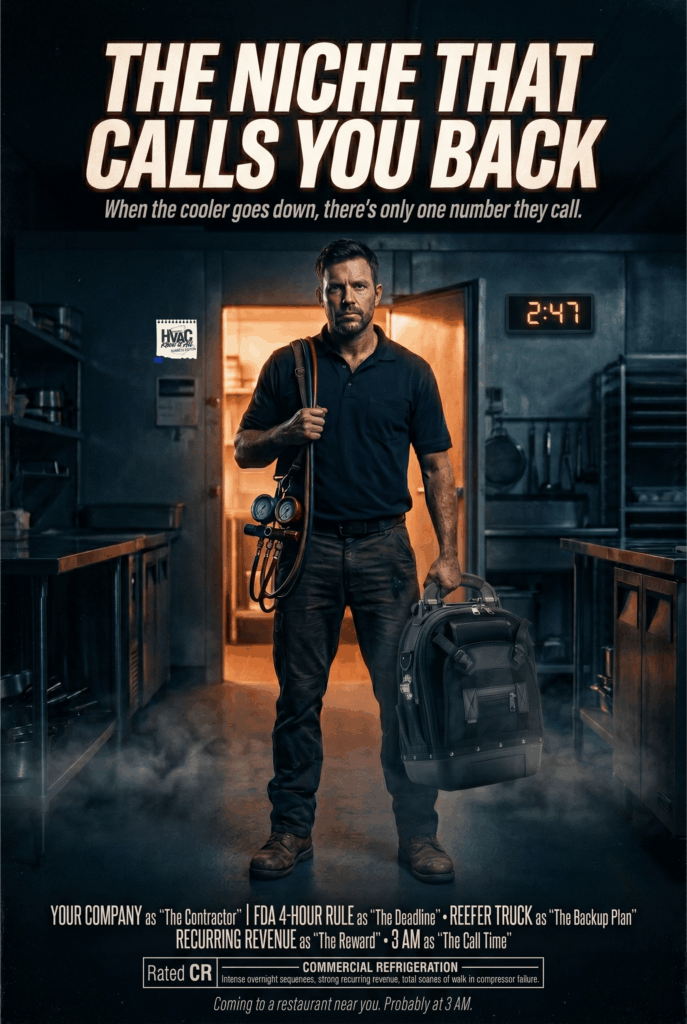
When a restaurant’s walk-in goes down, the owner is not weighing three quotes. They are calling the company they trust, and they need someone there now. The FDA’s 4-hour rule reinforces this: food held between 41 and 135 degrees Fahrenheit for more than four hours must be discarded.⁸ For a restaurant sitting on $5,000 worth of inventory in a failing walk-in, those four hours are the entire decision window. Priority emergency SLAs in commercial refrigeration typically guarantee a 2-hour response.⁹
That urgency is what creates sticky revenue. The trust built through reliable emergency service leads directly to installation work. When the customer needs a new unit, they are not soliciting bids. They are calling the company that showed up at 2 AM and saved their inventory.
Being a solution provider matters here more than in residential. When parts are not available overnight, knowing where to source a temporary backup makes a contractor worth far more than the hourly rate on the invoice. The difference between charging correctly for emergency work and absorbing losses on underpriced service calls is often the difference between building a sustainable commercial practice and burning out.
The trade-off is lifestyle. Commercial refrigeration means 3 AM calls, holiday emergencies, and the pressure of knowing every hour of downtime costs the customer real money. Gary posed the question directly: do you want a relaxed-pace business, or a fast-paced business with critical environments that gets you out of bed at 3 AM? Blair would take the critical environments every time. The relationships are stickier, the revenue is more predictable, and the work is more technically demanding.
Managing People, Not Positions
Blair’s management approach was simple to state and difficult to execute: his job was to serve his employees, and their job was to serve the customers. TDIndustries in Dallas was built on the same servant leadership framework and has been ranked the number-one plumbing and HVAC contractor for six consecutive years.¹⁰
The challenge every technician-turned-owner faces is that there is no management apprenticeship. You were trained to diagnose compressor failures, not navigate a conversation with a tech who is thinking about quitting. Building culture before buying software was the pattern at Kensington, and it is the pattern at most shops that retain people.
At the 5-to-25 person stage, every employee has specific motivations, specific frustrations, and a specific definition of what “being valued” means. One tech wants technical challenge. Another wants schedule flexibility for family. A third wants a clear path to lead. Blanket policies do not address any of that. Keeping people is a cash flow issue as much as a culture one. Every tech who walks out takes institutional knowledge and months of replacement cost with them.
The most interesting part of Blair’s approach was how he built the training program. He described himself as the least important voice in the process. Instead of designing curriculum from the top down, he asked five-year techs what they would want if they were starting now. Even high school apprentices got an equal voice. The result was a program that reflected what new technicians actually needed, and a culture where people felt like they were engaging in the business rather than just clocking in.
Gary reinforced this with his own practice: one-on-ones every couple of weeks. Not performance reviews. Conversations. How are you doing? How is the family? Anything I can do? That kind of consistent, personal check-in costs nothing. In an industry where technicians are choosing employers based on whether the boss actually sees them as people, it is the simplest competitive advantage you can build.
Additional Sources
- “Statistics on the Value of Employee Training and Development”, Shift E-Learning Blog, Research Summary, 2025.
- “HVAC Enrollment at Two-Year Colleges Up 18.7%”, HomePros News, Article, 2025.
- “Skilled Trades Initiatives Expand as Demand for Workers Is Projected to Grow”, Facilities Dive, Article, 2025.
- “Apprenticeship Programs Benefit HVACR Contractors and the Industry”, ACCA HVAC Blog, Article, 2025.
- “Work Opportunity Tax Credit”, Internal Revenue Service, Federal Program, 2025.
- “TECH Clean California”, Switch Is On / California Energy Commission, Program, 2026.
- “Commercial Refrigeration Equipment Market Analysis”, Grand View Research, Industry Report, 2025.
- “Danger Zone (40 Degrees F to 140 Degrees F)”, USDA Food Safety and Inspection Service, Federal Guidance, 2025.
- “Commercial Refrigeration Emergency Services”, Icebox Mobile Refrigeration, Industry Guide, 2025.
- “Contractor of the Year: TDIndustries”, PHC Pros, Award Profile, 2025.
Whether you require installation, repair, or maintenance, our technicians will assist you with top-quality service at any time of the day or night. Take comfort in knowing your indoor air quality is the best it can be with MOE heating & cooling services Ontario's solution for heating, air conditioning, and ventilation that’s cooler than the rest.
Contact us to schedule a visit. Our qualified team of technicians, are always ready to help you and guide you for heating and cooling issues. Weather you want to replace an old furnace or install a brand new air conditioner, we are here to help you. Our main office is at Kitchener but we can service most of Ontario's cities
Source link