Key Takeaways
- Private equity now drives the majority of HVAC M&A: PE closed over half of all HVAC deals in H1 2025, with add-on acquisitions jumping 88% year-over-year.¹ If you have not seen an acquisition in your market yet, you will.
- The first 90 days look great on the outside: New trucks, rebranding, optimistic press releases. Behind the scenes: management audits, cost center reviews, and the first quiet departures of experienced staff.
- By month 12-18, the talent bleed accelerates: The best technicians leave first because they have options. Callback rates rise. Institutional knowledge walks out the door and does not come back.
- Position yourself as the employer those departing techs want to join: Field credibility, healthy culture, and a real hiring pipeline are the three things that make displaced technicians choose your shop over the next PE platform.
Every contractor knows what it looks like from the outside when a competitor gets acquired. New trucks. Logo change. A press release about “investment in growth and technology.” The question nobody asks publicly: what happens to the company that got bought? What happens to the people working there? And what does it mean for your hiring pipeline when their best technicians start looking?
The answer is a predictable timeline, backed by acquisition data and exit patterns from the trades.
The First 90 Days: Rebranding and Reassurance
New trucks arrive. The logo changes. Uniforms get updated. Customer-facing messaging is optimistic: “Nothing will change. You are now part of a bigger family.”
Behind the scenes, three things happen simultaneously.
First, a management audit. Every position is questioned. Does that dispatcher need to exist? Is the service manager critical? Is there redundancy in the office? The spreadsheet analysis begins.
Second, a cost center review. Every line item is benchmarked against the PE firm’s other portfolio companies. Compensation packages are compared. Profitability per technician is calculated. The question in every meeting: how do we move faster and spend less?
Third, the first departures. These are usually senior technicians or managers who have networks elsewhere and recognize the operating philosophy shifting. They are not fired. They see the shape of things and choose to leave. The 20-year service manager who built the customer base notices the questions about “redundancy.” The lead tech who trained every apprentice watches the new ownership evaluate his position against a spreadsheet benchmark from a portfolio company in a different state. These people have options and they know it.
Customers do not notice at this stage. Service quality is typically still strong. But internally, the organization is recalibrating around metrics instead of relationships.
Month 6-12: The Optimization Phase
By month six, the new platform has installed KPI dashboards. Every technician is tracked by response time, first-call-fix rate, average ticket value, and customer satisfaction score. These metrics are real and sometimes valuable. They also mechanically reduce the technician from a problem-solver to a task-completer.
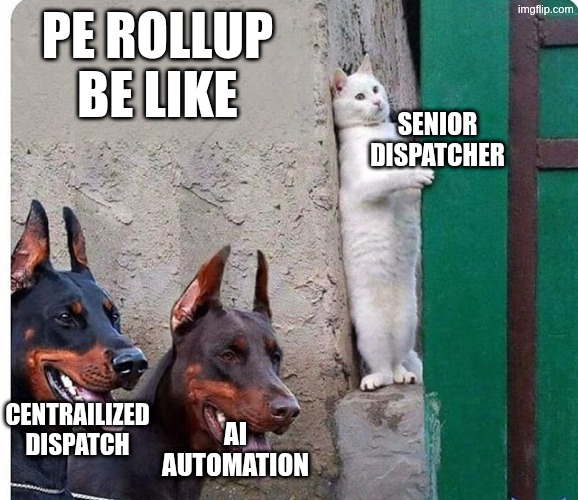
The dispatch function centralizes. Regional decisions about scheduling and routing move to a central hub, often hundreds of miles away. The dispatcher who knew that one customer preferred morning calls, or that a particular technician had a gift for high-touch commercial accounts, is replaced by an algorithm.
Service managers who came up through the field are replaced by operations people who have never held a wrench. Callbacks increase because replacement managers make decisions based on dashboard data, not field intelligence.
This is when the second wave of departures begins. Companies investing in top-quarter training see 218% higher income per employee.² The opposite is happening in the acquisition: training budgets are scrutinized, professional development is optional. The implicit message: we bought you to work the job, not to become better at the job.
Experienced technicians begin interviewing elsewhere. This is still quiet. It has not blown up. But the erosion has started.
Month 12-18: The Talent Bleed
The best technicians leave first. This is not opinion. This is what happens in every industry where skilled labor has options. The ones who stay are locked into non-competes, have family obligations, or have lower risk tolerance.
The problem accelerates exponentially. When the best tech leaves, it does not just remove one person from the schedule. It removes 15 years of relationships, troubleshooting intuition, and the institutional knowledge about which customer has the finicky system that requires a manufacturer call. It removes the person who trained the last three hires. It removes the reputation that kept customers from even considering another contractor. Replacing that with a job board posting and a two-week ride-along is not a plan. It is a slow-motion collapse.
Callback rates increase. Customer satisfaction falls. The platform now faces a quality crisis that cannot be solved by more KPIs. How you leave matters more than when you leave, and the departing techs know it.
HVAC enrollment at two-year colleges surged 29% in a single year.³ The labor market for technicians is tight. The acquisition was supposed to scale quickly. Instead, it is hemorrhaging experience and fighting to backfill.
Month 18-24: The Reckoning
Either the platform stabilizes and learns to operate differently, or the math stops working.
Renovo Home Partners, backed by Audax PE, promised to be the national platform for home services. They acquired dozens of regional contractors. The model required scale to work. When the scale did not come, the structure did not hold. The company collapsed with over $100 million in liabilities, leaving approximately 1,500 workers out of jobs.⁴ This was not negligence. It was a math problem that turned unsolvable.
Eighty-two percent of business failures trace to cash flow problems, not lack of effort.⁵ When an acquisition loses its best technicians and service quality declines, the cash flow problem follows. The company that seemed stable at month three is fighting for survival at month 18.
The PE firm faces a decision: reinvest and rebuild, or accelerate the exit. Typical hold periods range from 4 to 6 years, but pressure to show returns often compresses the timeline.⁶ When the math does not work at year three, the firm does not wait until year six to find out if things improve. The company gets sold again, stripped of remaining assets, or merged into another platform in worse shape. The technicians who stayed hoping things would stabilize find themselves working for a third owner in four years. Most do not wait to find out who the fourth will be.
What This Means for You: The Hiring Opportunity
When a competitor in your market gets acquired, the clock starts ticking.
Within 12 to 18 months, their best technicians will be available. Not fired. Not forced out. Available because they want to work somewhere that respects what they built and how they work.
The best HVAC business owners started in the field. They understand what a technician needs: autonomy, skill development, and the knowledge that their experience is actually being used. They did not start by building KPI dashboards. They started by building crews that trusted them.
To stop turning wrenches and grow your business, you need people willing to follow you into scale. When the acquisition happens down the street, your recruiting message is simple: we invest in what makes technicians better at their craft, and we do not need an algorithm to tell us you are valuable.
Building culture before buying software becomes your competitive advantage. Trade schools, commercial refrigeration, and managing real people all point to the same reality: field credibility and respect for the craft are what make departing techs choose your shop.
The competitor you are watching get acquired is working through a 24-month education on what you already know.
Additional Sources
¹ Capstone Partners. (2025). HVAC M&A Market Report H1 2025.
² ATD/Shift E-Learning. (2024). Training ROI and Income Per Employee Study.
³ HomePros News. (2024). Trade School Enrollment Trends.
⁴ Qualified Remodeler. (2023). Renovo Home Partners Collapse and Industry Impact.
⁵ US Bank/SCORE. (2023). Small Business Failure Analysis.
⁶ ACHR News. (2024). Private Equity Hold Periods in HVAC.
Whether you require installation, repair, or maintenance, our technicians will assist you with top-quality service at any time of the day or night. Take comfort in knowing your indoor air quality is the best it can be with MOE heating & cooling services Ontario's solution for heating, air conditioning, and ventilation that’s cooler than the rest.
Contact us to schedule a visit. Our qualified team of technicians, are always ready to help you and guide you for heating and cooling issues. Weather you want to replace an old furnace or install a brand new air conditioner, we are here to help you. Our main office is at Kitchener but we can service most of Ontario's cities
Source link