
What is a ductless HVAC system and how does it work?
What is a ductless HVAC system and how does it work is one of the most common questions homeowners ask when exploring alternatives to traditional central air — and for good reason. If your home lacks ductwork, has a new addition, or you’re simply tired of uneven temperatures from room to room, a ductless system might be exactly what you’ve been looking for.
Quick Answer: What Is a Ductless HVAC System and How Does It Work?
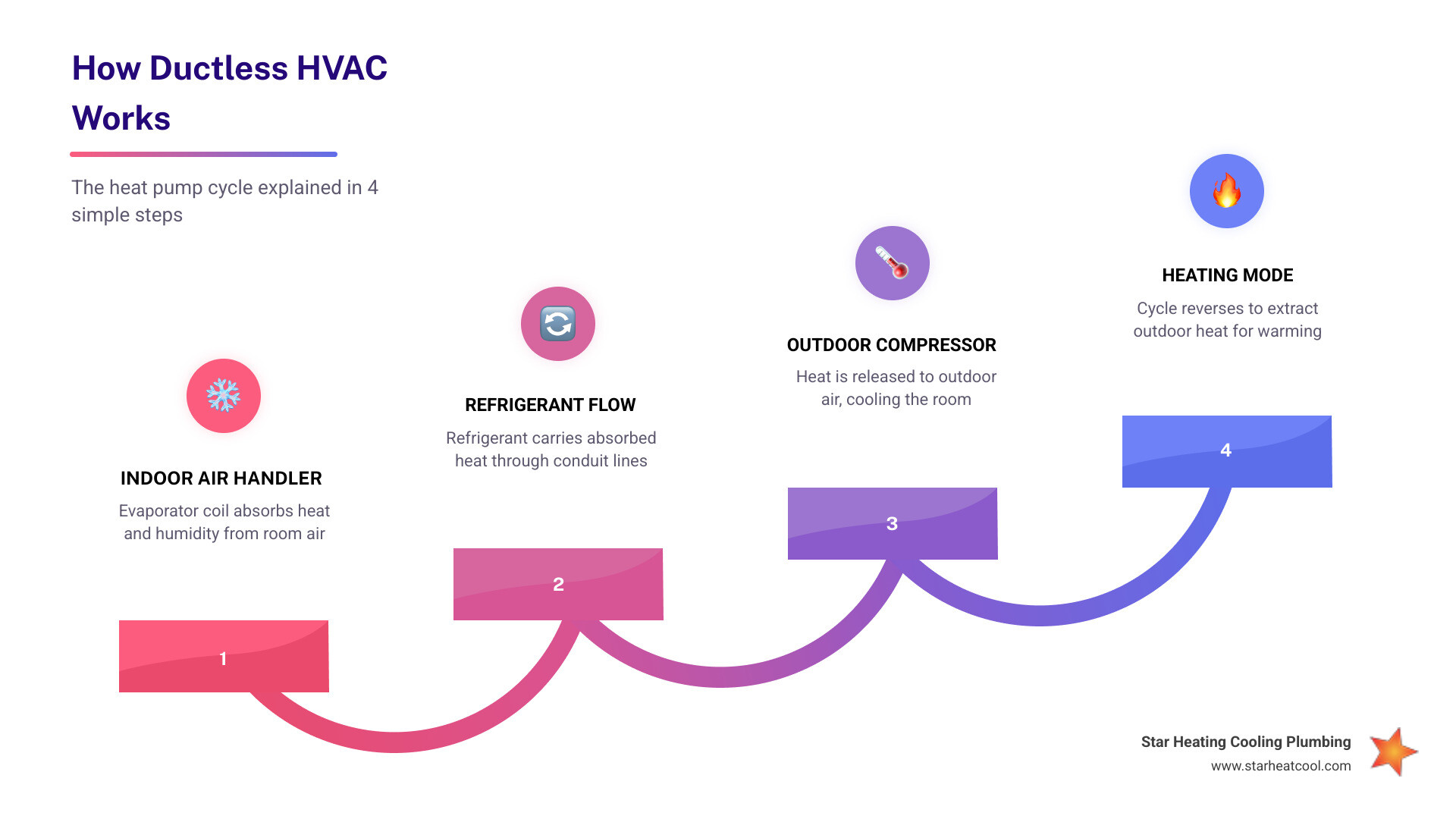
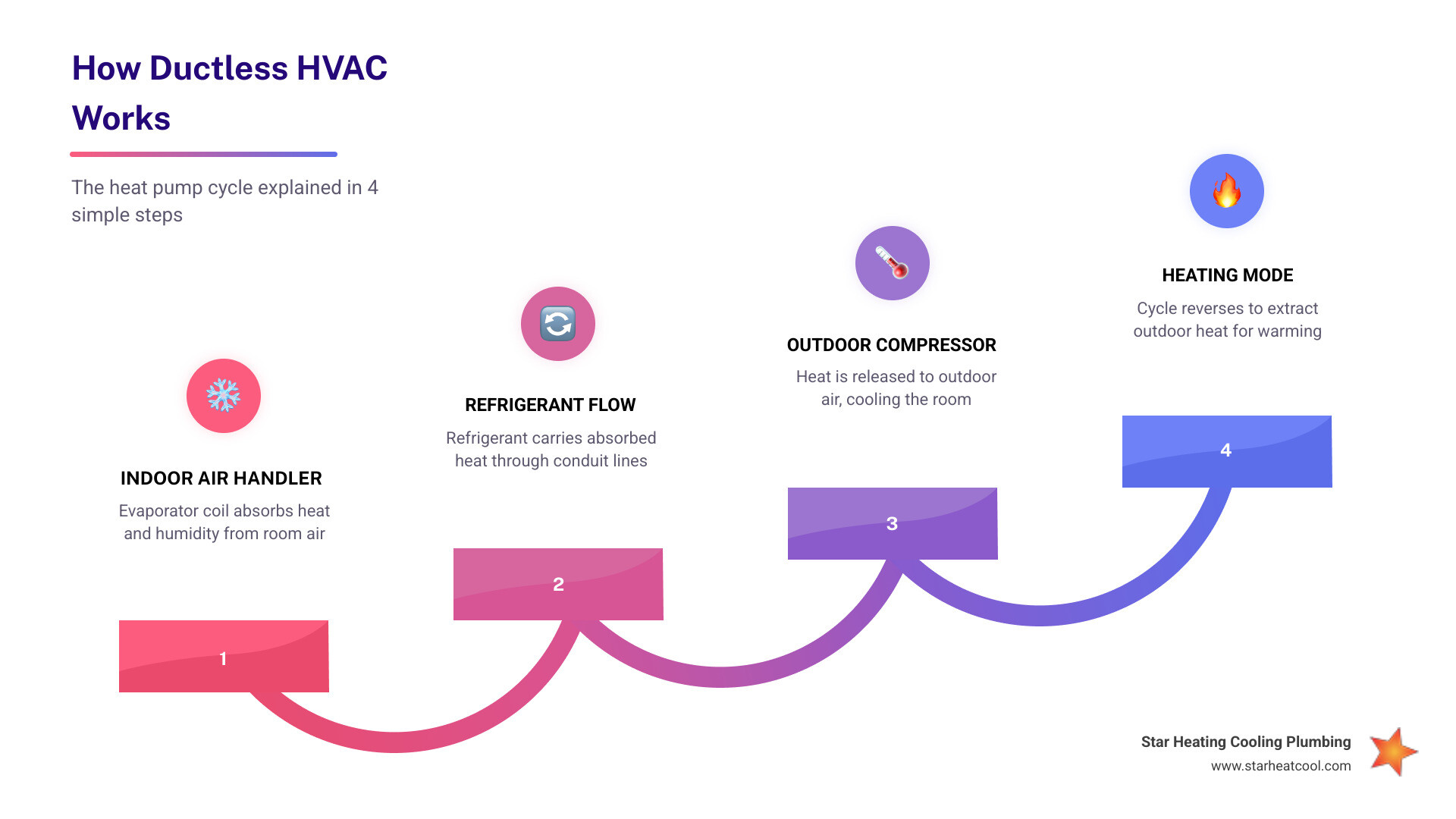
A ductless HVAC system (also called a mini-split) heats and cools your home without any ductwork. Here’s how it works in simple terms:
- An outdoor compressor unit pumps refrigerant through a small conduit to one or more indoor air handlers.
- The indoor unit absorbs heat and humidity from the room air using an evaporator coil.
- The refrigerant carries that heat to the outdoor unit, where it is released outside — leaving your room cooler.
- For heating, the process reverses — the system pulls heat energy from outside air and transfers it indoors.
- Each indoor unit can be controlled independently, giving you room-by-room temperature control without a single duct in the wall.
No ducts. No major renovation. Just precise, efficient comfort delivered directly where you need it.
More than 1.75 million American homes already use ductless systems — and the technology has come a long way since Mitsubishi first introduced it in Japan in 1959. Today, ductless mini-splits are recognized for eliminating the 20–30% energy loss that plagues traditional ducted systems, making them one of the smartest upgrades a homeowner can make in 2026.
Whether you’re dealing with a room that never seems to cool down, an older home without existing ductwork, or you simply want more control over your energy bills, understanding how ductless technology works is the first step toward making an informed decision.
I’m Jeff Rich II, Operations Leader at Star Heating, Cooling & Plumbing, and I’ve spent years helping Indiana homeowners navigate questions about what is a ductless HVAC system and how does it work — drawing on a lifetime in the trades that started on job sites with my father and uncle. Let me walk you through everything you need to know.
At its core, a ductless HVAC system is a split system, meaning it has components both inside and outside the home. However, unlike a traditional furnace and AC setup that relies on a massive network of metal ducts to blow air through your attic or crawlspace, a ductless system delivers conditioned air directly into the room.
To understand what is a ductless mini-split and how does it work?, you have to look at the “conduit.” This is a small bundle—usually requiring only a three-inch hole in the wall—that houses the power cable, refrigerant tubing, suction tubing, and a condensate drain line. This conduit links the indoor air handler to the outdoor compressor.
By going ductless, you eliminate the “middleman” of ductwork. In a traditional system, air travels through long spans of ducts where it often picks up dust or loses its temperature. In a ductless setup, the heat transfer happens right there in the room you are standing in. This makes the system incredibly responsive and efficient.
What is a ductless HVAC system and how does it work for cooling?
When you set your remote to “cool” on a hot July afternoon in Fishers, the indoor unit’s fan begins to pull warm air from the room. This air passes over evaporator coils filled with cold refrigerant.
The refrigerant absorbs the heat from your indoor air, causing the liquid refrigerant to turn into a gas. As this happens, moisture in the air condenses on the cold coils and is funneled away through the drain line, effectively dehumidifying the space. The now-cooled air is blown back into the room. Meanwhile, the heat-laden refrigerant gas travels through the conduit to the outdoor unit, where the compressor squeezes it, releases the heat to the outside air, and turns it back into a liquid to start the cycle again. This is why ductless ACs improve indoor air quality and control humidity so effectively—they are focused entirely on the environment of a single “zone.”
What is a ductless HVAC system and how does it work for heating?
One of the most impressive features of modern ductless technology in 2026 is its ability to provide year-round comfort. Most mini-splits are actually reversible heat pumps.
In the winter, the system essentially runs in reverse. Even when it feels cold outside, there is still heat energy present in the air. The outdoor unit extracts this heat energy and uses the refrigerant to “pump” it into your home. Modern systems are engineered for high-performance winter operation; many units can now provide reliable heat even when outdoor temperatures drop well below freezing, with some high-end models rated to function at -13°F. It is an incredibly energy-efficient way to warm a space because you aren’t creating heat (like an electric baseboard heater does); you are simply moving it.
The Essential Components of a Mini-Split System
When we come out to your home for ductless systems Fishers IN, we usually look at three primary components:
- The Outdoor Unit (Compressor/Condenser): This is the “engine” of the system. It sits outside on a pad or is mounted to the side of the house. It’s remarkably quiet—often operating at about 46 decibels, which is the volume of a normal conversation.
- The Indoor Air-Handling Unit: This is what you see on your wall or ceiling. It contains the fan and the evaporator coil.
- The Conduit: As mentioned, this is the umbilical cord of the system, connecting the indoor and outdoor portions through a small, unobtrusive hole.
Single-zone vs. multi-zone configurations
One of the best things about ductless technology is its scalability. We can design a system that fits your specific floor plan:
- Single-Zone: This is perfect for a home addition, a garage workshop, or a sunroom. One outdoor unit connects to exactly one indoor air handler.
- Multi-Zone: If you want to condition your entire home, a multi-zone system is the answer. One powerful outdoor compressor can often support up to eight indoor units. This allows for total “room-by-room” control.
You also have choices in how those indoor units look. While the high-wall unit is the most popular, you can also opt for ceiling cassettes (which are recessed and nearly flush with the ceiling), floor-mounted units (great for rooms with slanted ceilings or large windows), or even slim ducted units that stay hidden behind a wall or in a closet.
Key Benefits of Switching to Ductless Technology
The most significant advantage of ductless systems is their extreme energy efficiency. Research shows that 20% to 30% of the energy used to heat or cool a home is lost through leaks, cracks, and poor insulation in traditional ductwork. Because ductless systems don’t use ducts, that loss is instantly eliminated.
Furthermore, ductless systems use inverter technology. While a traditional furnace or AC is either “all on” or “all off” (which wastes a lot of energy during startup), a ductless compressor can ramp up or down like a dimmer switch. It maintains a steady temperature by running at lower speeds, which can reduce energy consumption by up to 40% compared to conventional systems.
Other top advantages include:
- Personalized Zoning: Stop arguing over the thermostat. You can set the master bedroom to 68 degrees while the guest room stays at 72.
- Quiet Operation: Without the “whoosh” and “clatter” of air rushing through metal ducts, these systems are whisper-quiet.
- Flexible Installation: We don’t have to tear up your walls or drop your ceilings to install them.
Improving indoor air quality in Fishers homes
Ductless systems are a breath of fresh air—literally. Traditional ducts are notorious for collecting dust, pet dander, and even mold over time. Every time the heat kicks on, those particles are blown into your living space.
With a ductless system, the air is filtered right at the source. Most units feature multi-stage filtration, including washable filters that trap large particles and specialized filters that can catch microscopic allergens. Because ductless ACs improve indoor air quality and control humidity, they are an excellent choice for allergy sufferers in the Indianapolis area.
Comparing Ductless Systems to Traditional Central Air
| Feature | Ductless Mini-Split | Traditional Central Air |
|---|---|---|
| Installation | Fast (usually 1 day) | Complex (requires ductwork) |
| Efficiency | Very High (No duct loss) | Moderate (20-30% loss) |
| Zoning | Built-in (Room by room) | Difficult/Expensive |
| Maintenance | Easy (Washable filters) | Requires duct cleaning |
| Aesthetics | Visible indoor units | Hidden (vents only) |
Ductless systems are often the “problem solvers” of the HVAC world. They are the ideal choice for retrofitting older homes in places like Noblesville or Zionsville that were built before central air was standard. They are also the go-to for home additions, finished basements, or “man caves” in the garage where extending the main ductwork would be too expensive or physically impossible.
Why ductless is the efficient choice in 2026
As we move through 2026, energy standards are stricter than ever. Ductless systems consistently earn high SEER2 (Seasonal Energy Efficiency Ratio) and HSPF2 (Heating Seasonal Performance Factor) ratings. Many models are ENERGY STAR certified, meaning they use up to 60% less energy than standard room AC units. By choosing a ductless system, you aren’t just saving money on your monthly bills; you’re significantly reducing your home’s carbon footprint.
Professional Installation and Maintenance for Longevity
While you might see “DIY” mini-split kits online, we strongly advise against them. A Fishers IN ductless mini-split installation Star requires handling pressurized refrigerants and complex electrical work.
More importantly, a professional ensures the system is sized correctly. We perform a “load calculation” to determine the exact BTU capacity your room needs. If a unit is too small, it will run constantly and wear out early. If it’s too large, it will “short cycle,” turning on and off so fast that it never properly removes humidity. Getting the size right is the key to a system that lasts 15 to 20 years.
Keeping your system running efficiently
Ductless systems are low-maintenance, but they aren’t “no-maintenance.” To keep your system in peak condition, you should:
- Clean the filters monthly: Most mini-splits have washable filters. Just pop them out, rinse them in the sink, let them dry, and put them back.
- Clear the outdoor unit: Ensure leaves, snow, or debris aren’t crowding the compressor.
- Schedule annual service: We recommend a professional ductless mini-split tune-up services in Fishers IN Star once a year. We check refrigerant levels, inspect the coils, and ensure the condensate drain is clear. If your system requires attention, our team provides ductless mini-split repair services in Fishers IN Star to restore your home’s comfort.
Frequently Asked Questions
Can a ductless system replace my furnace?
Yes, in many cases! Modern ductless heat pump technology is powerful enough to serve as a primary heat source for many homes. However, in our Indiana climate, some homeowners choose to use ductless as supplemental heating for “cold spots” while keeping their furnace, or they opt for “hyper-heat” models designed specifically for extreme cold.
How many indoor units can I have?
With a multi-zone outdoor compressor, you can typically connect up to eight indoor units. This allows you to create a custom comfort plan for every bedroom, the kitchen, and the living room, all controlled independently.
Are ductless units difficult to maintain?
Not at all. The primary task for homeowners is cleaning the washable filters every 1–3 months. Beyond that, a quick annual check by a professional is all it takes to keep the system running efficiently for two decades.
Conclusion
At Star Heating, Cooling & Plumbing, we’ve been a part of the Fishers community since 1987. As a family-owned, Carrier Factory Authorized Dealer, we take pride in our transparency and our commitment to doing the job right the first time. Our licensed technicians aren’t just there to fix a machine; they’re there to ensure your family stays comfortable in every season.
If you’re still wondering about what is a ductless HVAC system and how does it work for your specific home layout, we’d love to help. Whether you are in Carmel, Greenfield, or right here in Fishers, we can help you design a system that fits your life. Ready to experience the quiet, efficient comfort of a mini-split? Reach out to us for your ductless service installation Fishers IN and let’s get started.
Whether you require installation, repair, or maintenance, our technicians will assist you with top-quality service at any time of the day or night. Take comfort in knowing your indoor air quality is the best it can be with MOE heating & cooling services Ontario's solution for heating, air conditioning, and ventilation that’s cooler than the rest.
Contact us to schedule a visit. Our qualified team of technicians, are always ready to help you and guide you for heating and cooling issues. Weather you want to replace an old furnace or install a brand new air conditioner, we are here to help you. Our main office is at Kitchener but we can service most of Ontario's cities
Source link