The Short Answer: A family-owned HVAC company recommends the best rated residential HVAC systems for your house rather than the ones a corporate sales quota favors. The difference shows up in honest sizing, brand-agnostic advice, and technicians who treat your family like their own.
Central Florida has a lot of HVAC companies. Many are owned by private equity groups that bought up local names and kept the logo on the truck but aren’t tied down to the area by loyalty. That matters when you are spending thousands on a system meant to last 15 years. Below is how to read equipment ratings, what separates a family-run shop from a sales operation, and the questions worth asking before anyone quotes you a number.
What “Best Rated” Actually Means
Ratings are useful once you know what they measure. Three numbers do most of the work.
SEER ratings and energy use
SEER stands for seasonal energy efficiency ratio. It measures air conditioning output against energy consumption across a full season. A higher SEER rating means lower energy costs to cool the same house.
Since 2023, the U.S. Department of Energy rates systems using SEER2, a testing method that better reflects real ductwork. Florida sits in the Southeast region, which carries a higher minimum than northern states because our systems run so much longer.
Higher efficiency costs more upfront. In a climate like ours, the energy savings usually justify it. Our guide to SEER ratings walks through where the payback lands.
MERV ratings and air quality
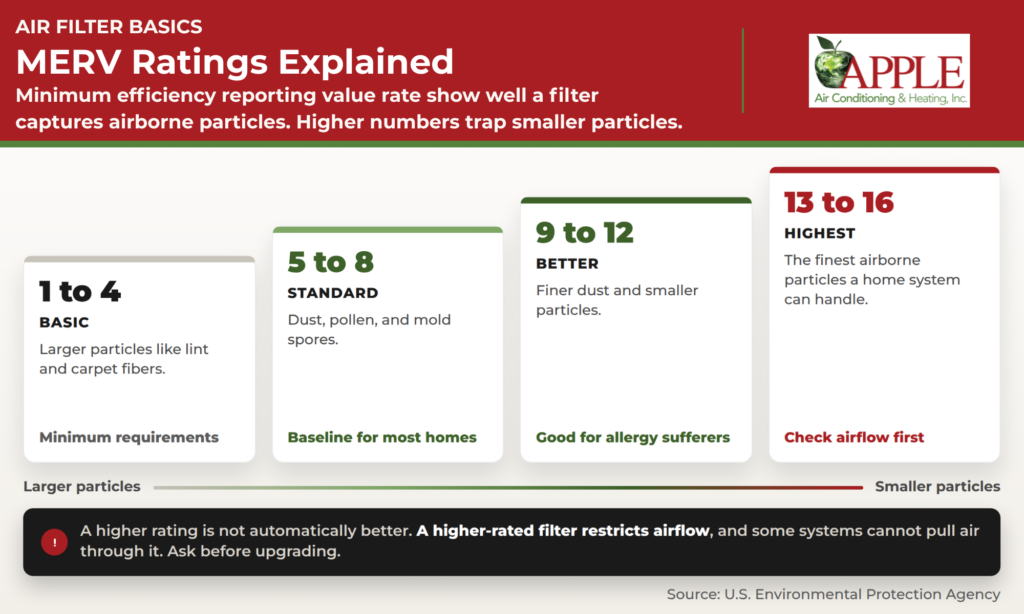
MERV stands for minimum efficiency reporting value. It rates how well an air filter captures airborne particles. The EPA notes that MERV measures capture of particles between 0.3 and 10 microns, and higher numbers trap smaller particles.
A higher MERV rating is not automatically better. A higher-rated filter restricts airflow, and some systems cannot pull air through it. Ask before upgrading.
Variable-speed technology
Older systems run at one speed. They blast cold air, hit the setting, and shut off. A variable-speed compressor runs at a lower speed for longer periods instead, which gives steadier temperatures, better humidity control, and lower energy consumption.
In Florida, the humidity control matters as much as the cooling. Longer run times at low speed pull far more moisture out of the air.
Variable-speed technology costs more than a single-stage unit. In a house that runs its cooling system nine months a year, the quieter operation and steadier humidity are usually worth it. In a small condo, they may not be.
Ratings Do Not Survive a Bad Install
A 20 SEER system installed wrong performs worse than a 15 SEER system installed right. Sizing is the first place installs go wrong. An oversized unit short-cycles, never runs long enough to dehumidify, and wears out early. Proper sizing accounts for square footage, ceiling height, window exposure, insulation, and existing ductwork.
- Ductwork gets inspected, since leaky ducts waste conditioned air before it reaches the room
- Refrigerant charge gets verified, because an undercharged system loses efficiency immediately
- Airflow gets measured, not assumed
- The old system’s failure gets diagnosed, so the same problem does not repeat
Our installation guide covers the process, and what to expect on install day explains the timeline.
How a Family-Owned Shop Recommends Equipment
Here is the practical difference. A company on a quota sells the system with the best margin that month. A family-owned company has to see you at the grocery store.
Apple AC recommends Carrier and Daikin based on engineering, warranty support, and parts availability. Our NATE-certified technicians are trained to install and service every major brand on the market, so the recommendation is never tied to what we happen to stock that month.
Being brand-agnostic means the honest answer is sometimes the cheaper one. A 3,000 square foot home with good insulation may not need the top-tier system. Our take on why HVAC pricing varies covers what actually drives a quote.
Matching the System Type to the Home
Not every house wants the same equipment. Three options cover most residential homes here.
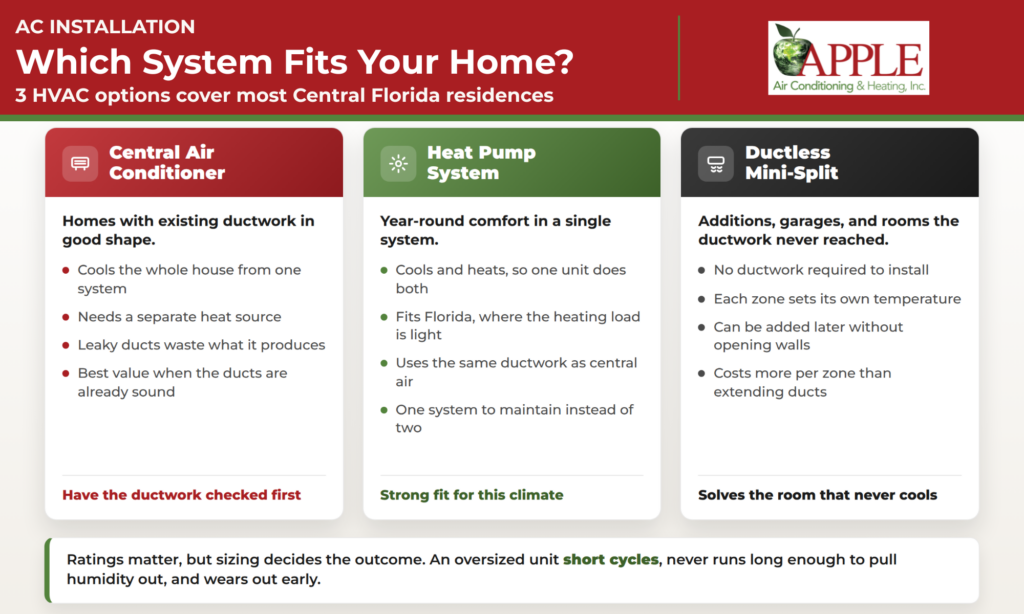
A central air conditioner is the default when the ductwork is already in good shape. A heat pump makes sense in Central Florida because our heating load is light. Mini-split systems solve the room that never gets cool, and they can be added later without touching the rest of the house. Our residential HVAC team will tell you which one fits, and we handle new construction and commercial buildings too.
What Florida Weather Does to Equipment
A system here works under conditions most of the country never sees. Nine months of cooling load, daily afternoon storms, and salt air near the coast.
- Extreme weather conditions during hurricane season bring power surges that damage compressors and control boards
- Sustained heat keeps systems running through the hottest part of the day for months
- Standing humidity loads the coil and the drain line far harder than a dry climate does
Equipment rated for average use gets tested under extreme conditions here, and we answer emergency calls around the clock when it fails. That is part of why we recommend the brands we do and why replacement timing matters more in this market. We have worked on Central Florida homes since 1997.
Indoor Air Quality Is Part of the System
A high-efficiency cooling system moves a lot of air. What that air carries through your house matters, especially with children or allergy sufferers at home.
Beyond a good air filter, whole-home options handle what filters miss:
- REME HALO whole-home air purifier, which treats air in the ductwork rather than one room
- Blue-Tube UV systems, which keep coils and drain pans clear of mold
- Humidity control, since Florida air carries moisture that filters do nothing about
Volatile organic compounds from paint, cleaners, and new furniture pass straight through a standard filter. Our indoor air quality products address the gap, and why air quality matters explains the health side.
What to Look For in Any HVAC Company
Start with the technician rather than the company name. NATE certification is a national standard that has to be earned and renewed, and it belongs to the person doing the work, so ask who is actually being sent to your house. You should also know who is knocking before they knock. Apple AC runs background checks on every technician, sends a text with the arriving technician’s name and photo, and puts everyone in a uniform with an ID badge.
Then read the warranty closely, because parts and labor are different things and plenty of quotes cover one without the other. Approved Apple AC installations carry a 10-year parts and labor warranty. Any company should be willing to put its terms on paper before you sign.
Look for a company with something at stake in the area. Apple AC has been run by the same family since 1997, with three generations in this trade and a team that lives in the same towns it serves. We build homes with Habitat for Humanity and help train the next wave of technicians through Orange Technical College, because the trade has to keep going after us. When we run a service call, it is usually a few streets from where a member of our team grew up.
Long-Term Reliability Comes From Maintenance
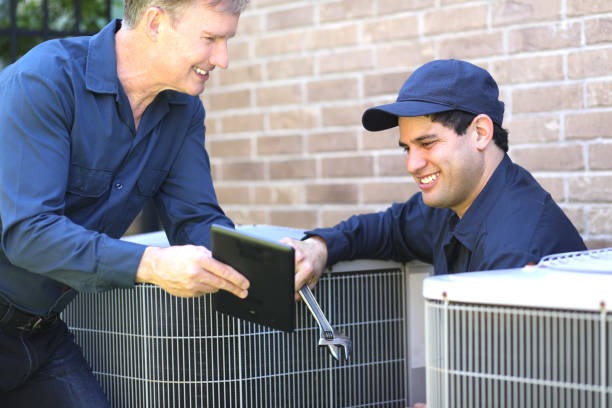
The best rated residential HVAC systems still fail early without proper maintenance. Regular maintenance protects the warranty, holds the efficiency rating you paid for, and catches small problems first.
- Change the air filter every 90 days, sooner with pets
- Book a tune-up before each cooling season
- Keep the outdoor unit clear by two feet
- Use a smart thermostat and hold steady settings
- Have ductwork checked every few years
A service agreement keeps visits on the calendar, our maintenance checklist covers the efficiency habits you can handle yourself, and our service team handles the rest.
Choosing a Company You Can Call Back
Equipment ratings tell you what a system can do in a lab. The company installing it decides what it does in your house. Look for honest sizing, brand-agnostic recommendations, certified technicians, written warranty terms, and a name that will still be answering the phone when something goes wrong.
Apple AC has been family owned since 1997, serving Orange, Lake, Seminole, Osceola, and Sumter counties. We treat your house the way we would a neighbor’s, because most of the time, it is one. Read what our neighbors say, or see why homeowners choose us.
Ready to talk about your system? Schedule service, request a free estimate on a new installation, or contact our team about financing and payment options.
Whether you require installation, repair, or maintenance, our technicians will assist you with top-quality service at any time of the day or night. Take comfort in knowing your indoor air quality is the best it can be with MOE heating & cooling services Ontario's solution for heating, air conditioning, and ventilation that’s cooler than the rest.
Contact us to schedule a visit. Our qualified team of technicians, are always ready to help you and guide you for heating and cooling issues. Weather you want to replace an old furnace or install a brand new air conditioner, we are here to help you. Our main office is at Kitchener but we can service most of Ontario's cities
Source link