
There is a very nuanced and misunderstood situation that plagues a lot of AHUs. It occurs in AHUs that utilize airflow tracking for control of their return fan and either intentionally or unintentionally operate in a fully recirculating configuration. This is the fifth article in a series written with the intent to explain the issue. The series provides several case studies for how I have seen the situation manifest and how a unique solution in each case was needed to rectify the issue.
The AHU recirculating mode death spiral occurs when the outdoor and relief air dampers are fully closed, the return damper is fully open, and the return fan is attempting to control to a return airflow setpoint. That setpoint is reset to maintain an offset from measured supply airflow. With the AHU in a fully recirculating damper configuration, that return airflow setpoint will never be tracked stably. The supply and return fans will begin to fight each other, and eventually it results in one fan at full speed, the other at minimum speed, and various other second-order effects impacting operation of the system. Refer to Part I for a more detailed explanation of the death spiral.
There are often scenarios where an AHU is intentionally put into such a fully recirculating configuration. Case Study 1 in the first part of this series described such a situation. There are also times when AHUs unintentionally find themselves in a damper configuration that allows the AHU recirculating mode death spiral to begin. Case Studies 2 through 4 provided examples of this.
Case Study 5 below introduces us to a different hospital, whose AHUs were controlled in a manner that intentionally put them into the recirculating mode of operation in two situations. Additionally, the AHUs unintentionally found themselves in such a situation in a third scenario. Case Study 5 will discuss one of the scenarios, and the final two articles in this series will discuss the remaining two.
Case Study 5: Control Approach:
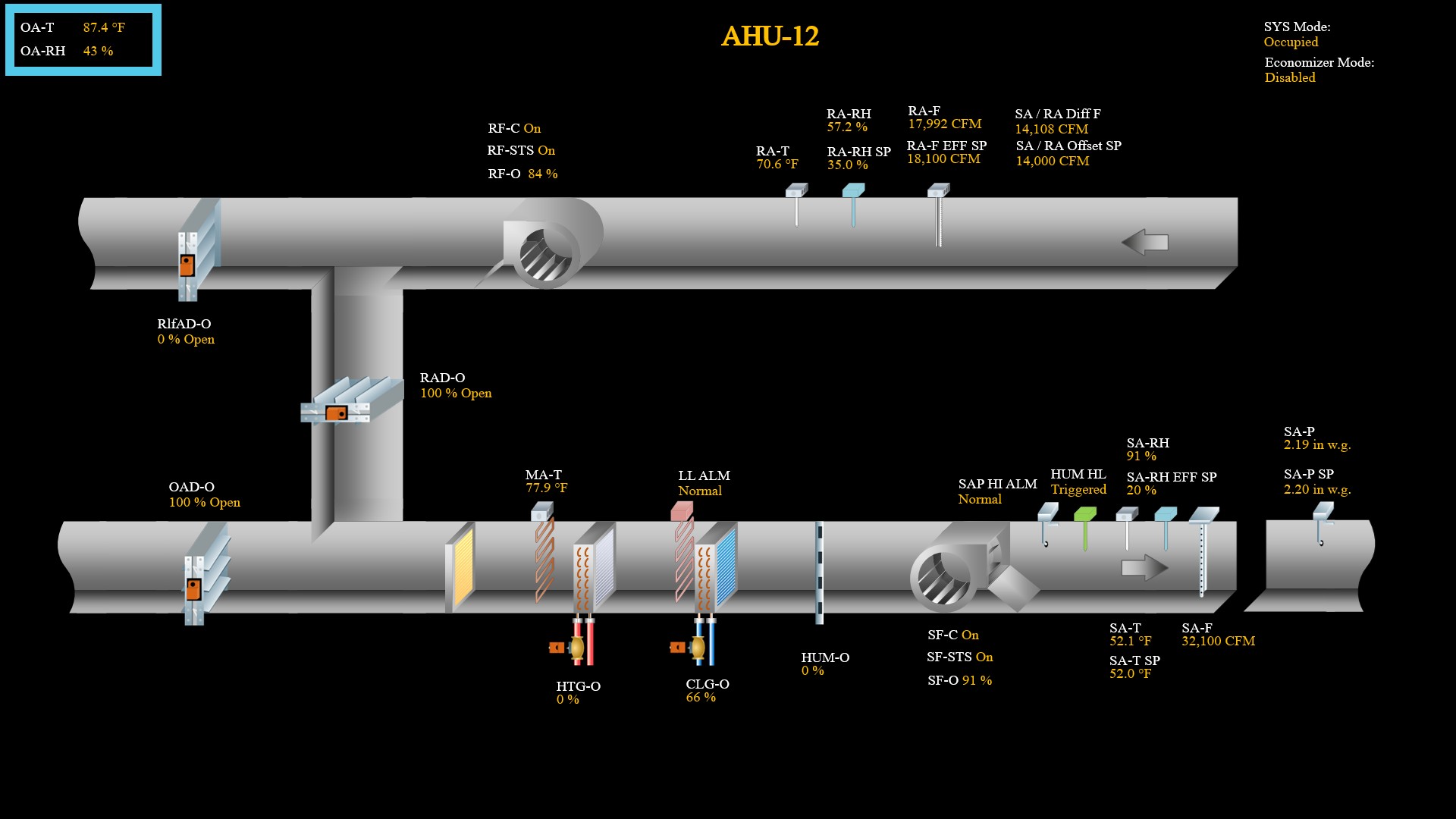
There were a variety of AHU sequences of operation for this particular building, but they all utilized the same approach for damper control. When operating in Occupied Mode, the AHUs were run with the outdoor air damper fully open. The return and relief air dampers modulated inversely to each other based on the output of the economizer control loop. For many of the AHUs, the return fan controlled to an airflow setpoint, which was a fixed offset less than measured supply airflow.
With this approach, if the economizer is disabled (during high ambient air temperatures) or bottomed out to a 0% output (during low ambient air temperatures), the return and outdoor air dampers would be fully open, the relief air damper would be fully closed, and the amount of outdoor airflow being brought in is essentially controlled by the return fan. See Figure 1. By conservation of mass, it can be seen that the airflow offset (SA / RA Offset SP) used to calculate the real-time return airflow setpoint (RA-F EFF SP) equals the amount of outdoor airflow being brought in, assuming the return fan is controlling well.
FIGURE 1: AHU operation with economizer disabled and return fan controlling for airflow directly. (Courtesy of Hawke Institute for Facility Systems)
This approach for damper control is only appropriate for spaces where the amount of outdoor air needed for pressurization requirements exceeds that needed to meet minimum ventilation code requirements, and I have only ever seen it implemented in healthcare facilities with a large quantity of dedicated exhaust air being pulled out of the space (which reduces the airflow needed to be pulled out by the return fan). When the economizer is active, higher quantities of outdoor air beyond the minimum outdoor airflow requirements (i.e., SA / RA Offset SP) would be brought into the system. See Figure 2.

FIGURE 2: AHU operation with economizer enabled and active, and return fan controlling for airflow directly. (Courtesy of Hawke Institute for Facility Systems)
This same approach for damper control was used for the few AHUs that actually controlled the return fan to a static pressure, while upstream return air valves dictated the flow rate of return air. See Figure 3. In this case, the supply air VAV boxes dictate the total supply airflow (SA-F), and the return air valves dictate the total return airflow (RA-F). It was the difference between the two flow rates (SA/RA Diff F) that dictated the minimum outdoor airflow.
The modes of operation shown in Figures 1, 2 and 3 are not susceptible to the AHU recirculating mode death spiral, since the outdoor air damper remained open. However, there were three instances where the outdoor air damper actually was closed, the AHU recirculating mode death spiral emerged, and chaos ensued. Below, I walk through the first such scenario.

FIGURE 3: AHU operation with economizer disabled and return fan controlling for static pressure. (Courtesy of Hawke Institute for Facility Systems)
Inappropriate Mixed Air Low Limit
A mixed air low limit control sequence was initially specified for several of the AHUs. Essentially, if the mixed air temperature dropped below 42°F, the sequence called for the outdoor air damper to fully close as a preemptive measure to protect the coils from freezing.
This sequence was not appropriate. Such a situation would prevent any outdoor air from being brought in, which would create a slew of issues beyond setting the stage for the AHU recirculating mode death spiral. Additionally, the preheat coils were fully expected to see such low mixed air temperatures during normal operations, and they were actually scheduled to handle -20°F entering air conditions to allow for the unit to be run with 100% outdoor air should a future pandemic occur. A recommendation to remove this mixed air low limit control sequence was brought to the design engineer well ahead of functional testing. He concurred, and it was removed.
Unfortunately, the change in sequence was not picked up by the temperature control contractor. Prior to functional testing of the AHU in question, I heard the construction team mentioning they could not keep a particular AHU running during cold ambient temperatures. They said they kept getting return air static safety switch trips. I asked if they had programmed the mixed air low limit sequence that was in the original construction documents, and they said “yes.”
This particular AHU had return valves, and its return fan controlled to static pressure, like the configuration shown in Figure 3. When the outdoor air damper closed as part of this inappropriate mixed air low limit sequence, the supply fan started pulling all its desired airflow through the return fan. This drops the return air static pressure. Initially, the return fan can compensate by slowing down, but it quickly bottoms out at minimum speed. Then the return air valves would start closing to bring their respective airflows back to their setpoints. It is at this point that the return air static pressure tanks and the return air static safety switch then triggers. This is identical to the situation detailed in Case Study 4 of this series.
I reminded the team that there was a change in the sequence to remove that mixed air low limit sequence. Once it was removed from the programming, they did not see the issue anymore.
Conclusion:
Mixed air low limit sequences have a place in some systems, but in my experience, they are almost always specified inappropriately. A future article will discuss this topic in depth.
In this particular scenario, an inappropriate mixed air low limit sequence cascaded into tripping a critical AHU offline because its return air static safety switch triggered. On the surface, that is very unintuitive, but that is the nature of the AHU recirculating mode death spiral. Making sense of the concept and all its many forms forces you to understand the interdependency of the various functions being performed by an AHU. By now, I hope it is blatantly clear that this phenomenon is happening all over the place, so it is not a topic we can afford to shy away from.
Whether you require installation, repair, or maintenance, our technicians will assist you with top-quality service at any time of the day or night. Take comfort in knowing your indoor air quality is the best it can be with MOE heating & cooling services Ontario's solution for heating, air conditioning, and ventilation that’s cooler than the rest.
Contact us to schedule a visit. Our qualified team of technicians, are always ready to help you and guide you for heating and cooling issues. Weather you want to replace an old furnace or install a brand new air conditioner, we are here to help you. Our main office is at Kitchener but we can service most of Ontario's cities
Source link

