Your furnace works harder in Indiana than in most parts of the country. From the first cold snap in October through the gray stretch of March, your heating system is running almost constantly, which means your furnace air filter is quietly doing its job around the clock. Knowing how often to change your furnace filter in winter is one of the simplest ways to protect your home this season.
The short answer: check it every month, replace it based on your filter type and household, and never let a busy week be an excuse to skip it. That last part is easy to manage: keep a couple of spare filters near the furnace so a filter change doesn’t require a trip to the hardware store.
How Often Should You Check Your Furnace Filter in Winter?
During Indiana’s heating season, plan to check your furnace filter once a month, no exceptions. Some filters will last the full month without needing a swap; others won’t make it three weeks, depending on your household. The check itself takes about 30 seconds and tells you everything you need to know.
Indiana winters run long. Temperatures drop well before Thanksgiving and don’t let up until March, which means your heating system logs far more run hours here than it would somewhere with a shorter winter. That extended workload is exactly why a monthly “check furnace filter” reminder makes sense: your filter earns its keep faster here.
Tip: Stock up on spare filters at the start of the season. When checking becomes replacing, you want that filter on hand, not on a to-do list.
Why Does Winter Put More Strain on Your Furnace Filter?
In warmer months, your HVAC runs occasionally. In winter, it’s essentially always on. Every time the system cycles, air gets pulled through the filter. And with windows sealed shut all season, the same air recirculates over and over. Dust, pet dander, cooking particles, and anything else floating around your home gets pushed through that filter again and again.
The result: filter life shortens significantly during cold weather. A filter that might last 90 days in spring can wear out in half that time during a hard Indiana winter.
A clogged filter doesn’t just mean dusty air. It restricts airflow to the point where your blower motor has to work harder to move warm air through the system. That extra effort shows up in higher energy bills and, over time, takes years off your furnace’s lifespan. It’s one of those problems that’s completely invisible until it isn’t.
Households with pets, multiple occupants, or recent renovations will see filters wear faster. Pet dander alone can cut expected filter life noticeably; something to keep in mind when setting your replacement schedule.
Does Your Filter Type Change How Often You Replace It?
Yes, and this is where a lot of homeowners get tripped up. Not all air filters are built the same, and the thickness and material of your filter affect how long it lasts.
Here’s a practical breakdown:
- Disposable filters/furnace filter 1 inch (fiberglass or basic flat): Replace every 1–2 months
- Pleated filters: Replace every 60–90 days; may be shorter during heavy heating season use
- Furnace filter 4 inch (thick media filters, 4–6 inch): Replace every 6–12 months
- Reusable filters (washable): Clean according to manufacturer guidance, don’t guess
MERV rating is worth a quick mention here. The minimum efficiency reporting value (MERV) measures how fine a filter’s filtration is. A higher MERV rating captures smaller particles. This is great for indoor air quality, but those denser high-efficiency filters can also restrict airflow faster if you don’t stay on top of filter changes. A MERV 8–11 is a solid range for most Indiana homes; anything higher should be confirmed compatible with your system.
Before buying a replacement, always check your existing filter for the correct dimensions. You’ll find the size printed on the frame. Grab that number before your next hardware store run, or keep one of your spare filters as a reference.
How Can You Tell It’s Time to Change Your Furnace Filter?
Your home gives you signals before the system starts to struggle; you just need to know what to look for.
Stand near a vent and hold your hand up. Restricted airflow is one of the first things you’ll notice: the air feels weaker than it should, or barely moving at all. Walk through the house and check for uneven heating; one room comfortably warm, another noticeably cooler. That imbalance is your heating system working hard to push air through a clogged filter.
If your energy bills have crept up without a clear reason, your filter may be forcing the blower to compensate. Similarly, if the furnace is running in long cycles but your home isn’t reaching the temperature on the thermostat, restricted airflow from a dirty filter is a likely culprit.
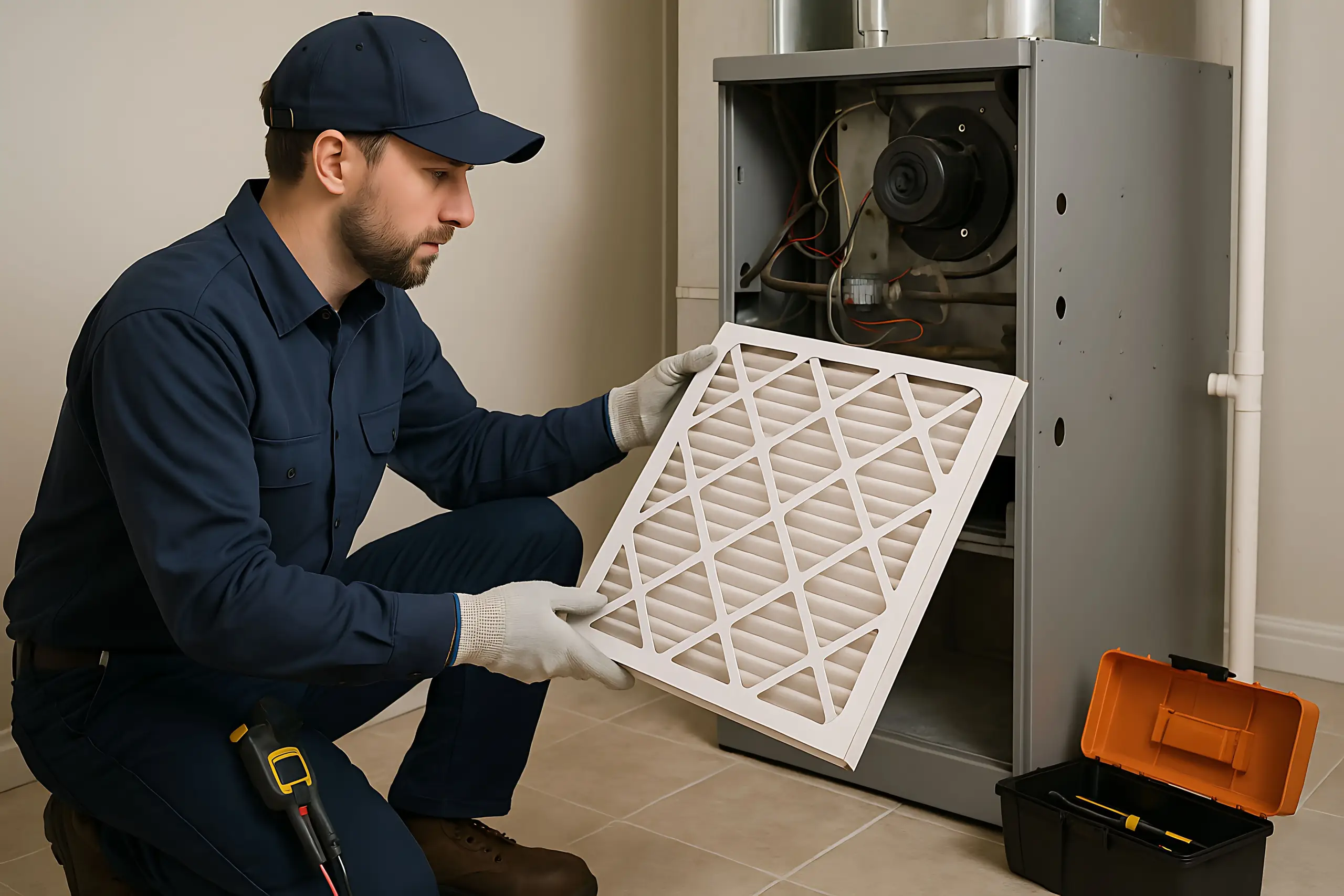
To locate your filter: check the return air duct (usually a large vent on a wall or ceiling) or look for the filter compartment near the blower at the base of the furnace. Most filters slide right out.
What Does a Dirty Air Filter Actually Look Like?
Pull it out and hold it up to a light source. A clean filter lets light pass through the material. A dirty filter that’s ready to be replaced is grey or brown, with debris packed into the surface of the pleats. No light gets through.
You don’t need to be an HVAC expert to read that. If it looks clogged, it is clogged. Before Indiana’s first cold snap each season, it’s worth doing a quick visual on your existing filter, even if you’re not sure when it was last changed. Thirty seconds now prevents blower motor strain and poor indoor air quality for the next four months.
When Should You Call a Pro Instead of Just Swapping the Filter?
A fresh filter solves a lot. But if you’ve replaced yours and you’re still seeing restricted airflow, uneven heating, or higher energy bills a few weeks later, the filter isn’t the whole story.
Clogged ductwork, worn furnace components, or a system that’s simply running past its efficient range can all produce the same symptoms as a dirty air filter. However, these won’t clear up with a furnace filter replacement. In more serious cases, issues like cracked heat exchangers require professional attention, not a DIY swap. A cracked heat exchanger is one of those things no amount of proper air filtration can address on its own.
This is where a seasonal furnace tune-up earns its keep. Not as a box to check, but as a relationship with someone who knows your system, notices changes from visit to visit, and can catch a small problem before it becomes a cold-night emergency. At HomeSense, that’s exactly the kind of care we’re built around: prevention first, honest answers always, and the kind of service that makes you feel like your home is in good hands.
If your furnace is giving you signals you can’t explain, we’d love to take a look.Schedule a tune-up with HomeSense before the deep freeze sets in, and head into the rest of winter with one less thing to worry about.
Posted in:
Heating, Indoor Air Quality
Whether you require installation, repair, or maintenance, our technicians will assist you with top-quality service at any time of the day or night. Take comfort in knowing your indoor air quality is the best it can be with MOE heating & cooling services Ontario's solution for heating, air conditioning, and ventilation that’s cooler than the rest.
Contact us to schedule a visit. Our qualified team of technicians, are always ready to help you and guide you for heating and cooling issues. Weather you want to replace an old furnace or install a brand new air conditioner, we are here to help you. Our main office is at Kitchener but we can service most of Ontario's cities
Source link