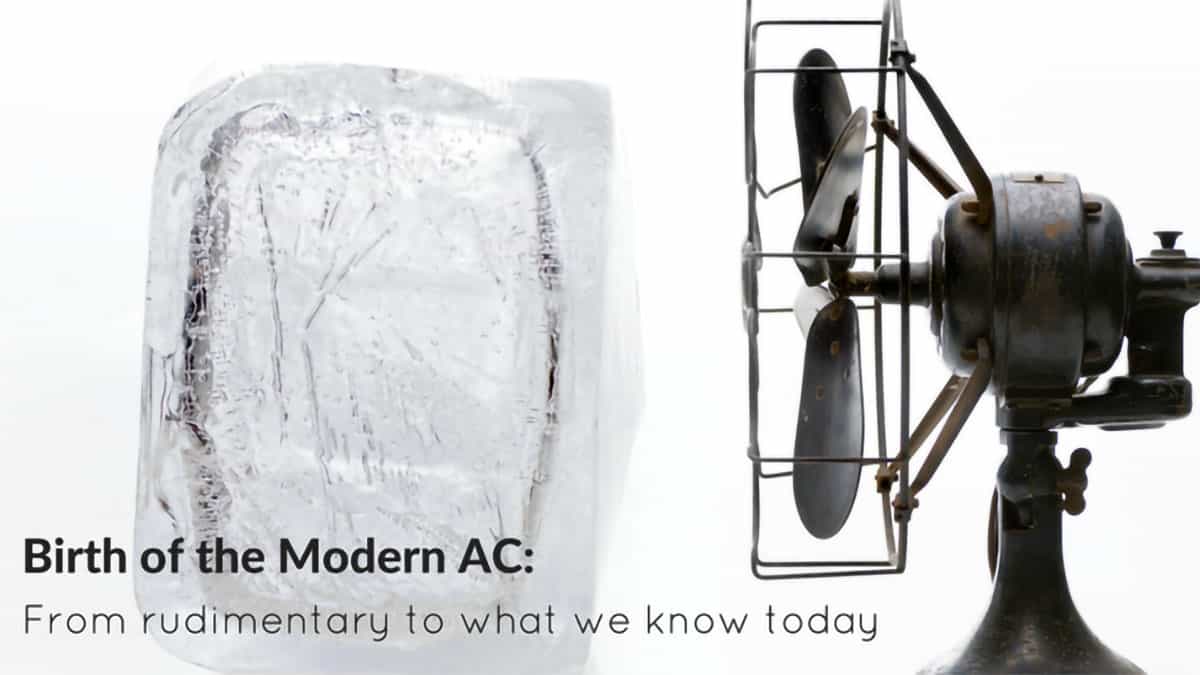
Willis Carrier invented modern air conditioning in 1902. He designed the first modern electrical system to control temperature and humidity at a Brooklyn printing company. Decades earlier, in the 1840s, Florida physician John Gorrie built an ice-making machine that cooled the air for his patients in Apalachicola.
How did people survive Florida summers before air conditioning? After more than 30 years working with HVAC systems across the Treasure Coast, Chris Jarrach understands why homeowners ask. When the heat and humidity settle over Port St. Lucie, it is hard to imagine life without cool air at the thermostat.
So, who invented air conditioning? The answer involves more than one person. The history of air conditioning stretches from Roman courtyards and Persian ice houses to John Gorrie’s cooling experiments in Florida and Willis Carrier’s first modern system.
Along the way, you’ll see how ancient cooling methods led to modern AC and why that history still matters in Florida homes today.
Key Takeaways
- Willis Carrier’s 1902 system controlled humidity at a Brooklyn printing company.
- John Gorrie experimented with mechanical cooling in Apalachicola during the 1840s.
- Ancient civilizations stayed cool with evaporation, airflow, shade, and stored ice.
- Home air conditioning expanded rapidly after World War II, with manufacturers producing more than one million room units in 1953.
- Modern AC still relies on airflow, refrigerant evaporation, and heat transfer.
Who Invented Air Conditioning?
Willis Carrier gets the credit for the first modern electrical air-conditioning system, which is why most people who ask who invented air conditioning hear his name first. He wasn’t the first to cool air with a machine, though. John Gorrie, a Florida physician, built an ice-making machine in the 1840s that was meant to cool both the air and his patients. It never found commercial success, largely because his main financial backer died before the idea could take off.
Both men earned their place in the story. Gorrie advanced the idea of mechanical cooling, and Carrier developed a practical system that controlled temperature and humidity. Air conditioning grew out of several contributions over many decades rather than a single moment of invention.
When Was Air Conditioning Invented?
Modern air conditioning was invented in 1902, when Willis Carrier designed a system to control humidity at a Brooklyn printing plant. People who ask when air conditioning was invented usually want one date, but the story has several, depending on whether you count the invention, the patent, or the name itself:
- 1840s: John Gorrie’s cooling experiments
- 1851: Gorrie’s ice-machine patent
- 1902: Carrier’s air-conditioning system
- 1906: Carrier’s “Apparatus for Treating Air” patent is granted
- 1906: The term “air conditioning” becomes associated with industrial air treatment
- Early 1930s: An early window-ledge room unit appears
- Postwar era: Home air conditioning becomes increasingly accessible
The full timeline further down this page lays out every milestone, including the ancient ones.
Willis Carrier and the First Air Conditioner
The history of air conditioning began with a need to control humidity, long before cooling homes became its main purpose.
The First Air Conditioner Was Built for Paper, Not People
According to Carrier’s history of air conditioning, the first air conditioner wasn’t designed to make anyone comfortable. In 1902, the Sackett-Wilhelms Lithographing & Publishing Company in Brooklyn had a stubborn problem: humidity made its paper expand and contract, which threw printed colors out of alignment. Carrier’s assignment was to fix the paper, and cooler workers were a pleasant side effect. Industrial humidity control, not residential comfort, was the original goal.
How the Willis Carrier Air Conditioner Worked
The Willis Carrier air conditioner pulled air across chilled coils. As the air cooled, moisture condensed out of it, so a single process lowered both temperature and humidity. That second job is what makes the design feel so familiar on the Treasure Coast, where removing moisture is nearly as important as lowering the temperature.
A system that lowers the temperature without removing enough humidity can leave a house cold and clammy, and a coil coated in grime cannot absorb heat or remove moisture as effectively. That is why professional AC coil cleaning is particularly useful in a humid climate.
Carrier later co-founded the Carrier Engineering Corporation in 1915 with six other engineers, which carried his humidity-control ideas well beyond that first printing plant.
Where the Term “Air Conditioning” Came From
Stuart W. Cramer, a North Carolina textile mill engineer, used the phrase “air conditioning” around 1906 to describe treating the air inside mills, where humidity affected the thread. Carrier adopted the term afterward, and it stuck because it described exactly what the equipment did: it conditioned air rather than simply cooling it.
John Gorrie: Florida’s Air Conditioning Pioneer
John Gorrie was an Apalachicola physician who developed an ice-making machine to cool his patients. In the 1840s, he used ice and moving air to cool rooms for people suffering from illnesses like yellow fever and malaria. His thinking was practical: ice shipped from northern lakes was expensive, so he went looking for a way to make it on site. The U.S. Patent No. 8080 he received in 1851 covered that ice machine, but he never secured the commercial backing needed to bring it to market.
Florida hasn’t forgotten him. The John Gorrie Museum State Park stands in Apalachicola, and his statue represents Florida in the U.S. Capitol’s National Statuary Hall Collection. He was fighting the same punishing heat and humidity that Treasure Coast homeowners deal with every summer, just without a thermostat to help.
Ancient Air Conditioning: How People Stayed Cool Before AC
Ancient air conditioning looked nothing like a modern system, and it certainly wasn’t refrigeration. People relied on evaporation, airflow, thick building materials, shade, and stored ice or snow, and the best of those ideas were clever enough to deserve respect.
Ancient Roman Air Conditioning
Ancient Roman air conditioning depended on architecture more than machinery. Thick masonry walls absorbed heat slowly, shaded courtyards (atria and peristyles) kept the sun off living spaces, and fountains and pools cooled the surrounding air as water evaporated. Rome’s aqueducts were built mainly to supply water, not to cool homes, though that water made the fountains and pools possible. The first of them, the Aqua Appia, dates to 312 BC.
One famous story involves Emperor Elagabalus (who ruled from 218 to 222 AD), who reportedly had snow hauled down from the mountains to cool his gardens. The Historia Augusta, the source for that account, is considered unreliable, so it’s best treated as legend rather than documented fact.
Ancient China
During the Han Dynasty, the artisan and inventor Ding Huan built a hand-cranked rotary fan. Several centuries later, accounts describe Tang Emperor Xuanzong’s Cool Hall, a palace room associated with water-powered fan wheels and fountains. Details of how it worked come from historical descriptions, so the exact engineering remains uncertain.
Ancient Egypt and Persia
Windcatchers directed natural breezes down into buildings, and the Persian version, known as the badgir, became a signature of desert architecture. Persians also built yakhchāl ice houses that stored ice through the summer, and qanats, underground water channels tied to water supply and, in some settings, cooling strategies. How widespread or effective each method was varied from place to place.
These comparisons are conceptual rather than technical equivalents, since ancient techniques and modern refrigeration work very differently:
| Method | Where | How it cooled | Modern counterpart in concept |
| Fountains, pools and thick walls | Rome | Evaporation, shade and thermal mass | Evaporator coils and insulation |
| Rotary fans and reported Cool Hall features | China | Moving air and water-assisted cooling | Blower fans and air distribution |
| Windcatchers | Egypt and Persia | Directing natural airflow | Ductwork and ventilation |
| Yakhchāl ice houses and qanat-related cooling | Persia | Ice storage and, in some settings, cooling through airflow and water | Refrigeration and heat-transfer systems |
How Air Conditioning Came Home
Residential air conditioning became more accessible after World War II as window units became less expensive. An early unit designed for a window ledge was patented in 1931 and reached the market in 1932, but its price kept it beyond the reach of most households. According to the U.S. Department of Energy, 43,000 lower-cost window units were sold in the United States by 1947. By the late 1960s, most newly built homes had central air conditioning.
For Florida homes, the transition from individual window units to central systems brought whole-house cooling and humidity control. Central air remains common in Port St. Lucie, while homes without ductwork may benefit from ductless systems. Understanding how to size a mini-split correctly is important before purchasing one.
How Air Conditioning Changed Florida
Air conditioning made year-round living and working in Florida’s hot, humid climate far more comfortable and practical. It reshaped homes, offices, hospitals, and tourism, and it’s widely linked to the state’s postwar population growth, though it was never the only factor behind it.
On the Treasure Coast, AC does more than provide comfort. It controls humidity, which helps manage excess moisture, reduce conditions that support mold growth, and relieve that sticky indoor feeling.
During peak summer calls in Port St. Lucie, Chris sees how quickly a house changes when a system quits in July: indoor humidity climbs, temperatures follow, and conditions can become unsafe for older adults, young children, and pets. A failed system in midsummer is far more than an inconvenience, which is why a prompt AC repair matters so much once the weather turns.
History of Air Conditioning Timeline
Whether you require installation, repair, or maintenance, our technicians will assist you with top-quality service at any time of the day or night. Take comfort in knowing your indoor air quality is the best it can be with MOE heating & cooling services Ontario's solution for heating, air conditioning, and ventilation that’s cooler than the rest.
Contact us to schedule a visit. Our qualified team of technicians, are always ready to help you and guide you for heating and cooling issues. Weather you want to replace an old furnace or install a brand new air conditioner, we are here to help you. Our main office is at Kitchener but we can service most of Ontario's cities
Source link