Key Takeaways
- Field experience is your unfair advantage: Owners who have turned wrenches understand what technicians deal with every day. That empathy shows up in better decisions, better hiring, and better retention.
- Scaling from 4 to 24 requires systems, not heroics: Kensington Mechanical grew from a 4-person family shop to a 24-person commercial refrigeration operation by building processes one painful stage at a time, starting on pen-and-paper invoices and ending on ServiceTitan.
- Outside buyers can kill a business in two years: One of Kensington’s competitors was purchased by a business school graduate with no trade background. Within two years, the company was gone. The technicians said they felt the soul leave.
- Private equity is reshaping HVAC at speed: PE firms accounted for over 50% of HVAC M&A deals in the first half of 2025, with add-on acquisitions rising 88% year-over-year.¹ If you are building to keep, field credibility is the moat PE cannot buy.
Roughly 60% of HVAC contractor businesses employ fewer than 20 people.² Most of them were started by technicians who got tired of working for someone else. That is the reason independent contractors still dominate this industry despite a PE wave that crossed 50% of all deal activity in the first half of 2025.¹
A recent two-part episode of the HVAC Know It All Business Edition Podcast featured a conversation with Andrew Blair of Kensington Mechanical, a commercial refrigeration company in Massachusetts that grew from 4 people to 24 over about a decade. The conversation covered what happens when you scale a family business, what happens when an outsider buys your competitor, and why the owners who have actually done the work tend to outlast the ones who just read about it.
Growing Up in the Trade
Some people choose HVAC. Some people grow up in it. Blair was the kid who tagged along with his father on jobs carrying a small hammer. He went through a vocational high school, tried electrical, tried plumbing, and landed on HVAC and refrigeration because it combined hands-on mechanical work with real problem-solving. Most techs who have been in the trade long enough understand that pull. It is the same reason you picked this over a desk.
When Blair joined Kensington as an apprentice, the company was four people: his father, a bookkeeper who had been there since before Blair was born, one veteran tech, and Blair himself. Corporate records show it started as Wellington Design in 1984, went through two name changes, and became Kensington Mechanical in 2009.³ For new owners weighing where to put their first dollars, the takeaway is simple: Kensington stayed tiny for decades before it grew. There is no shortcut past building a foundation.
Why Field Experience Changes Everything
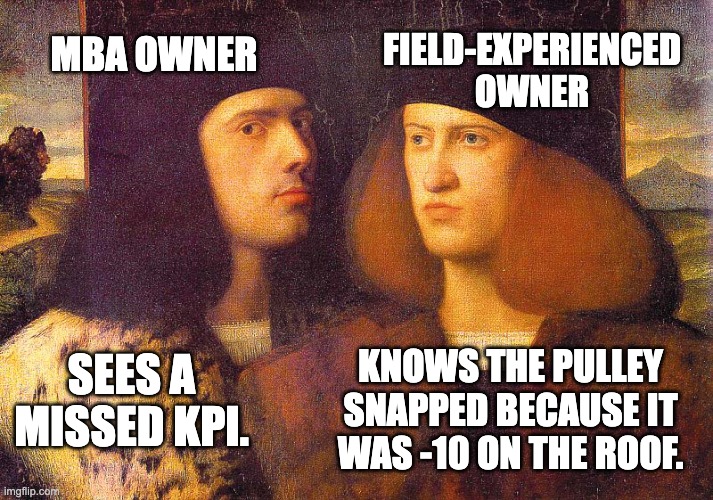
You are on a roof in January, trying to pull a pulley off a motor, and it snaps because of the cold. An owner who has been through that understands the delay. An owner who has only ever sat in an office sees a missed KPI on a dashboard.
That gap matters more than most business books will tell you. When leadership cannot evaluate diagnostic accuracy, cannot tell when a tech is sandbagging versus dealing with a legitimately difficult call, and cannot mentor a green apprentice through their first commercial refrigeration troubleshoot, the result is predictable. Good techs leave for companies where the boss actually understands what they do.
This is why technician-turned-owner businesses still hold a structural advantage over PE-backed consolidators in retention. The empathy gap is not abstract. It shows up on the P&L every time you lose a trained tech and spend months replacing them.
Scaling From 4 to 24: The Messy Middle
By late 2025, Kensington had grown to roughly 24 people and about $6 million in annual revenue. With approximately 12 revenue-generating field techs, that works out to $500,000 per tech, which sits squarely in the industry benchmark range.⁴
The growth was anything but clean. In 2016, the company was still running on triplicate carbon-copy invoices. That sounds ridiculous now, but as recently as 2020 only about 54% of HVAC companies used any FSM software at all.⁵ When the team tried to implement Jobber, the QuickBooks data import failed. They spent nights manually entering old invoices. For weeks, the techs said the new system was worse than doing nothing.
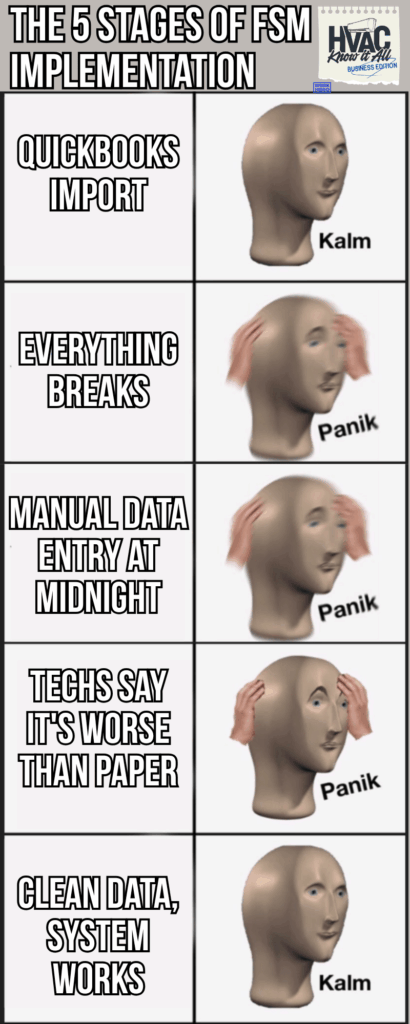
The software only became useful after the data was clean. Every contractor who has been through an FSM rollout knows this pain. Garbage in, garbage out. Choosing between QuickBooks, FSM, and a bookkeeper is one of the first real decisions a new owner makes. The tool matters less than the discipline of feeding it good data.
Kensington eventually outgrew Jobber and moved to ServiceTitan as the operation scaled past 20 people. That transition makes sense at a certain size, but it is not where most owners should start. Building culture before buying software is what made both transitions work at Kensington. The software did not fix the business. The team’s willingness to push through the pain together did.
When Private Equity Comes Knocking
One of Kensington’s competitors was about the same size. Roughly 10 technicians, commercial refrigeration. The owner sold to an individual with an MBA and strong academic credentials but no trade background. Within two years, the company was gone. The technicians who had been there described it the same way: they felt the soul go out of the business.
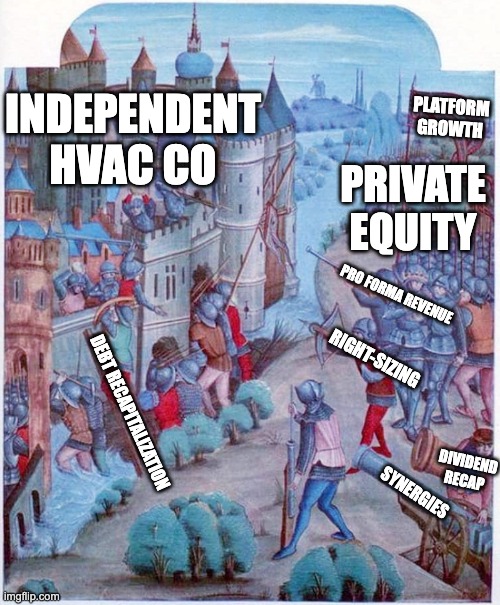
Renovo Home Partners, backed by Audax Private Equity, combined multiple home services companies into a roll-up platform. Within roughly five years, it collapsed with over $100 million in liabilities and approximately 1,500 workers out of a job.⁶ When institutional knowledge, customer relationships, and cultural cohesion walk out the door with departing technicians, the math stops working no matter how good the spreadsheet looked.
The pace of consolidation is real. PE add-on acquisitions in HVAC surged 88% year-over-year through H1 2025, with PE accounting for 50.6% of all deals.¹ Nearly 20 PE funds are actively competing for HVAC contractors.⁷ Current valuations average around 8x EBITDA, up 20% from pre-pandemic levels.⁸ Small owner-operated businesses typically trade at 2.75x to 3.25x seller’s discretionary earnings (SDE is what you actually take home plus add-backs, for those unfamiliar with the term).⁸
Not all PE involvement ends badly. But the typical hold period is 4 to 6 years,⁹ which means platforms acquired in 2019 and 2020 are now in their exit phase. That creates pressure to maximize short-term returns at exactly the moment when culture and retention matter most.
For owners planning to stay independent, the PE wave actually creates opportunity. Technicians squeezed by corporate consolidators are looking for companies with real leadership. If you have field credibility, a healthy culture, and margins that actually work, you are exactly what those techs are looking for.
What Comes After the Field
Blair left Kensington in late 2025 and moved into product development at Helix Earth Technologies, a climate-tech startup commercializing a liquid desiccant dehumidification system originally developed for NASA spacecraft. The company closed a $12 million oversubscribed Seed 2 round and won first place at the 2025 SXSW Pitch competition.¹⁰
That is a long way from pen-and-paper invoices. But Blair’s field background is precisely what makes him effective in a product development role. Understanding how commercial systems actually behave in the real world, how technicians interact with equipment, and what building operators need is not something you learn in an engineering program.
The paths within HVAC are expanding. The foundation has not changed. If you understand the work well enough to lead the people doing it, you have an advantage that no amount of capital can replicate. Field experience alone will not guarantee success. Plenty of excellent technicians have built million-dollar businesses and still ended up broke because they never learned the financial side. But in a market where PE-backed consolidators are cycling through management teams every few years and technicians are choosing employers based on whether leadership actually understands the work, field experience combined with business acumen is the most durable edge an independent owner can build.
Additional Sources
- “HVAC Services M&A Update”, Capstone Partners, Industry Report, 2025.
- “Data-Driven Guide to Commercial HVAC Growth”, BuildOps, Report, 2025.
- “About: Discover Our Expertise”, Kensington Mechanical, Company Website, 2026.
- “How Profitable Is an HVAC Business? Real Benchmarks”, Lightning Path Partners, Blog Post, 2025.
- “Field Service Management Software Statistics”, Field Service Software Analytics, Report, 2024.
- “Renovo Home Services Reportedly Shutters Operations”, Qualified Remodeler, News Article, 2025.
- “The PE Playbook: HVAC 2025”, Grata, Industry Report, 2025.
- “HVAC EBITDA Valuation Multiples”, First Page Sage, Report, 2026.
- “Next Stage of Private Equity Could Lead to Bigger Payouts”, ACHR News, Opinion, 2025.
- “Helix Earth Secures $12 Million in Oversubscribed Seed 2 Funding”, VentureBeat, News Article, 2025.
Whether you require installation, repair, or maintenance, our technicians will assist you with top-quality service at any time of the day or night. Take comfort in knowing your indoor air quality is the best it can be with MOE heating & cooling services Ontario's solution for heating, air conditioning, and ventilation that’s cooler than the rest.
Contact us to schedule a visit. Our qualified team of technicians, are always ready to help you and guide you for heating and cooling issues. Weather you want to replace an old furnace or install a brand new air conditioner, we are here to help you. Our main office is at Kitchener but we can service most of Ontario's cities
Source link