Key Takeaways
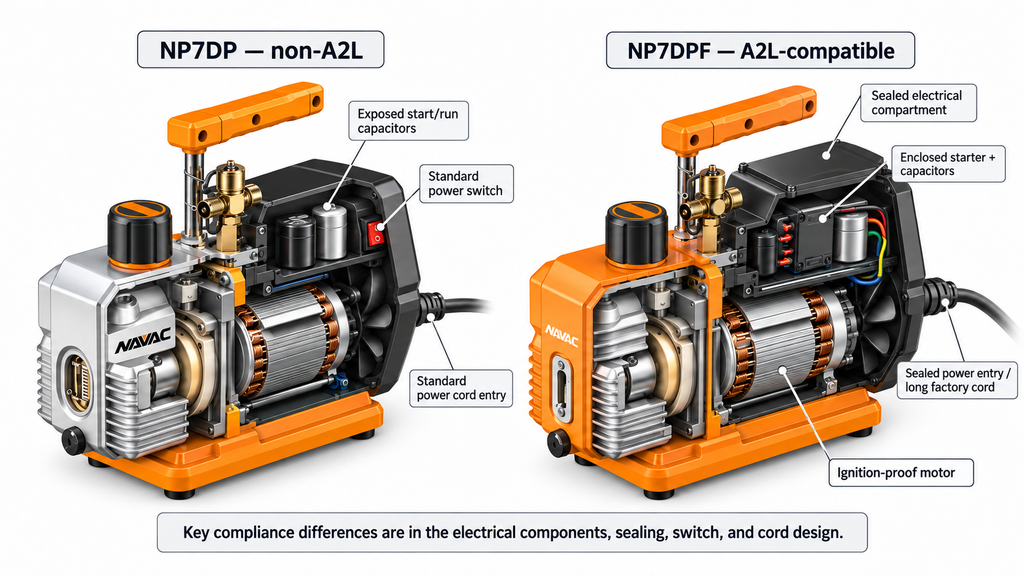
- Brushed motors are the primary ignition source eliminated: A2L-compliant vacuum pumps replace traditional brushed motors with brushless DC (BLDC) or sealed AC motors. Carbon brushes generate micro-arcs during normal operation, and those arcs are enough to ignite A2L vapor concentrations inside the pump housing.
- Three additional ignition sources changed alongside the motor: Non-sparking switches replace standard toggle switches, capacitors are either sealed or removed entirely, and power cords are integrated or locking to eliminate loose plug connections that can arc under load.
- Recovery machines carry higher flammability risk than vacuum pumps: A vacuum pump encounters trace refrigerant vapor during evacuation. A recovery machine processes continuous flow of concentrated flammable refrigerant throughout the entire operation, making every ignition source a higher-consequence failure point.
- A2L compliance does not qualify tools for A3 (hydrocarbon) work: A3 refrigerants like R-290 have minimum ignition energies tens to hundreds of times lower than A2L refrigerants. Depending on the jurisdiction and hazardous-area classification, A3 work may require ATEX or IEC 60079 rated equipment that A2L-certified tools do not provide.
Why A2L Changed the Motor Inside Your Vacuum Pump
The motor changed first. It is the most persistent ignition source inside a vacuum pump. Traditional brushed motors use carbon brushes riding against a spinning commutator to deliver current to the rotor. That contact produces a continuous stream of micro-arcs during operation.
On legacy refrigerants, those arcs were irrelevant. R-410A and R-22 are non-flammable. No concentration of either gas inside a pump housing will ignite regardless of the spark energy available. A2L refrigerants changed that calculation. R-454B, R-32, and other A2L blends carry a lower flammability limit (LFL) that, while higher than propane, is within the concentrations a vacuum pump can encounter during evacuation procedures.¹
A2L-compliant pumps use one of two motor types: brushless DC (BLDC) motors, which use electronic commutation instead of physical brush contact, or sealed AC motors with no exposed switching elements. Both eliminate the continuous arcing that defines brushed motor operation. The Yellow Jacket SuperEvac A2L and similar compliant pumps use BLDC motors specifically because the science of evacuation demands sustained deep vacuum performance, and BLDC motors deliver that without the wear characteristics of brushed designs.
A vacuum pump pulling to 500 microns encounters far less refrigerant than a recovery machine processing the full system charge. The motor swap on vacuum pumps is about eliminating an ignition source in a low-probability scenario. On recovery machines, the same motor swap addresses a high-probability one.
Switches, Cords, and Capacitors: The Other Ignition Sources
Three other components changed alongside the motor in A2L-compliant tools. Each can act as an independent ignition source, so the certification process addresses each separately.
Switches. A standard toggle switch creates a small arc every time it opens or closes the circuit. On a vacuum pump or recovery machine, that switch sits on or near the housing, in proximity to any vapor that escapes the sealed system path. A2L-compliant tools use non-sparking switches, either sealed contacts or electronic switching that eliminates the air-gap arc.
Capacitors. Start and run capacitors in single-phase motors store enough energy to produce a spark if they fail or vent. A2L-compliant designs either seal the capacitor in a vapor-tight enclosure or eliminate it entirely by using BLDC motors that do not require capacitor-start circuits. This is one reason BLDC adoption is accelerating across the A2L toolbag: the motor change solves two ignition sources at once.
Power cords. A loose plug connection under load arcs at the contact point. Compliant tools use integrated power cords (permanently attached, no detachable plug at the tool end) or locking connectors that maintain full contact under vibration. Most techs notice the cord change first: it affects how they store and transport the tool.
All four changes need to work together. A new motor does not address a sparking toggle switch left on the housing. Certification evaluates the entire tool as an assembly, not individual components, which is why aftermarket modifications to hose seals and fittings on A2L equipment can void the compliance rating.
Recovery Machines Face Higher Stakes
Vacuum pumps encounter trace refrigerant. During a standard system evacuation, the pump pulls the system to deep vacuum, and any residual refrigerant vapor passes through the pump at extremely low concentrations. The flammability risk is real but the exposure window is narrow.
Recovery machines face much greater refrigerant exposure. During refrigerant recovery, the machine processes the full system charge: liquid and vapor, at operating pressures, for the duration of the recovery cycle. The refrigerant concentration inside the machine is not trace. It is effectively 100% of whatever the system contains.
Recovery machines therefore face a harder certification standard. Continuous exposure to concentrated flammable refrigerant increases the consequences of an ignition source. A recovery machine running on a system charged with R-454B is processing flammable gas at concentrations well above the lower flammability limit for the entire cycle. A pump-down or refrigerant pump-down procedure that precedes recovery does not eliminate this exposure; it only changes the phase balance.
Bringing a recovery machine into A2L compliance therefore costs more than bringing a vacuum pump into compliance. The certification process is also more stringent. Techs evaluating equipment purchases should expect A2L-compliant recovery machines to carry a meaningful price premium over their non-compliant equivalents.
Evaluating Your Existing Equipment
Review every pump and recovery machine in your shop against the following checks. Understanding why breakers trip on new A2L equipment starts with knowing what changed inside the tools connecting to that equipment.
If the tool has a brushed motor, it is not A2L-compliant. No amount of external modification changes that. The arcing is inherent to the brush-commutator interface.
If the tool is A2L-compliant, it is not A3-compliant. A2L certification addresses lower flammability. A3 refrigerants (R-290, R-600A) have minimum ignition energies tens to hundreds of times lower than A2L blends (propane’s MIE is roughly 0.25 mJ, compared to 30 mJ or higher for most A2L refrigerants).² Depending on the jurisdiction and hazardous-area classification, A3 work may require ATEX or IEC 60079 rated equipment.³ Tools rated for A2L work are not designed for A3 ignition energy thresholds.
If the label does not specify A2L compliance, assume it is not. Manufacturer marketing around “ready for the transition” or “next-generation design” does not equal third-party certification for use with flammable refrigerants. Check for the specific A2L compliance marking from the manufacturer and confirm it with their technical documentation.
The alternative refrigerant transition is not slowing down. The Kigali Amendment’s HFC phasedown schedule tightens through 2036 (reaching 85% reduction in aggregate HFC consumption for non-Article 5 countries), and every step means more A2L systems in the field.⁴ Check the ratings on your vacuum pumps and recovery machines now, and replace tools that cannot be certified for those systems. Check A3 suitability separately from A2L compliance.
Additional Sources
- “Designation and Safety Classification of Refrigerants,” ASHRAE, Standard 34, 2024.
- “Explosive Atmospheres: Equipment General Requirements,” IEC, Standard 60079-0, 2017.
- “Safety of Household and Similar Electrical Appliances: Particular Requirements for Heat Pumps, Air-Conditioners and Dehumidifiers,” UL/IEC, Standard 60335-2-40, 2022.
- “Amendment to the Montreal Protocol on Substances that Deplete the Ozone Layer (Kigali Amendment),” UNEP, 2016.
Whether you require installation, repair, or maintenance, our technicians will assist you with top-quality service at any time of the day or night. Take comfort in knowing your indoor air quality is the best it can be with MOE heating & cooling services Ontario's solution for heating, air conditioning, and ventilation that’s cooler than the rest.
Contact us to schedule a visit. Our qualified team of technicians, are always ready to help you and guide you for heating and cooling issues. Weather you want to replace an old furnace or install a brand new air conditioner, we are here to help you. Our main office is at Kitchener but we can service most of Ontario's cities
Source link