
Millions more U.S. homes could potentially add heat pumps without pushing electricity demand beyond existing winter peaks. New research suggests that, at least in many parts of the country, winter grid “headroom” — capacity available above winter peak demand — could provide room for considerably more heat pumps than expected.
RMI, an energy research and policy nonprofit, estimates roughly 109 million U.S. homes — about three out of four — could ultimately use heat pumps within available winter grid capacity when both all-electric and hybrid systems are considered. RMI conducted the study to examine whether increased heat pump adoption could make better use of existing grid capacity, lower electricity rates, and reduce emissions
The opportunity, however, varies considerably by state. That distinction could eventually matter to HVAC contractors.
If utilities increasingly align incentives, rates, and electrification programs with the needs of their individual grids, the best heat-pump application in one market may look different from one in another.
“We were surprised by just how large the opportunity is within the grid capacity we already have today,” said Ryan Shea, a manager in RMI’s buildings program.
“In most states, nearly all homes could adopt heat pumps without increasing the state’s annual peak electricity demand when you consider a mix of all-electric and hybrid systems,” he said.
More Load, Lower Rates?
RMI’s analysis centers on how additional electric load could make use of existing winter headroom.
Looking for quick answers on air conditioning, heating and refrigeration topics?
Try Ask ACHR NEWS, our new smart AI search tool.
Ask ACHR NEWS
Many electric systems are built around their highest summer demand, when air conditioners are running. That can leave generation, transmission, and distribution infrastructure underused during winter.
“The key is adding heat-pump electricity sales without adding equivalent costs to the grid,” Shea said. “In states with winter headroom, heat pumps can make better use of infrastructure that customers are already paying for, spreading those fixed costs across more electricity sales, and putting downward pressure on rates.”
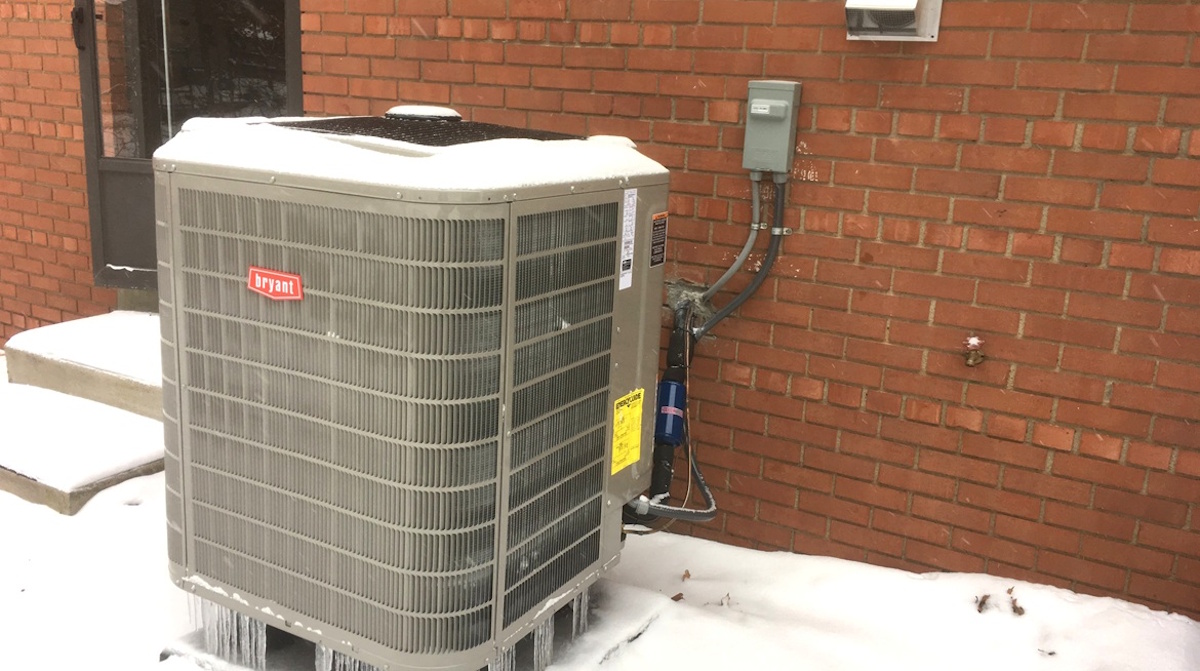
REGIONAL DIFFERENCES: An exterior HVAC installation illustrates how heat-pump impact opportunities vary by regional weather. Nate Adams said the key is setting the changeover temperature so the heat pump operates as much as practical during the heating season. (Courtesy of Nate Adams)
RMI estimates an all-electric heat-pump deployment strategy within available winter headroom could put average downward pressure of about 6% on residential electric rates across summer-peaking states, equivalent to about $86 annually per customer.
A combination of all-electric and hybrid heat pumps could increase that modeled effect to an average of 13%, or about $200 annually per customer.
Those figures are directional estimates rather than forecasts of what individual utilities or customers would experience. Distribution costs vary among utilities, and heat-pump deployment would occur over years as grid conditions, investments, and rates change.
Shea said realizing the potential savings would require policies that encourage heat-pump adoption and operation in ways that benefit the grid. Those could include shifting incentives away from conventional air conditioners and fossil-fuel heating systems, adjusting electric rates, and encouraging heat pumps when air conditioners are replaced.
All-Electric or Hybrid?
Where those heat pumps are installed matters. States with substantial winter headroom can accommodate more all-electric systems, while more winter-constrained states could rely more heavily on hybrid heat pumps, according to RMI.
Illinois provides one example. RMI estimates the state has approximately 8.9 GW of winter headroom. Under an all-electric-only scenario, about 30% of Illinois homes could convert to heat pumps before additional installations begin increasing winter peak demand.
RMI estimates a mix of 21% all-electric and 79% hybrid heat pumps could allow heat pumps to serve essentially all Illinois homes while remaining within today’s modeled winter headroom.
“Hybrid heat pumps can electrify the vast majority of a home’s winter heating while limiting electric demand during the relatively small number of extremely cold, high-demand hours,” Shea said.
ComEd, the largest electric utility in Illinois. sees a potential grid benefit from dual-fuel systems, although the utility did not participate in the RMI study or evaluate its methodology or assumptions.
Philip Roy, ComEd’s director of energy efficiency strategy and implementation, said pairing a heat pump with an existing gas furnace gives customers another electrification option.
“From a grid perspective, that flexibility may reduce winter electric demand compared with widespread adoption of systems that rely entirely on electricity,” Roy said.
Roy also noted that cold-climate heat pumps are designed to operate at very low outdoor temperatures and said ComEd plans its grid to reliably serve customers whether they choose an all-electric or dual-fuel system.
For RMI, how a hybrid system operates is also important. Shea said if the system turns to fossil-fuel heat too frequently, states lose much of the grid utilization, rate, and emissions benefits RMI associates with heat pumps.
Nate Adams, known as “Nate the House Whisperer,” sees the issue from the contractor and building-performance side. Adams, a co-author of the Hybrid Heat Homes paper, has worked with contractors and homeowners on electrification and heat-pump applications.
“The furnace is already in the basement, so adding a heat pump to it is the easiest ‘yes’ in HVAC,” Adams said. “What matters is the changeover setting.”
Adams said some hybrid systems switch to the furnace at around 35°F to 40°F, sometimes because installers leave factory or thermostat defaults unchanged. Lowering that point where local utility rates and equipment performance allow keeps the heat pump operating for much more of the heating season.
Longer term, however, Adams sees hybrid systems more as a bridge.
“I think of a hybrid as a one-cycle answer, not a destination,” he said.
Fueling the Options
Adams draws the regional dividing line somewhat differently than a grid model does. For contractors, he said, the existing heating fuel may matter more immediately than whether the electric system is summer- or winter-peaking.
“If the house has propane, oil, or electric resistance heat, an all-electric heat pump wins almost everywhere,” Adams said. “If it’s a cold climate with cheap gas and a sound furnace, like Ohio, Michigan or Illinois, a hybrid is usually the fastest practical path.”
There are also practical barriers that statewide grid models cannot capture.
Most HVAC replacements occur when equipment fails, Adams noted, making distributor inventory and what contractors have readily available significant factors. Sizing, existing ductwork, commissioning, controls, and electrical service can also determine whether a heat-pump application succeeds.
For hybrids, Adams said electrical service is generally less of an obstacle because replacing an air conditioner with a similarly sized heat pump typically uses the existing circuit. Electrical-panel limitations become more significant when converting a home to all-electric heating.
From Statewide Headroom to the Local Grid
There is another important limitation to statewide headroom: Grid capacity isn’t distributed evenly.
“Statewide headroom does not mean every feeder, transformer or substation has the same amount of available capacity,” Shea said. “Some local distribution systems will have more headroom than the statewide bulk grid, while others will require upgrades as heat-pump adoption grows.”
RMI says its analysis attempts to account for those costs by including estimates for distribution-system upgrades based on state-specific costs, winter headroom, population density, cost of living, and other grid characteristics.
ComEd’s experience in northern Illinois illustrates the distinction. Roy said ComEd has historically experienced its highest demand during summer, with many parts of the system seeing lower winter demand.
“Systemwide winter capacity doesn’t necessarily reflect the capacity available in every community or part of the electric grid,” Roy said. “Local equipment, including feeders, transformers, and substations, can have different capacity needs and may require upgrades before overall system capacity is reached.”
ComEd’s summer peak was about 21.2 GW in 2026, compared with about 15.1 GW during the 2025-26 winter season, Roy said. He cautioned that the difference should not be viewed as available capacity at every location.
As heat-pump adoption grows, Roy said, heating electrification will add winter demand and could eventually lead to more balanced seasonal peaks. The impact will depend on factors including the pace and location of adoption, equipment efficiency, and performance during extreme cold, and other sources of load growth.
“Adding efficient electric load during lower-demand winter periods presents an affordability opportunity to make better year-round use of the grid, benefiting all customers by spreading the costs of the system across greater usage,” Roy said.
For contractors, that local distinction matters because equipment ultimately connects to a distribution system with its own capacity and constraints.
Transmitting the Value
That does not mean HVAC contractors need to become utility planners.
“As little as possible,” Adams said when asked how much grid knowledge contractors should need. “If we need every HVAC contractor to understand transmission planning, we’ve already lost.”
Instead, Adams argues utilities and regulators should translate grid needs into things contractors and homeowners can act on.
“Put the grid knowledge into the rebate, the rate, and the thermostat default,” he said.
ComEd’s response suggests those signals could become more important as the grid evolves.
Roy said rebates, rates, and other incentives could increasingly account not only for how much electricity equipment uses, but when it uses electricity and how flexible that demand can be.
Heat pumps, smart thermostats, and other connected technologies can provide that kind of flexibility, while time-varying rates can encourage customers to shift electricity use away from more constrained or higher-cost periods.
“Over time, these factors could broaden the conversation contractors have with customers to include not only equipment efficiency, but also how a system performs during peak periods and whether it can take advantage of available programs or rate options,” Roy said.
Contractors still need to understand local energy prices well enough to properly configure hybrid systems, Adams said, particularly when determining the temperature at which a system switches from the heat pump to the furnace.
Shea similarly said the analysis reinforces that there isn’t one heat-pump configuration appropriate for every home or region. The best choice can depend on heating load, climate, existing equipment, utility rates, and customer priorities.
For Adams, however, one of the largest opportunities is considerably simpler than choosing between competing electrification pathways.
“We keep scoring heat pumps against furnaces,” he said. “The real competitor is the one-way air conditioner. That’s the box blocking the house, and it’s the cheapest one to change.”
RMI’s analysis suggests today’s winter grid headroom could accommodate far more heat pumps. How long that headroom lasts — and whether all-electric, hybrid, or other strategies make the best use of it — will vary by region.
For contractors, the grid may be changing the equation, but the decision still happens at the home — when an air conditioner or heating system needs to be replaced.
“When the air conditioner dies, replace it with a heat pump, furnace or not,” Adams said.
Whether you require installation, repair, or maintenance, our technicians will assist you with top-quality service at any time of the day or night. Take comfort in knowing your indoor air quality is the best it can be with MOE heating & cooling services Ontario's solution for heating, air conditioning, and ventilation that’s cooler than the rest.
Contact us to schedule a visit. Our qualified team of technicians, are always ready to help you and guide you for heating and cooling issues. Weather you want to replace an old furnace or install a brand new air conditioner, we are here to help you. Our main office is at Kitchener but we can service most of Ontario's cities
Source link
