
The Short Answer: When your AC is not turning on, start with the simple stuff: check the thermostat settings, look for a tripped breaker, and make sure the air filter is not clogged. If those do not bring it back, the problem is likely electrical, low refrigerant, or a failing compressor, which calls for a licensed technician.
A dead air conditioner in the middle of a Central Florida summer is no small thing. The house heats up fast, and you want a clear plan, not a guessing game. This guide walks through the common reasons an AC system stops working, the safe checks you can do in a few minutes, and when to call a pro. Apple AC is here to help, and has answered these summer emergency calls across Central Florida since 1997.
Why Your AC Is Not Turning On: Common Causes
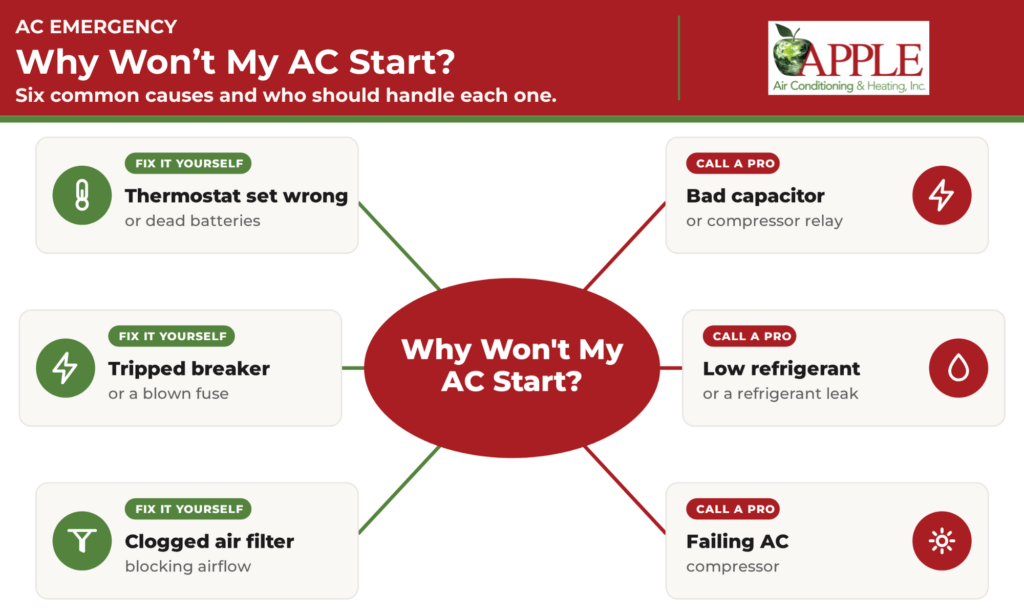
The U.S. Department of Energy lists these among the most common air conditioner problems, and most of the serious ones trace back to an electrical part, the refrigerant level, or the compressor.
| Cause | What You Might Notice | Who Fixes It |
| Wrong thermostat settings or dead batteries | Blank screen, no response, set to the wrong mode | You |
| Tripped breaker or blown fuse | The AC unit is completely dead with no sound | You, then a pro if it trips again |
| Clogged air filter or blocked airflow | Weak airflow, warm air, or a frozen evaporator coil | You |
| Full drain line | Standing water, system shut off by the float switch | You or a pro |
| Bad capacitor, compressor relay, or fan motor | Humming outdoor unit, the cooling fan will not spin | Pro |
| Low refrigerant or a refrigerant leak | Warm air, ice on the lines, longer run times | Pro |
| Failing AC compressor | Tripping breaker, loud noises, no cooling at all | Pro |
Quick Checks You Can Do Safely
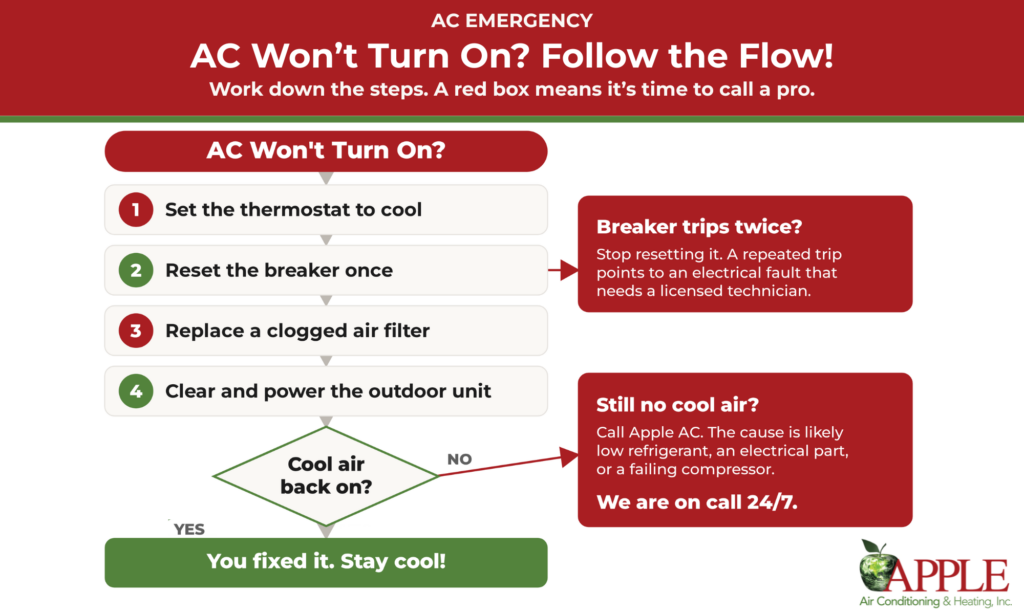
Before you assume the worst, run through these fast checks. Many no-cool calls come down to one of these simple things. Here is how to run each check, what the results mean, and where the line sits before you call a pro.
Check the Thermostat
Confirm the thermostat is set to cool and a few degrees below the room temperature. If the screen is blank, replace the batteries before anything else.
Reset the Power
Open your electrical panel and look for a tripped circuit breaker. A breaker that sits between on and off has tripped, so flip it fully off, then back on, one time. Beyond the main panel, some indoor units and condensate pumps have their own small reset button worth pressing once. If a quick reset gets cool air flowing again, great. If the breaker trips a second time, stop there. A breaker that keeps tripping points to an electrical issue that needs a technician, not another reset.
Clear the Airflow Path
A badly clogged air filter chokes airflow and can shut the system down, so swap in a clean one. Make sure your supply vents are open too. Steady airflow protects the evaporator coil from freezing, which is a frequent reason an AC stops cooling. A clean filter also supports your indoor air quality while the system runs.
Check the Outdoor Unit
Make sure nothing is blocking the outdoor condenser unit, keep two feet of clear space around it so it can breathe, and confirm its disconnect switch is on. Then watch it while the system calls for cooling. The cooling fan on top should spin and the unit should hum quietly. If it is silent or just humming, a capacitor, fan motor, or compressor relay may have failed, and that is a job for a pro.
Look at the Drain Line
A full condensate drain line can trip a safety float switch and stop the AC. If you see standing water near the indoor unit, that may be the cause.
When to Stop and Call a Pro
Some repairs are not safe or legal to attempt at home. Call a licensed technician right away if you run into any of these.
- The breaker trips again after one reset, which signals a deeper electrical problem.
- You smell burning or see scorched marks near the unit or electrical panel.
- The air stays warm and you suspect low refrigerant or a refrigerant leak.
- The outdoor unit hums but the compressor or cooling fan will not start.
- Ice has formed on the refrigerant lines or the indoor coil.
Handling refrigerant requires training and EPA certification, and electrical and compressor work carries real risk. A pro can test the pressure switch, read the low pressure side, check every electrical connection, and recommend a repair or a new AC installation if the unit is near the end of its life. If your home is still blowing warm air after the basics, that points to one of these pro-level fixes.
Did You Know?
Most no-cool emergencies trace back to a part that was already wearing out. A yearly tune-up catches a weak capacitor or a low refrigerant level before it leaves you without air conditioning during some of the hottest months of the year.
What Happens on an Emergency Service Call

When you call for emergency AC repair, it helps to know what to expect. A technician works through the whole HVAC system to find the real cause behind the breakdown rather than the surface symptom. A trained professional will:
- Test the electrical side: the breaker, the capacitor, the contactor, the compressor relay, and each electrical connection.
- Check the refrigerant: read the low pressure side, test the AC pressure switch, and look for a refrigerant leak.
- Inspect the moving parts: the fan motor, the cooling fan, and the compressor for signs of wear.
- Clear the basics: the air filter, the condensate drain line, and the evaporator coil.
Apple AC sends a background-checked technician in a marked truck, and you get a text with their name and photo before they arrive. With 24/7 service, the goal is a clear diagnosis and a fast fix so your home cools down as soon as possible.
How to Stay Cool and Safe While You Wait
Florida heat is no joke, so protect your household while help is on the way. The CDC recommends a few simple steps to stay safe in extreme heat.
- Drink water often, even if you do not feel thirsty.
- Close blinds and curtains on the sunny side of the house.
- Use fans to move air, and spend time on the lowest floor.
- Check on older family members, kids, and pets, who feel the heat first.
- If your home gets too hot, head somewhere cool like a library or store for a while.
Pro Tips to Avoid the Next Breakdown
- Book a tune-up each spring so small problems get caught before summer. Our guide on keeping your AC running efficiently walks through what a visit covers.
- Change the air filter every one to two months during cooling season.
- Flush the condensate drain line so it does not back up and shut the system down.
- Keep a maintenance plan so regular maintenance stays on schedule without you tracking it.
Apple AC Can Help, Day or Night
When your AC is not turning on, start simple: thermostat, breaker, filter, and the outdoor unit. If a reset does not bring back cool air, or the breaker trips again, the cause is likely electrical, low refrigerant, or the compressor, and those should be handled by a trained technician.
Apple AC is a family-owned, NATE-certified team that has kept Central Florida homes and businesses cool since 1997, with 24/7 service across Central Florida Counties. We show up on time, explain the root cause in plain terms, and offer financing when a bigger repair is required. Ready to get cool? Schedule service or get a free estimate and let our team cool you off.
Whether you require installation, repair, or maintenance, our technicians will assist you with top-quality service at any time of the day or night. Take comfort in knowing your indoor air quality is the best it can be with MOE heating & cooling services Ontario's solution for heating, air conditioning, and ventilation that’s cooler than the rest.
Contact us to schedule a visit. Our qualified team of technicians, are always ready to help you and guide you for heating and cooling issues. Weather you want to replace an old furnace or install a brand new air conditioner, we are here to help you. Our main office is at Kitchener but we can service most of Ontario's cities
Source link