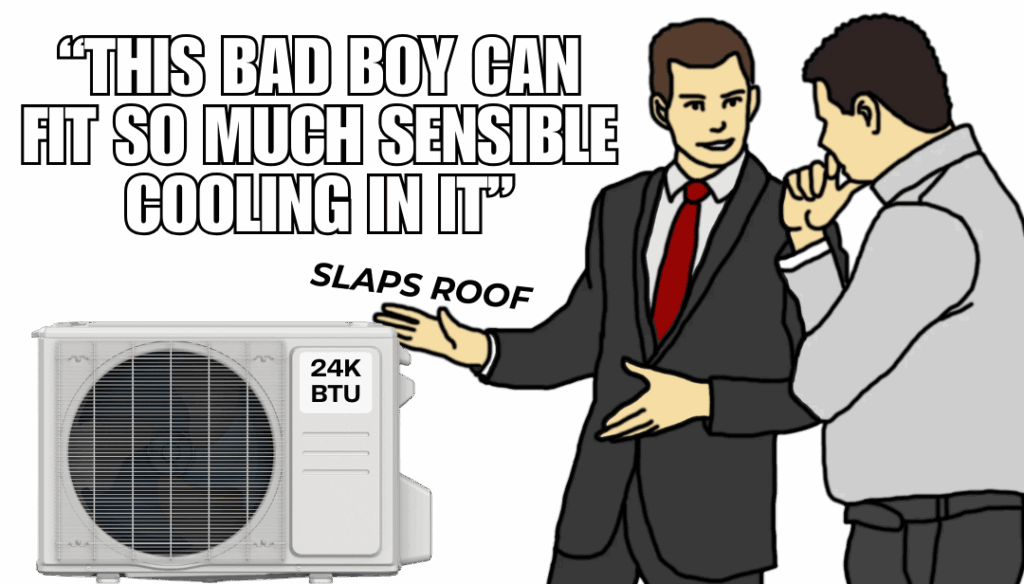
Oversizing Creates Problems: Larger mini splits short-cycle, removing less moisture than properly sized units running longer.
Multi-Zone Systems Struggle: A 36,000 BTU outdoor unit with an 18,000 BTU minimum capacity cannot modulate down for a single 6,000 BTU bedroom call, resulting in short cycles and zero latent removal.
Thermostat Satisfaction ≠ Comfort: When cooling stops, dehumidification stops. The system ramps based on sensible BTUs only, ignoring latent load entirely.
The 60°F Dew Point Rule: ASHRAE specifies indoor dew point below 60°F to prevent mold.¹ Surfaces that reach dew point temperature will sweat, and a mini split blowing 45°F air creates cold spots where moisture condenses.
Customers love mini splits… until August rolls around and their walls start sweating.
Sales reps talk about efficiency ratings and whisper-quiet operation. They rarely mention what happens when you install a high-SEER inverter system in a humid climate. The unit cools beautifully. The thermostat reads 72°F. And the customer calls you back because their closet smells like a gym bag.
This is the dehumidification gap. Understanding it will save you callbacks and protect your reputation.
Why Mini Splits Struggle with Humidity
Every air conditioner removes two types of heat. Sensible heat lowers temperature. Latent heat removes moisture. The ratio between them, called Sensible Heat Ratio (SHR), determines whether a system dries the air or just cools it. Understanding the refrigeration cycle fundamentals helps explain why this matters.
Traditional fixed-speed units ran at full blast until satisfied. Cold coil, lots of condensate, good dehumidification. Modern inverter mini splits are smarter. They modulate output to match the load, which is great for efficiency but terrible for moisture control.²
But when the room approaches setpoint, the inverter slows the compressor down to 15 Hz, refrigerant mass flow drops, suction pressure rises, and coil temperature floats up to 52°F or higher.
If the return air dew point is 58°F and your coil is running at 55°F, you have almost no dew point depression. Minimal condensation. The system becomes sensible-only cooling.
At low frequencies, SHR can approach 1.0. That means 100% sensible cooling and virtually zero moisture removal.³
The Oversizing Trap
A 12,000 BTU unit in a 100 square foot office will satisfy temperature in minutes. Even at minimum modulation, output exceeds load.
This will result in a latent penalty. Dehumidification takes time. When a compressor starts, the coil must cool down and wet out before condensate drips. This takes 10 to 15 minutes. An oversized unit running 5 minute cycles never gets there. The coil gets wet, the thermostat satisfies, and when the unit stops, that moisture re-evaporates right back into the room.
Florida HVAC contractor Curt Kinder documented exactly this: 85% RH with mold growing on wooden furniture from an oversized mini split.⁴ The fix was not refrigerant or cleaning. It was acknowledging the equipment was wrong for the load.
A Mitsubishi FS06 rated at 6,000 BTU has a minimum capacity of 1,700 BTU. When the actual load is 1,500 BTU per hour and the system bottoms out at 1,700, it short-cycles rather than dehumidifies. This is why proper heat load calculations matter more than ever with inverter equipment.
🎧 Podcast: Humidification and De-Humidification Deep Dive w/Brett Phillips from AprilAire, where he breaks down humidity management for residential and commercial spaces.
The Multi-Zone Trap
Multi-zone systems multiply these problems.
A 36,000 BTU outdoor unit might have an 18,000 BTU minimum capacity. Put four 9,000 BTU heads on it and run only the bedroom at night. The outdoor unit cannot modulate below 18,000 BTU to serve a zone needing 2,500 BTU.
Result: the bedroom unit gets flooded with capacity. Temperature drops fast. Compressor shuts off. Humidity stays high.
Gary discussed this with Gerry Wagner on the Inverter Compressor Technology podcast. The same features that make multi-zone systems flexible for capacity matching create headaches for humidity control.
One homeowner on Green Building Advisor reported persistent 60%+ RH from a Mitsubishi multi-zone despite the contractor changing jumper settings for coil temperature and fan speed. Nothing worked. The suggested fix: eliminate one condenser entirely.⁵
📺 Video: Ductless Heat Pump Tips for HVAC Pros to Master Zoning and Install Smarter with David Rames Part 1 covers multi-zone system design and installation considerations.
When to Add Dedicated Dehumidification
Some signs are obvious. Indoor humidity above 60% during cooling. Musty smell in closets. Visible condensation on supply vanes or the wall below the unit.
If the mini split cannot be right-sized, and often it cannot be in retrofit situations, you need supplemental dehumidification. Whole-house dehumidifiers from Aprilaire or Santa Fe run $1,500 to $3,500 installed. That is real money, but less than a mold remediation bill.
For context, ENERGY STAR program analysis ranks dedicated whole-home dehumidifiers well ahead of electric reheat dehumidification on annual energy use per pint of moisture removed, with typical residential paybacks landing inside the equipment’s useful life when runtime is high.⁶
The three pillars of indoor air quality are humidity, filtration, and ventilation. When a mini split handles only temperature, you have a one-legged stool.
🎧 Podcast: Dehumidification Stratagies w/ John Stischok from Armstrong Fluid Technology. Learn about controlling high humidity in HVAC systems.
Installation Practices That Help
Right-sizing is everything. Run a Manual J calculation. ACCA Manual S allows sizing as low as 90% of calculated cooling load. In humid climates, aggressive sizing at 88 to 90% improves dehumidification because the system runs longer.
Choose single-zone systems for bedrooms whenever possible. A 9,000 BTU 1:1 system can modulate down to 1,700 BTU. That same head on a multi-zone outdoor unit might struggle below 6,000 BTU.
Check fan behavior during thermal-off. Some units run the fan continuously to sense room temperature. This re-evaporates condensate from the coil. Cutting the JRRE jumpers on Mitsubishi indoor units stops the fan with the compressor, which prevents that humidity spike.
Dry mode is not a permanent solution. It locks the fan on low and runs the compressor in bursts to make the coil cold. But it keeps cooling the room. Your 72°F setpoint becomes 66°F, and the customer shuts it off because they are cold. Then humidity spikes again.
📺 Video: HVAC Maintenance – Checking Electric Reheats for Dehumidification. A Tutorial on electric reheat systems for dehumidification control.
The Bottom Line
Mini splits excel at sensible cooling. They struggle with latent loads, especially at part load conditions in humid climates.
Understanding the history of mini split technology helps explain why. These systems evolved in Japan, where climate conditions differ significantly from the American Southeast or Midwest. The drive for higher SEER ratings pushed manufacturers toward warmer coil temperatures, which is the opposite of what you need for moisture removal.
Do not promise humidity control with equipment designed for temperature control. When humidity matters, size conservatively and have the dedicated dehumidification conversation early. Your callback rate will thank you.
Additional Sources
ASHRAE. Position Document on Limiting Indoor Mold and Dampness in Buildings. American Society of Heating, Refrigerating and Air-Conditioning Engineers (2022).
Withers, C. & Sonne, J. Evaluating Moisture Control of Variable-Capacity Heat Pumps in Mechanically Ventilated, Low-Load Homes in Climate Zone 2A. Florida Solar Energy Center (2019).
ASHRAE Handbook of HVAC Systems and Equipment, Chapter 49: Unitary Air Conditioners and Heat Pumps. American Society of Heating, Refrigerating and Air-Conditioning Engineers (2024).
Bailes, A. Can You Oversize a Mini-Split Heat Pump? Energy Vanguard (2024).
Green Building Advisor. Options for Oversized Mini-Split Humidity Issues. Fine Homebuilding Media (2024).
U.S. ENERGY STAR. Dehumidifier Program Specification, Version 5.0. U.S. Environmental Protection Agency (2024).
Whether you require installation, repair, or maintenance, our technicians will assist you with top-quality service at any time of the day or night. Take comfort in knowing your indoor air quality is the best it can be with MOE heating & cooling services Ontario's solution for heating, air conditioning, and ventilation that’s cooler than the rest.
Contact us to schedule a visit. Our qualified team of technicians, are always ready to help you and guide you for heating and cooling issues. Weather you want to replace an old furnace or install a brand new air conditioner, we are here to help you. Our main office is at Kitchener but we can service most of Ontario's cities