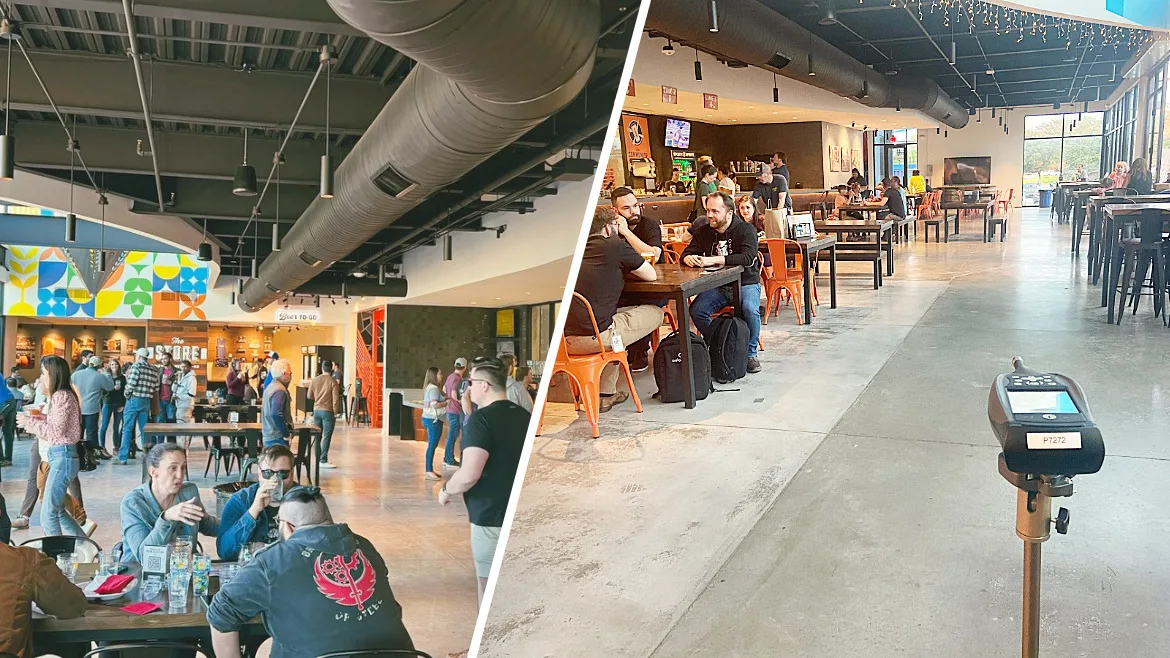
But at the massive 70,000-square-foot Community Beer Co. located in Dallas, owner Kevin Carr could tell a Texas-size problem was brewing. The space’s industrial design was creating a seriously bitter soundscape. Instead of a smooth blend of live music and conversation, the hard surfaces were reflecting sound that watered down guests’ enjoyment of the space.
Valuing precision in his brewing practices, Carr didn’t want to throw random ingredients into the mitigation effort and simply hope for the best. Below, he shares how acoustic analysis led to a mitigation strategy that filtered out the noise and served up a better-sounding experience for guests, staff and musicians.
1. When did you realize the acoustics were a problem?
From the beginning, our goal was to create a sense of community. But a chaotic soundscape made it hard for guests to connect with each other and enjoy the live music. Hard surfaces like concrete floors and steel beams reflected sound. Guests had to raise their voices just to talk to one another, and our staff needed regular breaks to rest their ears.
2. What impact was the noise having on the guest experience and business?
The atmosphere was convivial and high energy, which is exactly what we wanted, but there is a difference between lively and overwhelming. Guests’ voices were competing with noise bouncing off the hard surfaces. The high-end acoustic system we’d installed to support live music also had to compete with echoes throughout the space. In the end, conversations were hard to hear, and the quality of live music suffered. We even had some musical acts that were reluctant to rebook because of poor sound quality.
3. How did you approach the noise challenge?
We wanted data before purchasing any solution. It would have been easy to start hanging sound panels without really knowing whether they would solve the issue. Engineers at Owens Corning took measurements throughout the entire space to establish a baseline for the noise challenges in each area. The team wanted to understand how sound behaved in different areas of the restaurant, like the tap room and main dining space, so they measured background noise, operational sounds and reverberation levels in each space and level. That gave us confidence that the materials installed would address the actual problems.
4. What did the measurements show?
Measurement data showed that noise wasn’t simply a case of guests talking over each other. The space itself was making everything louder because sound bounced around for so long. Once we understood how much reverberation was contributing to the noise, it became clear that we needed to change how the space handled sound. We needed to trap it and diffuse it. We also wanted to address the problem without taking away from the industrial chic design that was part of our identity.
5. How did you handle acoustic mitigations without changing the look of the space?
We didn’t want to cover walls with obvious acoustic treatments, lay down carpet or hang drapes. Maintaining the open feel was important, so setting up a lot of partitions wasn’t a good idea either. The team addressed this challenge by installing Owens Corning SelectSound® FF-Black Acoustic Boards Next Generation. The boards are covered with a black veil that seems to disappear into the open plenum. Installation was straightforward, and the boards attached with dark impaling pins.
Beyond the ceiling, the boards were also wrapped around elements like beams and protuberances, where they catch sound waves that travel horizontally across the room, essentially acting as sound sponges that soak up noise and keep it from bouncing around the room. The material is designed to absorb the mid-to-high frequencies that are common in hospitality spaces.
The installation was also planned so that we could keep operations, and our people, working without having to shut down for a retrofit.
7. How did the sound intervention affect noise levels?
The change was noticed immediately. Conversations became much easier, and guests no longer had to raise their voices to be heard across the table. Music didn’t have to compete against echoes. It simply made the entire space feel more relaxed. Complaints about noise essentially disappeared after the first floor was completed, and staff stopped needing “ear rests” every 30 minutes.
Owens Corning engineers also provided us with data to quantify the improvements. Data from testing conducted by Owens Corning showed the SelectSound® FF-Black Acoustic Boards Next Generation achieved a 50% reduction in reverberation times1, meaning that sound energy is able to decay twice as fast. The data also showed a 50% reduction in background noise1, a 25% reduction in normal operation noise1, and the main taproom was 6 dB quieter1.
1 Owens Corning SelectSound FF Black Acoustic Board Next Generation Installation Internal Study, dated 2024
9. Looking back, would you have approached acoustics differently during the original design?
Without question. If you’re designing a large hospitality space with concrete, steel, glass and open ceilings, acoustics should be considered from the beginning. It’s much easier to address potential noise problems during design than to retrofit later. We were fortunate that we found an effective solution, but planning for acoustics early would have saved time and effort.
10. What advice would you offer engineers and designers working on hospitality projects?
Don’t think of acoustics as a “nice-to-have” or a finishing touch. Sound is part of the overall performance of the building. You can create a visually inviting space, but if people struggle to hear each other, the building isn’t fully delivering on its purpose. Good acoustic design can boost the guest experience and give building owners greater flexibility in how they make use of space.
Whether you require installation, repair, or maintenance, our technicians will assist you with top-quality service at any time of the day or night. Take comfort in knowing your indoor air quality is the best it can be with MOE heating & cooling services Ontario's solution for heating, air conditioning, and ventilation that’s cooler than the rest.
Contact us to schedule a visit. Our qualified team of technicians, are always ready to help you and guide you for heating and cooling issues. Weather you want to replace an old furnace or install a brand new air conditioner, we are here to help you. Our main office is at Kitchener but we can service most of Ontario's cities
Source link