
Key Takeaways
- AI is pattern matching, not thinking: Today’s tools line up your situation against millions of past examples and predict the most likely answer. That is powerful, and it is not understanding, which is exactly why you can see through the sales pitch once you know how it works.
- Confident does not mean correct: On open-ended factual questions, some of the newest “reasoning” models returned wrong answers up to 79 percent of the time, in the same smooth voice they use when they are right. The verification is on you.
- “AI employee” and “agent” mean something specific: The jump from a chatbot to a tool that does real work is the ability to take an action in software. Knowing that line tells you which claims are plausible and which are vapor.
- Where the data comes from decides whether to trust it: A tool built on manufacturer specs and bulletins beats one scraping open forums for a technical answer. Always make a tool show its source.
Every week there is a new AI tool that will read your compressor, book your calls, or optimize your plant, and every pitch sounds like science fiction. Some of it is real and useful. A lot of it rides on a word most people cannot define. Strip the hype away and modern AI is doing one core thing: matching patterns and predicting the most likely next piece.
That is not an insult to the technology, it is the key to using it well. Once you understand what is happening inside the box, you stop being impressed by demos and start asking the questions that separate a tool worth paying for from a 150 dollar ghost.
What AI Actually Is: A Pattern Matcher That Predicts
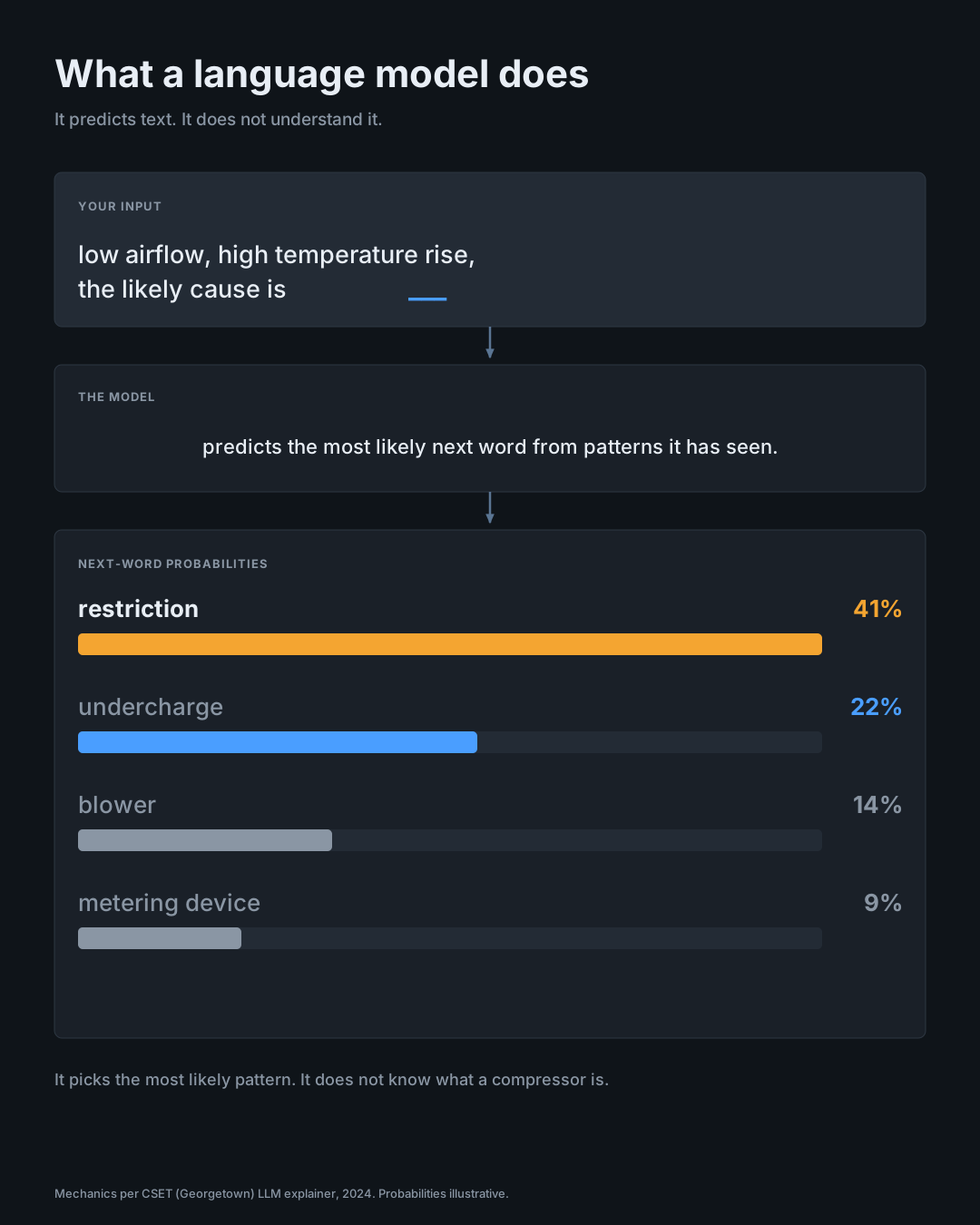
A large language model, the kind of AI behind ChatGPT and the chatbots being sold to your shop, works by predicting text. It takes your input and calculates what is most likely to come next, one piece at a time, based on patterns it absorbed from a huge pile of text during training.¹ There is a lot of math and probability running underneath, and there is no concept, no meaning, and no understanding behind it.
The cleanest way to see the limit is a picture. Ask an image generator for a clock showing 6:00 and it will very often hand you a clock with the hands at 10 and 2, because nearly every clock photo it trained on was set to 10:10 for advertising.² The model is not reading time. It is returning the most statistically common pattern that matches the word “clock.” Text models do the same thing with your questions. For HVAC, the most common text about a piece of equipment is generic consumer-facing marketing, not the service bulletin or fault-code table you actually need.
Researchers have put numbers to this. When Apple’s team took standard math problems and only changed the names and values, leading models dropped accuracy, which points to pattern matching over training data rather than formal step-by-step logic.³ That is the honest frame for the whole category: statistically sophisticated pattern matching that can produce outputs resembling reasoning without performing it. If you want a starting map of where these tools fit in the trade, our guide on navigating AI and automation is a good on-ramp.
Why It Sounds So Sure of Itself
Here is the part the marketing skips. When the pattern is thin or missing, the model still predicts an answer, because predicting is the only thing it does. It does not say “I do not know” unless it was specifically built to. The dangerous result for a tech is that a wrong answer arrives with the same confidence as a right one.
The data on this is blunt. On open-ended factual benchmarks, OpenAI’s own testing showed its o3 model wrong on about 51 percent of general-knowledge questions and its o4-mini model wrong on roughly 79 percent, with public-figure questions landing near 33 and 48 percent. Newer reasoning models actually scored worse on these open-ended recall tasks than the versions before them.⁴ The lesson here is not that AI is useless. On a constrained task, like pasting in a spec sheet and asking it to summarize what you handed it, error rates fall a lot. On an open question like “what causes this fault on this unit,” you are in the high-risk zone.

It gets worse for trust. A peer-reviewed study found that people over-estimate how accurate an AI answer is when it comes with a long, fluent explanation, even when the extra length adds no accuracy.⁵ The polish is doing the convincing, not the correctness. Treat any single AI answer as one input to weigh, the same discipline covered in prompting a service call.
Chatbot, Agent, “AI Employee”: What the Words Mean
Buyers get hit with three words that are not the same thing. A plain chatbot takes text and returns text. A reasoning model parses what you meant and works through steps. An agent reasons and then takes a real action in software, using tools and following a goal with limited supervision.⁶ An “AI CSR that books the job” is a narrow, tool-using agent doing one defined workflow.
That distinction is your hype filter. “Our AI talks to your customers” is table stakes. “Our AI books the job and writes it to your schedule” is a real, checkable claim you can ask a vendor to demo live. Calling a single-workflow booking agent an “AI employee” oversells it, and knowing the ladder tells you exactly what to make them prove.
Adoption is real but earlier than the ads suggest. In one 2026 survey of contractors across the trades, only 12 percent had embedded AI into operations, 34 percent were experimenting, and 41 percent were still watching (a vendor-run survey, so read the source-base bias).⁷ A separate vendor report put active AI use among HVAC contractors near 38 percent.⁸ Most shops are evaluating, not running, which is the right speed.
Garbage In, Garbage Library: Where the Answer Comes From
After your question, the biggest quality lever is the data the tool was built on. An open-web model trained on forums, videos, and random posts is a different animal from a closed tool grounded in manufacturer specs, bulletins, and fault-code tables. When researchers grounded models in the right source documents before answering, accuracy on factual tasks improved substantially over the model working from memory alone.⁹ In a head-to-head on technical questions, a chatbot trained on a specific professional guideline set outscored general chatbots like ChatGPT and Gemini.¹⁰
That is the real case for a manufacturer-built app, the kind that sifts decades of compressor data when you punch in a model number, over a cold web chatbot for a technical lookup. The same sourcing problem shows up in search, which we covered in answer engine optimization. Black box versus white box comes down to one question: can the tool show you where the answer came from? If it cannot point to a bulletin number and revision date, weight it lower.
Answer honestly about the tool being pitched
Will it show its source for an answer (manual, bulletin, doc and revision)?Non-negotiable
Is it grounded in data fit for your work (manufacturer specs, your records), not just the open web?
Does it flag when it is unsure, instead of always answering with confidence?
Is there a clear line for what it does alone vs what needs your sign-off, with an override?Non-negotiable
Can you check its output faster than just doing the task yourself?
Does it tie into your field-service and accounting software without double entry?
Do you own your data, can you audit it, and export it if you cancel?Non-negotiable
Can the vendor show a real before and after or reference customers, not just a demo?
How it scores: three answers are non-negotiable. If a non-negotiable is a No, the tool fails no matter how it scores elsewhere. Source, human override, and data ownership are the ones you do not bend on.
Verdict
Recommendation
—
answer the 8 questions
Red flags
—
non-negotiables missing
Answer the questions above
Every box starts at No on purpose. Most tools fail at least one non-negotiable, so make the vendor earn each Yes.
A Field Tech’s BS Detector: Five Questions for Any AI Pitch
Turn all of this into five questions you keep on the truck:
- What is it actually matching against? What data was it trained on, and is that data right for my problem?
- Will it show its source? A spec sheet and a forum post are not equal evidence.
- What does it do when it does not know? Does it flag uncertainty, or just predict anyway?
- Where is the human in the loop? What can it do on its own, and what needs my sign-off?
- Can I verify the output fast? If checking the answer takes longer than doing the job, it is not saving you time.
None of this means avoid AI. It means use it with your eyes open, the way you would not trust a meter you never calibrated. The techs who understand the machine get the value. The ones who treat it as magic inherit its mistakes. Staying curious about the tools, the theme of the Kaizen mindset, is how you keep the upper hand.
Next time a tool gets pitched to you, run the five questions before the demo dazzles you. The pitch is built to hide the limits. You now know where they live.
Additional Sources
- “The Surprising Power of Next Word Prediction: Large Language Models Explained, Part 1”, Center for Security and Emerging Technology (CSET), Georgetown University, Explainer, 2024.
- “The 10:10 Clock Paradox: Why AIs Insist on the Default”, TI Inside, Technology Analysis, 2025.
- “GSM-Symbolic: Understanding the Limitations of Mathematical Reasoning in Large Language Models”, Mirzadeh et al., Apple, Research Paper (arXiv), 2024.
- “OpenAI’s New Reasoning AI Models Hallucinate More”, TechCrunch, Technology Report, 2025; and “A.I. Is Getting More Powerful, but Its Hallucinations Are Getting Worse”, The New York Times, News Analysis, 2025.
- “What Large Language Models Know and What People Think They Know”, Steyvers et al., Nature Machine Intelligence, Peer-Reviewed Study, 2024.
- “What Are AI Agents?”, Amazon Web Services, Technical Documentation, 2025.
- “2026 State of AI in the Trades”, ServiceTitan, Industry Survey, 2026.
- “2025 AI Industry Report: The AI-Assisted Skilled Trades Pro”, Housecall Pro, Industry Survey, 2025.
- “CRAG: Comprehensive RAG Benchmark”, Meta AI Research, Conference Paper (NeurIPS), 2024.
- “Performance Comparison of a Domain-Specific Chatbot and General-Purpose Models”, Dental Traumatology (Wiley), Peer-Reviewed Study, 2025.
Whether you require installation, repair, or maintenance, our technicians will assist you with top-quality service at any time of the day or night. Take comfort in knowing your indoor air quality is the best it can be with MOE heating & cooling services Ontario's solution for heating, air conditioning, and ventilation that’s cooler than the rest.
Contact us to schedule a visit. Our qualified team of technicians, are always ready to help you and guide you for heating and cooling issues. Weather you want to replace an old furnace or install a brand new air conditioner, we are here to help you. Our main office is at Kitchener but we can service most of Ontario's cities
Source link