There comes a point when you can walk away.
You can sell the company, take the money and sit on a beach somewhere. After decades of early mornings, payrolls, equipment purchases and customer emergencies, nobody would blame you.
Steve Passannante could have done that.
Instead, every morning when he backs out of his driveway, he sees a plaque honoring his father. He points toward it and makes the old man a promise.
“I’m gonna be better than you today, Dad.”
Then comes the admission: “I never will be, but I never stop trying.”
His father has been gone for decades. It doesn’t seem to matter. Passannante still talks to him every day.
That ritual stuck with me after I left Cleats Manufacturing because I hadn’t gone there looking for a story about fathers and sons, loyalty, apprentices or the people who teach you how to work.
I went there looking for innovation, and I was pretty determined to find it.
So I kept asking Passannante about technology. What changed? What did the new machines make possible? How did you know when to take the risk?
Passannante answered me. But then he’d start talking about his father. I’d ask about machinery, and we’d end up talking about an employee. I’d ask about technological change, and he’d tell me about his sons. Then there was the apprentice whose parents called him at home, the food truck driver who couldn’t believe the boss regularly bought lunch for his crew, and the man who taught a young Passannante how to operate a Bobcat.
At some point, I stopped trying to pull him back. And once I did, the innovation story started making sense.
Cleats’ story isn’t one of rejecting technology. Passannante spent years investing in equipment that kept the company competitive, and he described a collaborative process for making those decisions.
“You jump in because the guy that’s selling it to you, you pick their mind, and you have your people with you, not just me,” he said. “Because my people, my workers have questions I won’t ask.”
Once everyone was comfortable, Cleats would make the investment and work through the adjustments.
“All the machines that we bought, I’m glad we bought them because they kept us competitive with today’s market,” Passannante said.
Now his sons are increasingly driving those decisions.
“Me getting older, with my kids coming up, they’re the force behind it now,” he said.
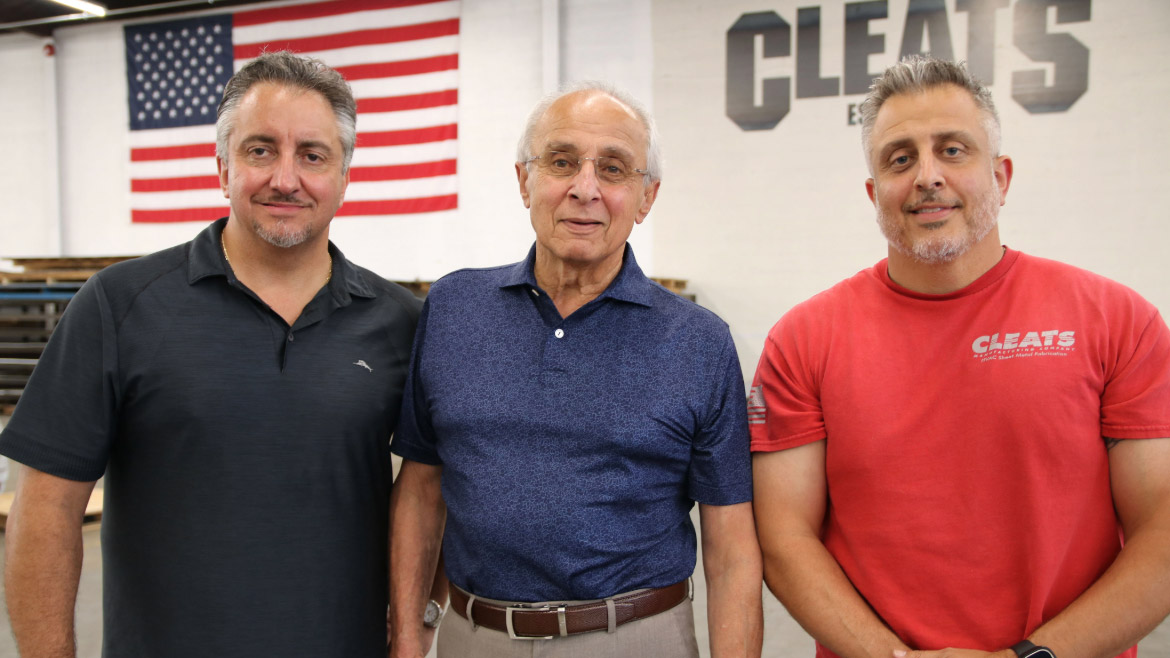
FAMILY LEGACY: Steve Passannante junior, left, with Steve Passannante senior and Nick Passannante. (Staff photo courtesy of Austin Keating)
That might be the conventional innovation story. One generation adopts the machinery of its era, then hands the company to another. But it isn’t the whole story.
Ernie DeLord founded Cleats Manufacturing in 1964, initially producing slip and drive cleats. Passannante, DeLord’s son-in-law, joined in 1974, when the company’s product line still centered on sheet-metal connectors.
Back then, contractors performed more fabrication themselves, often sending unassembled duct to the field and assembling it on site. Cleats gradually took on more of that work, adding rectangular duct and fittings, spiral pipe, gasketed round fittings, welded duct, prefabricated assemblies and other sheet-metal products.
Each addition shifted another piece of fabrication away from the jobsite and into the shop.
The idea was straightforward: Let contractors concentrate on what they did best while Cleats concentrated on fabrication.
That specialization became the company’s niche. Cleats didn’t become a service contractor. It became a fabricator, expanding from connectors into complete ductwork systems while building relationships with some of Chicago’s largest contractors. By its 50th anniversary in 2014, Cleats was recognized in the Congressional Record as one of the largest HVAC fabricators in Chicagoland.
Machines made that scale possible, but Passannante kept returning to something else when explaining how the company got there: People.
“I didn’t do it,” he told me. “We did it.” Then he said it another way: “They make this place what it is.”

PARTNERSHIPS: From left to right: Marty Kackys, Director of Operations; Steve Jr., President; Joe Passannante, CEO; Steve Sr., President Emeritus; and Eli Howard, COO of SMACNA. (Courtesy of Cleats Manufacturing)
To understand why Passannante talks that way, you have to go back before Cleats.
He grew up around New York and New Jersey. His family had nice things, including horses and go-karts, but his father made sure comfort didn’t become entitlement.
“My dad taught me how to work,” Passannante said. “I wasn’t spoiled. He made me work.”
At his father’s garbage business, one worker taught Passannante how to drive a Bobcat and what hard physical work looked like. Their relationship extended far beyond the job. When the man died, his family asked Passannante to serve as a pallbearer and escort the man’s wife at the funeral.
He wasn’t one of the man’s children. But they trusted him like family.
That relationship left an impression. So did watching his father run a business.
Decades later, those lessons show up around Cleats. Several times a month, when the food truck comes around, Passannante picks up the bill for his employees, usually $150 to $250.
“I get that money back before the day’s over,” he said.
“How do you not treat your people?” Passannante added. “They’re making your life better.”

GENERATIONS: Nick Passannante and the next generation of Cleats Manufacturing carry forward a family business built on sheet metal fabrication, technology and long-standing relationships. (Staff photo courtesy of Austin Keating)
He makes a point of recognizing apprentices when they’re doing good work. He’s even received calls from parents he had never met who wanted him to know how highly their sons spoke of him.
“There are good kids out there,” Passannante said. “You just don’t hear about them.”
There is evidence inside Cleats that the approach has staying power. Shop Foreman Oscar Figueroa came to Cleats as an apprentice in 2008 and stayed. Several employees, Figueroa said, have been there for more than 20 years.
“It’s the people,” Figueroa concluded. “It’s always your people.”
The philosophy extends to customers. Sheet metal fabrication is rarely static. Jobs change. Dimensions change. Ductwork that was needed yesterday can suddenly be replaced by something else that’s now an emergency.
“If I make the mistake, instantly it’s corrected,” Passannante said. “If they make the mistake, I do my best to make the change and give them a break on the price.”
Why? “You build a relationship with people.”
Those relationships extended throughout the trade. Passannante became involved with SMACNA Greater Chicago, and his son Joe, who joined Cleats in 2004 and became vice president of operations, then CEO, later served as the chapter’s president. Joe, Nick Passannante and Steve Passannante Jr. are all part of Cleats today, with Joe serving as CEO, Nick serving as vice president and Steve serving as president.
The physical evidence of the company’s evolution is all around them. At the old facility, getting finished duct onto a truck could be an ordeal. The current plant has eight loading docks. Two duct lines can run concurrently, avoiding roughly 15 minutes otherwise spent switching sizes. Automation has removed labor from processes that once required more hands.
“I’m so proud of this building,” Passannante said. “Compared to what we had, it’s incredible.”
Yet inside that modern sheet metal operation, he still takes pride in having done the work himself.
He recalled unloading a truck loaded with skids and coils while several apprentices watched. They hadn’t known he could drive a forklift. Apparently, neither had the driver.
“You’re the best dressed forklift driver I’ve ever seen,” the driver told him.
Passannante laughed. “I’ve done all this stuff.”

PEOPLE FIRST: Cleats employees combine skilled labor with specialized machinery to produce ductwork and fittings for contractors across the Chicago market. (Staff photo courtesy of Austin Keating)
His father taught him to work. Other workers taught him skills. Figueroa went from apprentice to shop foreman. Now another group of apprentices is learning inside a fabrication operation those earlier generations would barely recognize.
Passannante may miss his flip phone, but don’t confuse that with resistance to change.
“You got to move with the times,” he said.
Cleats did. So did Passannante. Now his sons are doing it again.
“I didn’t want to sell this place because I wanted my kids to have it,” he said. “They wanted it. That’s why I wanted them to have it. That’s why I didn’t sell it.”
That answer gets closer to what I had been trying to find with all those questions about innovation.
The machinery matters. Two duct lines running simultaneously matter. Eight loading docks matter. Moving fabrication off the jobsite matters. Those improvements helped turn a company making cleats and connectors into a major HVAC duct fabricator.
But they don’t explain why somebody chooses not to sell, why employees stay for 20 years or why contractors keep coming back when they have more options than ever. Relationships do.
Innovation doesn’t always arrive on a truck wrapped in plastic. Sometimes it’s incremental: a fitting made in the shop instead of the field, another machine, another loading dock, another employee who learns a trade, another contractor who knows the fabricator on the other end of the phone will make it right.
Day after day, year after year, the accumulation becomes the innovation.
Passannante measures himself the same way.
Every morning he backs out, sees that plaque and issues the same challenge.
“I’m gonna be better than you today, Dad.”
He knows he won’t be. At least that’s what he says. But tomorrow he’ll try again.
His sons are doing the same in their own way. They’ll buy the next machine, solve the next fabrication problem and make the place a little different from the company their father handed them.
Apprentices will become journeymen. Some will stay 20 years. Incrementally.
And after spending an interview trying to get Steve Passannante to tell me about innovation, I finally understood that he’d been talking about it all along.
Whether you require installation, repair, or maintenance, our technicians will assist you with top-quality service at any time of the day or night. Take comfort in knowing your indoor air quality is the best it can be with MOE heating & cooling services Ontario's solution for heating, air conditioning, and ventilation that’s cooler than the rest.
Contact us to schedule a visit. Our qualified team of technicians, are always ready to help you and guide you for heating and cooling issues. Weather you want to replace an old furnace or install a brand new air conditioner, we are here to help you. Our main office is at Kitchener but we can service most of Ontario's cities
Source link