
Key Takeaways
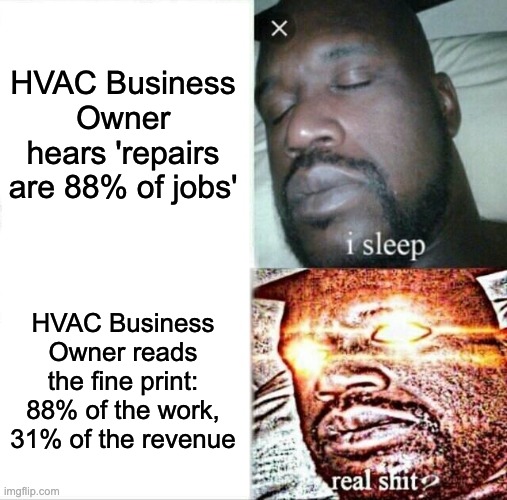
- Repair is the new bread and butter, by volume: Roughly 88% of HVAC jobs are now repairs, but repairs are only about 31% of revenue.¹ ² The shop that wins reads that gap correctly and builds for the workload it creates.
- The math pushes every customer toward financing: The average repair ticket is up 47% to about $1,205,¹ yet 37% of adults cannot cover a $400 surprise in cash.³ Offer a payment plan and 62% of homeowners are more likely to move forward.²
- Repair-led work is high margin and high transaction count: Service and maintenance gross margin (revenue left after the direct cost of the job) beats install margin, but you run far more invoices, calls, and truck rolls per dollar collected.
- You win on operational leverage, not headcount: A repair-led shop drowns in admin. Pairing automation with a human in the loop lets a two or three van operation carry a big-shop back office without a big-shop payroll.
Something changed in the residential HVAC market, and most new owners are reading it wrong. They see softening replacement sales and assume customers have stopped spending. Homeowners are spending differently in 2026: repair over replace, urgency over planning, and financing over cash. For a contractor still building a book of business, that shift is an opening.
Housecall Pro’s platform data shows the average HVAC repair ticket rose 47% over four years, from about $818 in 2021 to roughly $1,205 in 2025.¹
The rise of the repair economy was one of the themes Gary covered with Roland Ligtenberg, Co-Founder of Housecall Pro, on the Business Edition podcast (co-hosted by Furman Haynes of WorkHero):
Read the Numbers Right: Volume Versus Revenue
Here is the trap, and it is the most important thing to get straight. Repairs are about 88% of HVAC jobs by count, but only about 31% of revenue.¹ ² Both numbers are true, and the space between them is the whole insight.
One install ($8,000 to $16,000 or more) dwarfs one repair ($1,205). Installs still own most of the dollars, while repairs own almost all of the work. For every 100 jobs you dispatch, roughly 88 are repairs. That is where your trucks, your phone time, and your invoicing time go. If you hear “repair is most of the business” and picture a few big tickets, you will build the wrong shop. The repair economy is a workload story: more jobs, smaller tickets, faster turnover. Design for transaction count, not transaction size.
Why Homeowners Are Stuck in Repair Mode
The conditions pushing customers toward repair are structural, and they are not lifting soon. Roughly 72% of homeowners are not planning to move, and about 69% live in homes 20 years or older.² That is a built-in base of aging equipment somebody has to keep running.
Meanwhile a new system got a lot more expensive. The A2L refrigerant transition means new R-410A equipment can no longer be sold as of January 1, 2026, and the redesigned R-454B and R-32 systems cost more to build. Add tariffs that HARDI has flagged as high as 46% on top exporters,⁴ and new-system retail is running an estimated 15% to 30% higher than before.
The independent data backs the squeeze. New central AC and heat pump shipments fell hard through 2025, down 26.8% in July, 30% in August, and 49.4% in October year over year.⁵ A replacement now costs eight to thirteen times what a repair costs, so a homeowner with a 15-year-old system makes the rational call and fixes it. One note so you do not over-rotate: existing R-410A systems are legal to operate and repair for the foreseeable future, which is exactly why the repair pipeline is deep.
Why Repair Means Financed
The repair economy and consumer financing are the same conversation. Most homeowners cannot absorb a surprise repair in cash. Federal Reserve data shows 37% of U.S. adults cannot cover a $400 emergency without borrowing,³ and Synchrony found only about one in four homeowners has repair savings set aside.⁶ So the offer matters as much as the price. In Housecall Pro’s 2026 survey of more than 1,100 homeowners, 62% said they are more likely to move forward when financing is offered.² A new condenser at “$12,000 today” gets a no. The same job at a monthly payment gets a yes more than half the time.
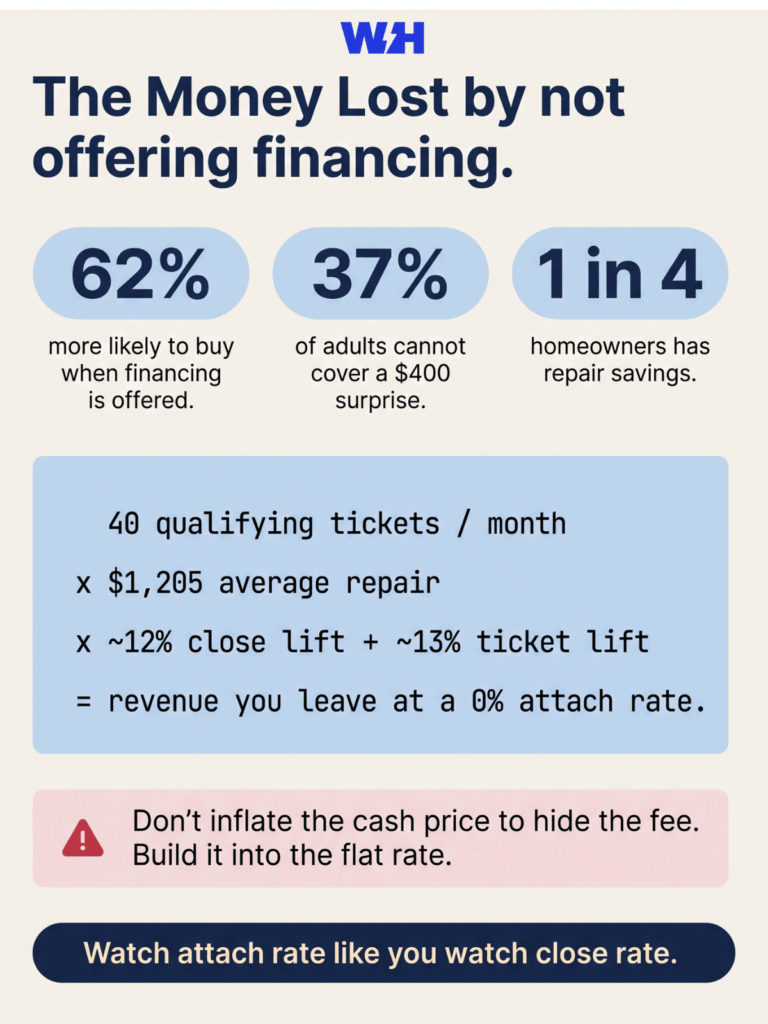
Financing is not free. Providers like Wisetack, GoodLeap, and Synchrony charge dealer fees that come off your margin (gross margin: the money left after the cost of the job), from a couple of points on a standard plan to nine or twelve points on a long zero-percent promo. Some shops inflate the cash price to bury that fee, a practice now drawing regulatory attention. The clean way: price transparently, build a known financing cost into your flat rate, and let the customer choose. The payoff is real. Contractors using integrated financing see roughly 12% higher close rates and 13% higher average tickets.⁷
Your Numbers
How it works. Housecall Pro’s 2026 homeowner survey found 62% are likelier to move forward when financing is offered. Contractors using integrated financing see about 12% higher close rates and 13% bigger tickets (ServiceTitan, Synchrony and Visa). This tool applies that lift to the share of tickets where you offer a plan.
Quick Presets
Left on the table / year
—
by staying at your current attach rate instead of the target
Added revenue / month
—
at the target attach rate
Financing upside vs cash only
—
$ / year at target
Dealer fees / year
—
build this into your flat rate
Net Revenue / Year
Estimates only, not financial advice. Real results depend on your offer, your providers, and how you present price. Build the dealer fee into your flat rate rather than inflating the cash price.
The Repair-Led P&L
Repair-led work is more profitable per dollar than most owners expect. Diagnostic and service calls run 50% to 65% gross margin, repairs 45% to 60%, and maintenance agreements 55% to 75%. Residential replacement runs 35% to 50%, new construction often 18% to 28%. (Treat these as industry-range benchmarks.) That spread is why so many busy shops are broke: a healthy service department quietly subsidizes a bloated install department, and the blended number hides it. We broke that down in why your business loses money on $150 service calls.
Leaning repair-led strips out the low-margin install drag and pushes you toward recurring revenue, where durable businesses get built. Maintenance programs report retention as high as 96%, and a maintenance-heavy book is a more valuable, more sellable asset. If you have not built one, service agreements are your shoulder-season insurance, and whatever you do, start your pricing at market rate.
The Admin Load
Now the hard part. Remember the gap: 88% of the work for 31% of the revenue.
A repair-led shop runs far more dispatches, invoices, reminders, and follow-ups per dollar than an install shop. Three repairs and a tune-up in a day is four invoices, four follow-ups, and four chances to drop a ball. The admin weight scales with job count, and your job count just exploded. We have written about the admin tax paperwork puts on your service hours, and a repair-led model is where that tax gets most expensive.
You have three ways to carry it:
- Hire a full-time office person at roughly $4,000 to $6,000 a month in fixed overhead, which compresses the margin the repair strategy was meant to protect.
- Do it yourself on 60-hour weeks until you burn out.
- Or use the option that did not exist for a small shop a few years ago: a back office that combines automation with human experts, where the software handles repetitive volume (booking, reminders, invoicing) and trained humans own the judgment calls.
Housecall Pro’s 2025 survey found more than 70% of contractors have tried AI tools, active users reclaim about four or more hours a week, and adoption runs about as fast for solo operators as for 50-person firms.⁸ The leverage that used to belong only to large shops is now available to the one-van operator. Just get on one system of record first before you bolt on anything clever.
Do Not Torch Your Install Capability
Part of this repair surge is cyclical. The industry contracted after the mid-2000s peak, so fewer systems were installed for years and a wave of equipment is aging out together. Some of the 2025 shipment drop is also de-stocking after buyers pulled installs into 2024 ahead of the refrigerant change. The replacement market will come back, and the shops with the deepest repair relationships will own that rebound.
So treat repair as the front door, not the whole house. Be honest about the line between a smart repair and a sale you should not make. A clean heuristic: lean toward repair when the repair cost is under roughly 30% to 50% of replacement and the system is under about 10 to 12 years for a heat pump or AC, or 15 years for a furnace. Have the total-cost-of-ownership talk out loud. That honesty turns a $300 repair customer into a $14,000 replacement customer two winters from now. For the bigger picture, our 2026 HVAC market correction survival guide holds up.
Where to Start
Do three things this week. Turn on a financing option and build its known cost into your flat rate, so the 62% who need a payment plan can say yes without you eating the fee blind. Separate your service and install margins on paper so you can see which department actually feeds you. Pick one system of record and run every job, invoice, and follow-up through it, then decide what you automate and what stays human.
Homeowners changed how they spend, and the contractor who builds for more jobs, faster answers, and easier payment is the one who gets paid.
Additional Sources
- “Trades Pulse: HVAC Repair Economics”, Housecall Pro, Industry Report, 2026.
- “The State of Home Service Spending”, Housecall Pro, Consumer Survey, 2026.
- “Economic Well-Being of U.S. Households (SHED)”, Federal Reserve Board, Government Report, 2025.
- “Tariffs and HVACR Equipment Pricing”, HARDI via The ACHR News, Trade Publication, 2025.
- “Monthly Shipments Data”, Air-Conditioning, Heating, and Refrigeration Institute (AHRI), Industry Data, 2025.
- “Lifetime of Home Care Study”, Synchrony, Consumer Survey, 2026.
- “Consumer Trends Report”, ServiceTitan with Synchrony and Visa, Industry Report, 2025.
- “AI Adoption Report”, Housecall Pro, Industry Survey, 2025.
Whether you require installation, repair, or maintenance, our technicians will assist you with top-quality service at any time of the day or night. Take comfort in knowing your indoor air quality is the best it can be with MOE heating & cooling services Ontario's solution for heating, air conditioning, and ventilation that’s cooler than the rest.
Contact us to schedule a visit. Our qualified team of technicians, are always ready to help you and guide you for heating and cooling issues. Weather you want to replace an old furnace or install a brand new air conditioner, we are here to help you. Our main office is at Kitchener but we can service most of Ontario's cities
Source link