
Key Takeaways
- Every HVAC business hits three growth ceilings: 1-3 trucks, 4-8 trucks, and 10+ trucks. Each one is broken by a people decision, not a market condition or a bigger line of credit.
- Ceiling 1 breaks when you stop doing everything yourself. Your first real operational hire, often your spouse or a dedicated office person, is what gets you past three trucks. The kitchen table payroll phase has an expiration date.
- The math on your “free” office labor is brutal. If you are answering phones from an attic instead of running calls, you are leaving $55,000 or more per year on the table. That is the cost of the chair you refuse to fill.
- Your spouse is a cheat code, not a shortcut. A co-owner with equal emotional investment will outperform any employee. But that only works if you both chose it, not if one person got drafted.
More than 70% of HVAC businesses in the United States are family-owned.¹ That number makes sense when you think about how most of them start: one technician, one truck, and a spouse handling the books after their own workday ends. It is the most common origin story in the trade.
What is less common is the business that grows past it.
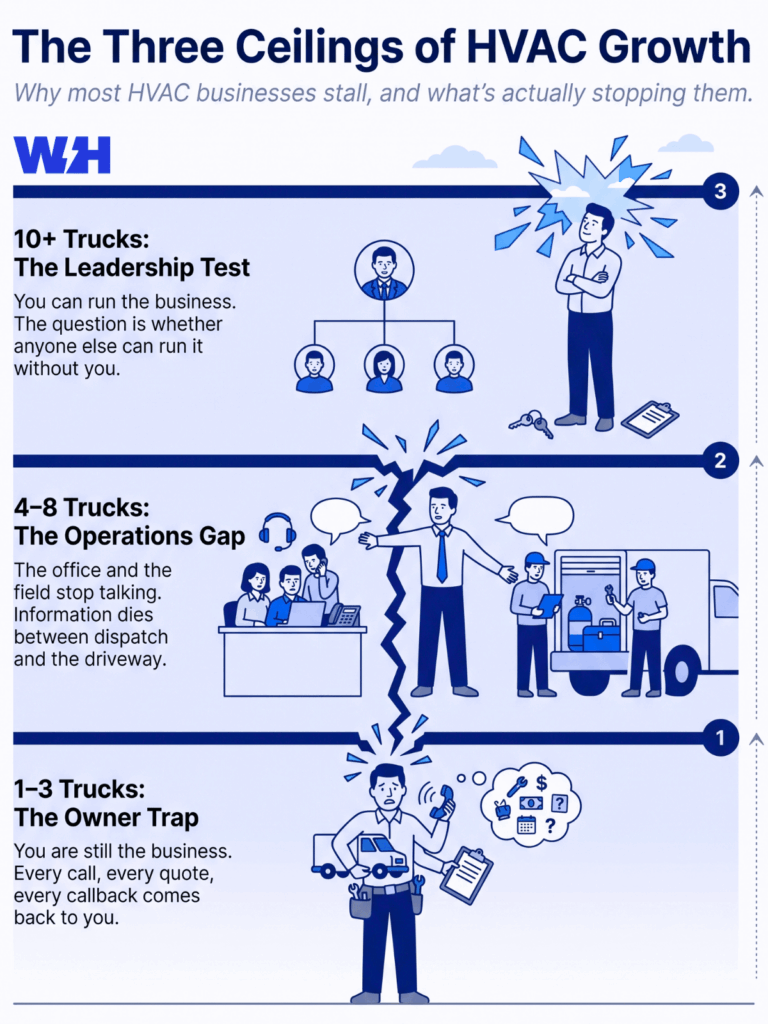
Industry benchmarking data suggests that HVAC contractors face three distinct growth plateaus, typically at 1-3 trucks, 4-8 trucks, and 10+ trucks.² The average contractor who reaches 10 trucks has been at it for 7 to 15 years. Most never get there. Not because the work dries up or the market turns, but because they never make the people decision that breaks through the ceiling they are stuck under.
If you are wondering why your business has been the same size for the last three or four years despite steady demand, this framework might explain it.
The Three Ceilings of HVAC Growth
The pattern is consistent enough across the industry to be worth naming.
Ceiling 1 (1-3 trucks) is the owner trap. You are the technician, the dispatcher, the bookkeeper, and the boss. You answer calls between service appointments. You run payroll from the cab of your truck. If you have a spouse involved, they are probably doing accounts payable from the kitchen table with no title, no salary, and no clear end point. The business runs because you personally touch everything.
Ceiling 2 (4-8 trucks) is the operations gap. You have employees now, but the office and the field do not understand each other. The field thinks the office pushes paper. The office thinks the field ignores every process you implement. Systems that worked at three trucks start breaking at six.
Ceiling 3 (10+ trucks) is the leadership test. You have people and systems, but every important decision still routes through you. The business runs, but only as long as you are in the room.
Each ceiling breaks the same way. Not with a new piece of equipment or a bigger credit line, but with a people decision that changes how the business operates. If you are thinking about starting your own HVAC business, understanding these ceilings before you hit them is the single most valuable planning tool you will find.
Ceiling 1: The Owner Trap
This is where most HVAC businesses live permanently. The owner is generating all or most of the revenue. Every administrative task that pulls them away from the field is unbilled time, and unbilled time compounds fast.
The math is not complicated. A residential HVAC technician in 2026 bills between $85 and $150 per hour for standard service.³ If you are spending 20 hours a week on phones, dispatch, invoicing, and follow-ups instead of running calls, that is $2,000 a week in lost revenue at a conservative $100/hour rate.
A part-time CSR or office admin costs $18 to $22 per hour, which the Bureau of Labor Statistics confirms sits right at the 25th to 75th percentile for the role.³ At 20 hours a week, that is $360 to $440.
Net gain from filling that chair: roughly $55,000 to $59,000 per year. Scale the CSR to full-time hours and the net gain settles closer to $36,000, but you also get your evenings and weekends back. Either way, the empty office chair is the most expensive seat in your business.
This is the Ceiling 1 trigger. The moment filling that seat makes financial sense is the moment you have the data to make the hire. If you are still turning wrenches and wondering why the business is not growing, the answer is probably sitting in that empty chair.
The Family Decision Nobody Talks About
Female workers in HVAC-related occupations have the second-highest annual divorce rate of any profession at 4.41%, according to a 2022 LendingTree analysis of Census Bureau data.⁴ The missed dinners, the emergency callbacks during birthdays, the phone ringing at 10 p.m. because a furnace went down. That pressure does not go away when you start a business. It intensifies, because now the financial risk is yours too.
For the 70%+ of HVAC businesses that are family-owned, the decision to bring your spouse into the operation is not just a hiring decision. It is a family decision. And most owners skip the conversation entirely. The spouse starts answering phones after their regular job. Then they take over accounts payable. Then invoicing. There is no title, no salary, and no discussion about what happens when the arrangement stops working.

The contractors who break through Ceiling 1 with their spouse tend to do three things differently. They have the conversation before they need to, covering what the business actually needs, what the spouse is giving up, and what success looks like for both of them in two years. They split roles by strength, not by default, with clear lanes so overlap does not create friction. And they treat it like a real hire with a formalized role, a real salary, and proper HR structure, because misclassifying a worker is a problem whether they are family or not.
When the Numbers Say “Hire”
The kitchen table phase ends when one of two things happens: the spouse burns out, or the numbers make it undeniable.
The numbers question is straightforward. If you are losing money on $150 service calls because you cannot get invoices out fast enough, or if your cash flow cycle has a 45-day gap because nobody is following up on receivables, those are symptoms of an unfilled office chair, not a revenue problem.
Calculate what it costs to keep doing the work yourself versus hiring someone. If the gap is $36,000 to $59,000 a year (depending on whether you go part-time or full-time), the hire pays for itself before you finish the first quarter.
The burnout question is harder to quantify but just as expensive. A spouse doing unpaid administrative work on top of their own career is not a sustainable model. The resentment builds quietly, and by the time you notice it, the damage is done. Having that kitchen table conversation early, honestly, about roles and expectations and compensation, is cheaper than the alternative.
What Ceiling 2 Looks Like from Here
Breaking through Ceiling 1 does not mean the hard part is over. It means the hard part changes shape.
Once you have someone running the office and your first dollar is going to the right priorities, you will eventually hit Ceiling 2: the point where the office and field stop understanding each other. Success meetings, shared KPIs, and operational empathy become the tools that break through that next barrier. But none of that matters if you never clear the first one.
The ceiling is not the market. It is not the economy. It is not the price of copper. It is the people decision you have not made yet.
Additional Sources
- “Family Business Statistics and Trends,” U.S. Small Business Administration, Report, 2023.
- “HVAC Contractor Growth Benchmarking,” BDR (Business Development Resources), Industry Report, 2024.
- “Occupational Employment and Wage Statistics: HVAC Mechanics and Installers / Customer Service Representatives,” U.S. Bureau of Labor Statistics, Data Release, 2025.
- “Marriage and Divorce Rates by Occupation,” LendingTree Research, Analysis of U.S. Census Bureau American Community Survey Data, 2022.
Whether you require installation, repair, or maintenance, our technicians will assist you with top-quality service at any time of the day or night. Take comfort in knowing your indoor air quality is the best it can be with MOE heating & cooling services Ontario's solution for heating, air conditioning, and ventilation that’s cooler than the rest.
Contact us to schedule a visit. Our qualified team of technicians, are always ready to help you and guide you for heating and cooling issues. Weather you want to replace an old furnace or install a brand new air conditioner, we are here to help you. Our main office is at Kitchener but we can service most of Ontario's cities
Source link