An HVAC technician’s encounter with an armed customer is serving as a reminder that safety extends beyond electrical hazards or rooftop work.
On July 9, Quality Heating, Cooling, Plumbing and Electric in Tulsa, Oklahoma, sent a technician on a service call. Cassie Pound, vice president and co-owner of Quality, said there were multiple repairs at the home to resolve. However, the customer wasn’t interested in having any of the work done.
“At the time to collect the $89 service fee, [the homeowner] said, ‘Good luck getting that from me,’ and pulled a gun,” Pound said.
The technician was able to leave and contacted Quality about the incident. Pound said the company uses ServiceTitan Field Pro, so they have a full audio recording of the incident. With that in hand, they called the police.
“We go into about 120 houses a day, and I think the world’s always been a little bit crazy, but these scenarios continue to increase,” Pound said. “We’re just like, ‘Why is this still happening?’”
Last October, Nate Baird, a self-employed HVAC technician in Indianapolis, Indiana, was nearly shot while running from a gun-wielding customer. According to Baird, she refused to pay for his services in fixing her dryer. When he tried to leave, she blocked the door and brandished a pistol, saying she would kill him if he didn’t fix her dryer.
“I figured if she was going to kill me, she was going to do it anyway,” he said. “[Either] I stopped and fixed her dryer for free as she told me to, or not. I figured it wouldn’t make any difference, so I might as well just leave, run, and try to get away.”
Looking for quick answers on air conditioning, heating and refrigeration topics?
Try Ask ACHR NEWS, our new smart AI search tool.
Ask ACHR NEWS
He was able to flee through a back door, saying he heard a gunshot and a bullet whiz by. After he filed a report, the local police arrested the woman.
No one was physically hurt in these instances, but that isn’t always the case. On July 2, a 31-year-old plumber was shot to death at a home in Harris County, Texas. Last December, a 65-year-old man was arrested for firing at and injuring heating and cooling employees working on a neighbor’s property in St. Louis, Missouri.
“From contractor to contractor, or owner to owner: you can’t ignore this anymore and pretend that it won’t happen to you,” Pound said. “You need to be prepared and have trainings and direct conversations with your team, and your team needs to know how to react.”
Reducing the Risk
It can be impossible to know how a customer will behave or react. What HVAC contractors can do is prepare their workers through de-escalation training and permit them to leave an unsafe situation.
Pound said they consistently tell their workers that their lives are more important than anything else. By reaffirming that technicians won’t be reprimanded or punished for prioritizing their safety, they’re empowered to leave a job site if it’s too dangerous.
“This technician was newer with us … He may have feared retaliation from us for not doing something a certain way,” Pound said. “It’s reminded us that we need to have that training more often and that conversation more often.”
If there isn’t an immediate threat of violence, HVAC workers can attempt to de-escalate the situation. According to a toolbox talk on de-escalation from the General Building Contractors Association, there are two important concepts when trying to de-escalate:
- Reasoning logically with angry people isn’t possible. The first objective is to reduce the level of anger to make discussion possible.
- De-escalation techniques do not come naturally. The instinct when confronted by an angry person is a fight-or-flight response, but when de-escalating, a person must appear centered and calm.
The association recommends relaxing facial muscles and appearing confident. Speak in a modulated, low, monotonous tone of voice. Allow for extra space between you and the angry person, about four times the usual distance. Be respectful, even when firmly setting limits or calling for help.
Regarding what not to do, never turn your back for any reason. Don’t be defensive if the customer shouts or insults you. Don’t point or shake your finger, and keep your hands out of your pockets.
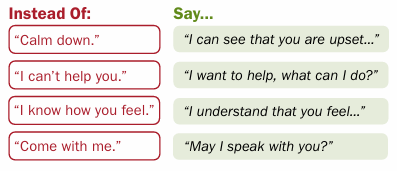
According to the Cybersecurity and Infrastructure Security Agency, the following are examples of phrases to use:
General Building Contractors Association says a person will know within two to three minutes if de-escalation is working. If not, trust your instincts. If you determine or feel it isn’t working, stop and disengage.
If the situation is escalating and violence may occur, move to a safe location and call law enforcement.
“We can prepare our technicians the best that we can by having conversations on what they’re supposed to do and how to protect themselves if something happens,” Pound said.
Whether you require installation, repair, or maintenance, our technicians will assist you with top-quality service at any time of the day or night. Take comfort in knowing your indoor air quality is the best it can be with MOE heating & cooling services Ontario's solution for heating, air conditioning, and ventilation that’s cooler than the rest.
Contact us to schedule a visit. Our qualified team of technicians, are always ready to help you and guide you for heating and cooling issues. Weather you want to replace an old furnace or install a brand new air conditioner, we are here to help you. Our main office is at Kitchener but we can service most of Ontario's cities
Source link